Get in touch
Thank you for reaching out! Please tell us more about your needs — our expert team will get back to you within 24 hours.
Get in touch
Thank you for reaching out! Please tell us more about your needs — our expert team will get back to you within 24 hours.




A deep dive into the technical requirements for flame retardant materials in modern rail transport.
EN 45545-2 is the unified European fire safety standard mandatory for all materials used in railway vehicles. It dictates how components like seat fabrics, curtains, and wall panels must behave during a fire to protect passengers and crew. The standard focuses on controlling flame spread, heat release, smoke density, and gas toxicity. Materials are classified based on the train’s operating environment—from Hazard Level 1 (low risk) to Hazard Level 3 (high risk, such as underground metros). Compliance with this standard, particularly at the HL3 level, ensures that materials provide the maximum possible safety window for evacuation in high-risk scenarios like tunnel fires.
Further reading: Comprehensive Technical Guide for Selecting Rail Transit FR Seat Fabrics

EN 45545-2 is the specific section of the European railway safety regulations that defines the fire behavior requirements for materials and components. It is a comprehensive safety standard that establishes a unified set of performance criteria across the European Union, effectively replacing older, fragmented national standards such as the UK’s BS 6853, France’s NF F 16-101, and Germany’s DIN 5510-2.
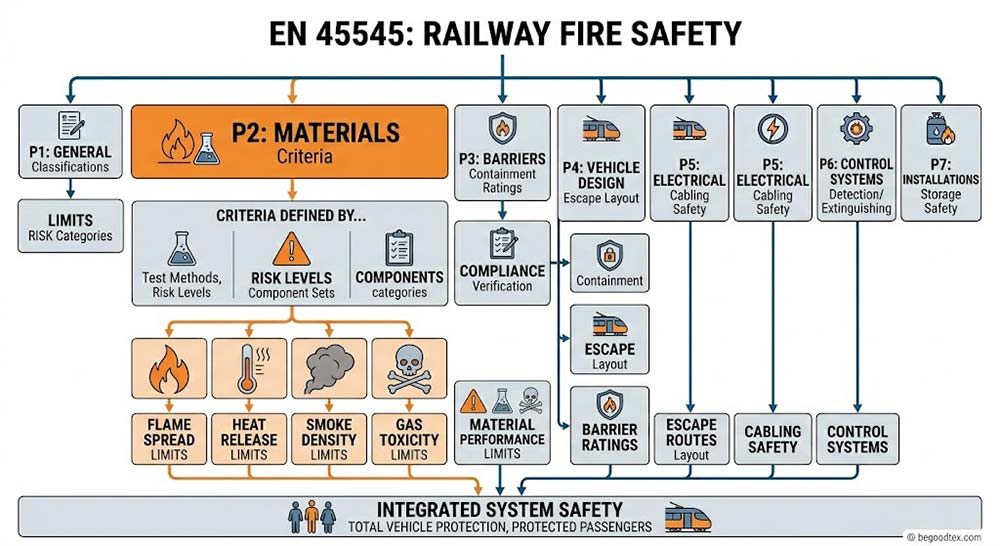
The name itself carries significant meaning. “EN” stands for European Norm. The number “45545” refers to the overarching series titled “Railway applications – Fire protection on railway vehicles.” The “-2” identifies Part 2, which is the technical core of the regulation. While other parts of the series handle design and installation, Part 2 is the document that material manufacturers must follow to ensure their products—whether textiles, plastics, or foams—are legally permitted on a train.
To understand the scope of Part 2, it helps to see where it fits within the larger regulatory framework:
Part 2 is unique because it serves as the bridge between laboratory testing and real-world application. It tells a fabric producer exactly which test methods to use and what the pass/fail limits are based on where the fabric will be installed.
In a railway fire, especially one occurring in an underground tunnel or a high-speed transit line, the primary goal is not necessarily to save the vehicle, but to keep the environment survivable for as long as possible. EN 45545-2 controls five critical fire behavior factors:
Ignitability measures how resistant a material is to catching fire when exposed to a small heat source, such as a match, a cigarette, or a short-circuited wire. The standard uses specific tests to ensure that materials do not contribute to the start of a fire. If a seat fabric is highly resistant to ignition, many accidental fires are stopped before they can grow.
If a fire does start, the standard limits how far and how quickly the flames can travel across the surface of the material. This is measured using a “Lateral Flame Spread” test. In a train carriage, we want to prevent fire from “racing” along a curtain or a wall panel to the ceiling, which would quickly engulf the entire cabin.
Heat release is perhaps the most dangerous factor in a confined space. It measures the amount of thermal energy a material adds to the fire. If the heat release is too high, the temperature in the carriage can skyrocket to over 500 degrees C or 600 degrees C in minutes, leading to a “flashover.” A flashover is a terrifying event where every combustible item in the room ignites at once due to radiant heat. EN 45545-2 sets strict limits on the MARHE (Maximum Average Rate of Heat Emission) to prevent this.
Thick, black smoke is a leading cause of panic and disorientation. In a tunnel, visibility is the difference between life and death. If the smoke produced by burning seat foam or wall panels is too dense, passengers cannot see emergency exit signs or follow evacuation paths. The standard measures the specific optical density of smoke to ensure the air remains clear enough for escape.
Statistically, the majority of fire-related deaths in the railway sector are caused by the inhalation of toxic gases rather than the heat of the fire. When materials burn, they release a “cocktail” of chemicals. EN 45545-2 measures the CIT (Conventional Index of Toxicity), focusing on several deadly gases:
Technical Insight: In a subway system, where evacuation might take 15 to 30 minutes through a smoke-filled tunnel, gas toxicity limits for HL3 materials are incredibly strict—often requiring values nearly zero for the most dangerous chemicals.
The standard does not apply a “one size fits all” rule. Instead, it carefully categorizes vehicles and individual components to ensure the level of protection matches the level of risk.
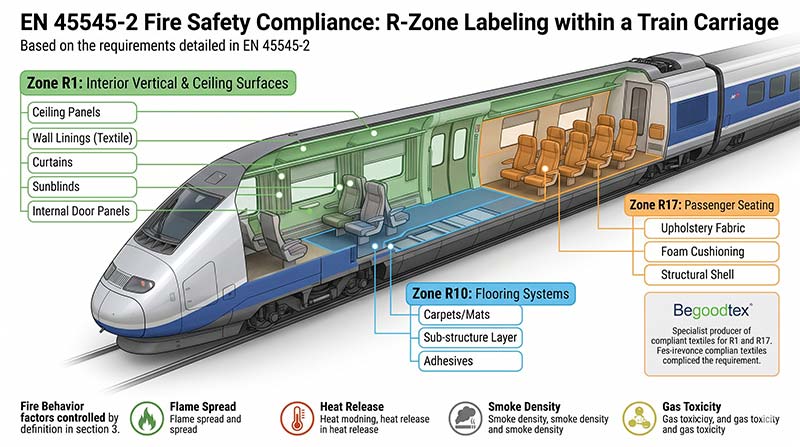
This is the most critical area for procurement officers and designers. Every item in the train is assigned a “Requirement Set” (represented by the letter R). Here are the most important categories for interior materials:
| Requirement Set (R) | Detailed Description of Parts |
|---|---|
| R1 | General Interior Surfaces: Covers window curtains, sunblinds, wall panels, ceiling panels, and large partition surfaces. These are tested for flame spread, heat, and smoke. |
| R17 | Passenger Seating Upholstery: This is a critical category. It includes the outer fabric, the fire-blocking layer, and the foam. It is tested as a “composite” to see how the whole seat behaves. |
| R22 / R23 | Internal Small Parts & Cables: Electrical insulation, small gaskets, window seals, and lighting diffusers. R22 is for interior and R23 is for exterior or hidden areas. |
| R10 | Flooring Systems: Includes carpets, rubber flooring, and the adhesives used. Tested primarily for “Critical Radiant Flux” to prevent fire spread on the floor. |
The Hazard Level (HL) is a risk rating that ranges from HL1 (lowest risk) to HL3 (highest risk). To determine the HL, the standard looks at two things: where the train goes and what kind of train it is.
HL1: Generally for freight trains or trams that stay in open areas. The requirements are minimal.
HL2: The standard for most regional European rail. It assumes the train can reach an exit point fairly quickly.
HL3: The highest standard. Mandatory for metro systems and high-speed rail in long tunnels. Materials for HL3 must pass the most rigorous tests for smoke and toxicity. In our production at Begoodtex, we focus primarily on the HL3 level because it represents the pinnacle of safety and allows our fabrics to be used in any rail project worldwide.
While the European standard is often considered the most comprehensive, it is not the only one. Understanding how it compares to others is vital for global projects.
In North America, NFPA 130 is the dominant standard. While both share the goal of protecting passengers, NFPA 130 relies on different testing methods, such as ASTM E162 for flame spread and ASTM E662 for smoke. EN 45545-2 is generally more modern because it integrates gas toxicity limits directly into its core requirements, whereas NFPA 130 leaves toxicity to the discretion of local authorities.
The aviation standard FAR 25.853 is famous for its 12-second and 60-second vertical burn tests. While aircraft interiors have extremely high requirements for “self-extinguishing,” they often focus less on the specific “tunnel toxicity” indices that are central to the railway HL3 rating. You cannot simply use an airplane fabric on a train without re-testing it for EN 45545-2.
The automotive standard FMVSS 302 is used for passenger cars and buses. It is a very basic horizontal burn test that measures how fast a flame moves. Compared to EN 45545-2, it is extremely easy to pass and does not account for smoke or toxicity at all. For this reason, automotive-grade fabrics are never safe for use in the railway industry.
As a manufacturer specialized in flame retardant textiles, we see EN 45545-2 as more than just a regulatory hurdle; it is a design philosophy. For any producer in this sector, this standard is the primary benchmark for several reasons:
In our work at Begoodtex, we prioritize meeting the R1 and R17 requirements at the HL2 and HL3 levels. By providing test reports from independent, accredited laboratories, we give our clients the confidence that their interior designs are not only beautiful but legally compliant and safe for millions of passengers.
EN 45545-2 is the definitive fire safety standard for the modern railway industry. By dividing materials into specific requirement sets and hazard levels, it ensures that every component—from curtains to cushions—is tested for its impact on passenger safety. The standard’s focus on heat release, smoke density, and gas toxicity makes it the most effective tool for preventing disasters in enclosed spaces like tunnels. For designers and engineers, choosing materials that meet the HL3 requirement is the most reliable way to ensure long-term safety and global compliance.
It is a standard. It defines the limits and requirements, but it uses many different test methods (like ISO 5660-1 for heat or ISO 5659-2 for smoke) to verify if a material is compliant. You cannot “do an EN 45545-2 test,” but you can test a material according to EN 45545-2.
For most textile manufacturers, the Smoke Density and Gas Toxicity tests for HL3 are the most difficult. Achieving a CIT (Toxicity) value below 0.75 or 0.9 requires very clean, high-purity flame retardant fibers without heavy chemical additives.
No. HL3 is a higher safety tier. However, you can always use an HL3-certified fabric in an HL1 or HL2 train. This is why we recommend HL3 for most global projects—it covers all bases.
R1 is for “horizontal and vertical” surfaces like wall panels and curtains. R17 is specifically for “Complete Passenger Seats.” R17 is often stricter because seats are thick and contain more combustible material than a thin curtain.
No. Because we use Inherently Flame Retardant (IFR) technology, the protection is built into the fiber itself. It cannot be washed out or worn away, ensuring the EN 45545-2 compliance remains for the life of the fabric.