Get in touch
Thank you for reaching out! Please tell us more about your needs — our expert team will get back to you within 24 hours.
Get in touch
Thank you for reaching out! Please tell us more about your needs — our expert team will get back to you within 24 hours.
This article deeply explores ten key certification standards in the global textile industry, covering multiple dimensions from hazardous substance testing (such as OEKO-TEX®) and organic content assurance (such as GOTS), to recycled material traceability (such as GRS), and specific functional requirements (such as NFPA 701 for flame-retardant fabrics). By systematically reviewing the background, standards, and scope of application for these certifications, it provides a clear, practical decision-making guide for purchasers, designers, and production managers within the industry.

To help you quickly establish a macro understanding of several mainstream certifications, the table below compares them across different dimensions. This is like checking the visa requirements for different countries before a trip, which can help you plan the most efficient route.
| Certification Standard | Main Focus | Scope | Significance for Consumers |
| OEKO-TEX® STANDARD 100 | Testing for harmful substances in finished products and all production stages | The entire textile chain, from yarn to finished product | Product is safe and harmless for skin contact |
| GOTS | At least 70% certified organic natural fibers, environmental and social standards | The entire processing chain, from harvesting to finished product | Product is sourced from organic farming and production is environmentally sound and humane |
| GRS | Recycled content percentage, chain of custody, social and environmental practices | Products containing at least 20% recycled material | Product uses recovered materials and is produced responsibly |
| bluesign® | Chemical, water, and energy management for the entire production process | The entire supply chain, from chemical supply to textile manufacturing | Product manufacturing minimizes impact on the environment and human health |
Guaranteeing user health and safety is the cornerstone of all product design and manufacturing. In the textile field, this means ensuring that fabrics do not contain harmful chemicals that could cause allergies, illness, or even more severe health problems.
Imagine the most basic requirement for the pajamas you buy for your child or the sheets used in a hospital? The answer is undoubtedly “safety“. OEKO-TEX® STANDARD 100 was created precisely for this purpose, and it is one of the most famous and authoritative global labels for testing harmful substances in textiles (Jace Apparel, 2025).
The core idea of this certification system is: a final textile product can only be granted the STANDARD 100 label if every component—from sewing thread, buttons, and zippers to prints—has passed strict testing for harmful substances.
The list of substances tested covers hundreds of chemicals known to be harmful to health, including azo dyes, formaldehyde, phthalates, and heavy metals. Furthermore, its limit values are, in many cases, stricter than national and international regulations. It divides products into four classes based on their use and degree of skin contact, with Class I (infant items) having the most stringent requirements. For purchasers, choosing suppliers with this certification means prioritizing consumer health.

REACH (Registration, Evaluation, Authorisation and Restriction of Chemicals) is not a voluntary certification label, but a mandatory chemical regulation that must be complied with to enter the EU market. It acts as a rigorous “chemical gatekeeper,” regulating all industrial chemicals entering the 27 EU member states, which naturally includes textiles.
The core principle of the REACH Regulation is “No Data, No Market“. It requires manufacturers and importers to register chemical substances in their products exceeding a specific quantity and to assess the risk they pose to human health and the environment. Extremely strict restrictions apply, particularly to Substances of Very High Concern (SVHC).
If your product, such as flame-retardant or coated fabric, contains an SVHC at a concentration above 0.1% (by weight), you are obligated to provide sufficient information to downstream users and consumers. For businesses planning to export to Europe, a deep understanding and compliance with the REACH Regulation is a prerequisite for avoiding trade barriers and legal risks.

As consumer environmental awareness awakens, the “green” attributes of a product are increasingly becoming a significant factor influencing purchasing decisions. People are concerned not only about the product itself but also about its origin and production method.
If OEKO-TEX® focuses on “Is the product safe?,” then GOTS (Global Organic Textile Standard) answers the deeper question of “Is the product organically sourced and is the production process responsible?“. GOTS is widely considered the “Gold Standard” for organic textiles globally (Pihoo Textile, 2025).
To achieve GOTS certification, the product must contain at least 70% certified organic natural fibers (such as organic cotton, organic linen). To use the “organic” label, the organic fiber content must reach over 95%.
However, GOTS’s vision extends much further, covering the entire supply chain from raw material harvesting, environmentally friendly processing, to social responsibility practices. This means that from the farm to the factory, wastewater treatment, chemical usage (prohibiting toxic heavy metals, formaldehyde, etc.), and worker labor rights (prohibiting child labor, ensuring safe working environments) must comply with its strict regulations. Choosing GOTS-certified products sends a clear signal to the market: your brand not only offers high-quality products but is also committed to preserving the planet’s ecosystem and human dignity.

bluesign® offers a unique perspective. It does not directly test the final product but intervenes before production begins, auditing the selection stage for chemicals, materials, and processes. Its philosophy is that if the production source is “clean,” the final product will naturally also be “clean“.
This system is called “Input Stream Management“. It collaborates with chemical suppliers, fabric manufacturers, and brands to jointly create a safe, efficient, and environmentally friendly production chain. A textile product certified by bluesign® means its production process has met the highest standards in five areas: consumer safety, water emissions, air emissions, resource productivity, and occupational health and safety (bluesign®, n.d.). For textiles using complex chemical processes, such as high-performance outdoor apparel or technical flame-retardant fabrics, bluesign® certification provides powerful proof that the pursuit of functionality does not sacrifice environmental and human well-being.

The concept of the circular economy is fundamentally transforming manufacturing. Turning waste into valuable resources not only reduces reliance on virgin materials but also alleviates the burden on the environment.
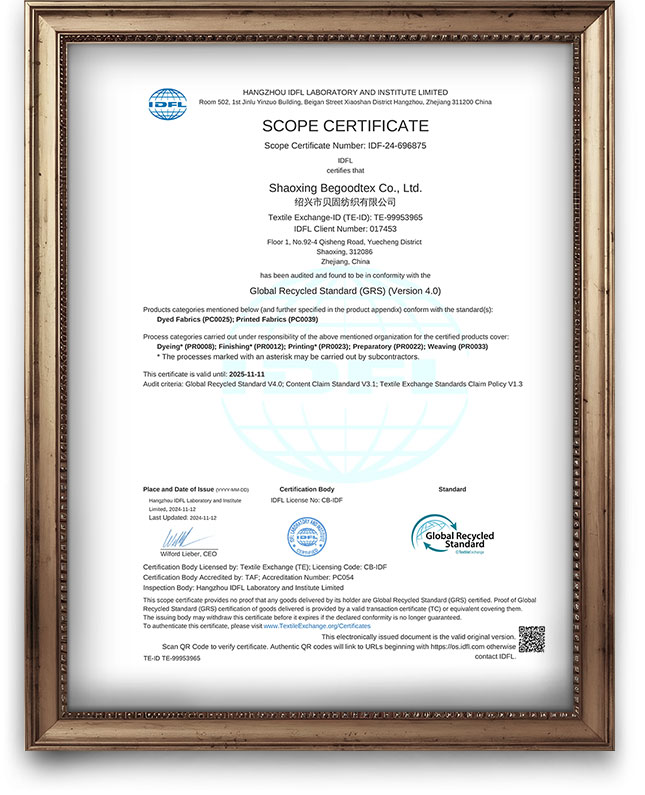
The Global Recycled Standard (GRS) is designed for companies that wish to verify the recycled content in their products. It is a more comprehensive and strict standard, applicable to any product containing at least 20% recycled material. To display the GRS logo on the product, the recycled content must be above 50%.
The value of GRS lies in its strict requirements for the “Chain of Custody“. It ensures that the identity of the recycled material is maintained and traceable throughout the entire process, from the recycling stage to the final product. Imagine a jacket claimed to be made from recycled plastic bottles; GRS guarantees the truth of this statement. Furthermore, GRS also includes requirements for social responsibility, environmental protection, and chemical usage during the production process, making it a comprehensive sustainable development certification (Sino-Silk, 2025). For companies like BEGOODTEX, which are committed to developing eco-friendly flame-retardant fabrics, GRS certification is strong proof of their commitment to sustainable development.
The Recycled Claim Standard (RCS) can be viewed as the basic version of GRS. Its main goal is also to track and verify the content of recycled materials in a product, but unlike GRS, RCS does not include additional requirements for social or environmental aspects.
RCS is applicable to any product containing at least 5% recycled material. It offers two labels: RCS 100, which guarantees the product contains 95% to 100% recycled material, and RCS Blended, which applies to products with 5% to 95% recycled material.
For companies just starting to explore the use of recycled materials, or whose supply chain cannot yet meet all the social and environmental requirements of GRS, RCS provides an excellent starting point. It allows them to convey their efforts in recycling to consumers in a transparent and credible manner.

For textiles with specific uses, such as curtains in public spaces, medical textiles, or protective workwear, they must meet specific performance standards in addition to basic safety and environmental requirements, with flame retardancy being particularly important.
In the United States and Canada, when supplying curtains, draperies, or other hanging textiles for hotels, theaters, schools, or any public assembly area, NFPA 701 is a standard you cannot avoid. Developed by the National Fire Protection Association (NFPA), it is the authoritative test method for evaluating the resistance of a fabric to flame propagation when vertically suspended.
The NFPA 701 test simulates a small ignition source (like a match or lighter) contacting the bottom of the fabric. The test evaluates the fabric’s after-flame time, char length, and whether there are any flaming melt-drips.
Flame-retardant fabrics certified under NFPA 701 mean they will self-extinguish when exposed to an ignition source, preventing the acceleration of flame spread and buying valuable time for evacuation. For a professional flame-retardant fabric manufacturer like BEGOODTEX, its products passing the NFPA 701 test through third-party laboratories like SGS and TUV is the passport to the North American market.
Begoodtex passes NFPA 701 testing standard
Similar to the status of NFPA 701 in North America, BS 5867 is the mandatory fire safety standard in the UK for hanging textiles like curtains and drapes. The standard is divided into two parts, with Part 2 setting more stringent requirements for fabrics used in public places (such as hospitals, schools, hotels, etc.).
BS 5867 Part 2 classifies fabrics into Type A, B, and C based on their wash durability and fire resistance. Type B requires the fabric to self-extinguish after contact with a flame source. The even more demanding Type C requires the fabric to maintain its flame-retardant properties even after multiple washes (usually 50 times).
This is particularly important for medical privacy curtains or hotel curtains that require frequent washing. Choosing permanently flame-retardant fabrics that comply with the BS 5867 Type C standard ensures reliable safety protection throughout their entire service life.
Begoodtex passes BS 5867 testing standard
To understand the requirements for flame retardancy in different regions more clearly, the table below summarizes several mainstream international standards. This is a very useful reference for manufacturers and purchasers who need to supply products to multiple markets.
| Standard | Applicable Region | Primary Application | Brief Introduction to Test Method |
| NFPA 701 | USA, Canada | Vertical hanging textiles (curtains, drapes) | Vertical burn test, evaluating after-flame time, char length, and melt-drips |
| BS 5867 Part 2 | UK | Curtains, drapes | Vertical burn test, graded by number of washes and flame retardant performance (Type B/C) |
| DIN 4102-B1 | Germany | Building materials, including decorative textiles | Vertical burn test, B1 grade means “low flammability” |
| M1 | France | Building materials and interior decorative textiles | Radiant heat source test and dripping test, M1 is the highest grade, “non-combustible” |
| CAN/ULC-S109 | Canada | Flame-resistant textiles and films | Includes both small-flame and large-flame vertical burn test methods |
A modern brand’s responsibility is not limited to its product but extends to every person involved in creating those products. Ensuring that workers in the supply chain receive fair treatment and a safe working environment is becoming a crucial measure of brand value.
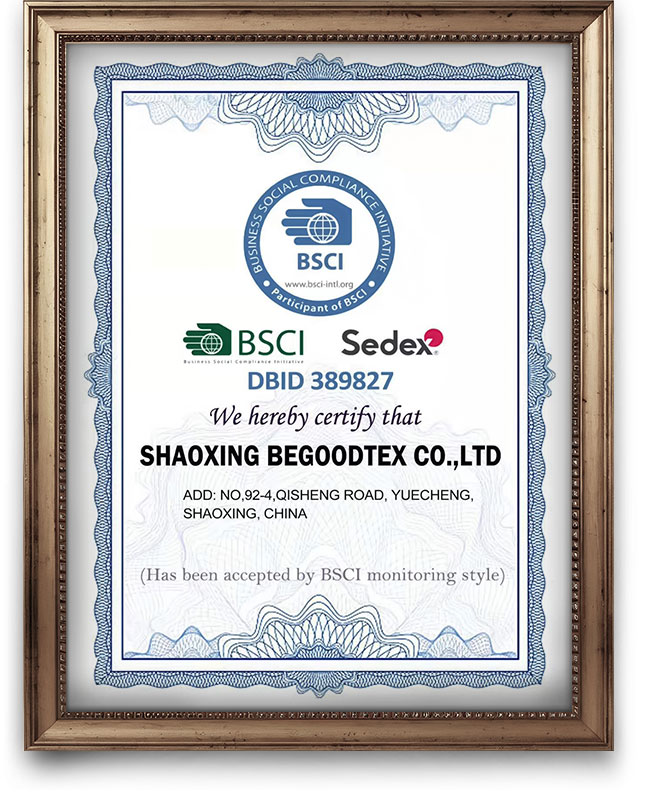
The Business Social Compliance Initiative (amfori BSCI) is a business-driven leading system aimed at improving working conditions in the global supply chain. It is not a certification but a common Code of Conduct and audit system based on the International Labour Organization (ILO) conventions.
Brand owners or retailers who join BSCI can commission independent audit bodies to audit their supplier factories. The audit covers 11 core labor rights areas, ranging from prohibition of discrimination, fair remuneration, and decent working hours to occupational health and safety. BSCI audit results help purchasers understand their suppliers’ performance in social responsibility and encourage continuous improvement. For suppliers, passing the BSCI audit is a powerful way to demonstrate their commitment to ethical production to international buyers.
Similar to BSCI, Sedex is a global membership organization dedicated to promoting ethical and responsible practices in the supply chain. SMETA (Sedex Members Ethical Trade Audit) is a widely adopted business ethical audit methodology developed by Sedex.
The SMETA audit is based on the Ethical Trading Initiative (ETI) Base Code, covering four pillars: Labour Standards, Health and Safety, Environment, and Business Ethics. The standardization of its report format allows brands and suppliers to share audit results on the Sedex platform, reducing duplicate audits and increasing efficiency (QIMA, 2024). Choosing partners who have passed the SMETA audit means you are collaborating with a company that equally values transparency and respects labor rights.

Facing these 10 essential textile industry certifications, you might ask: which one should I choose? The answer to this question is not singular; it depends on several key factors:
A smart strategy is often a combination approach. For example, an eco-friendly flame-retardant curtain for a hotel, exported to the US, could have an ideal certification combination of: GRS (to prove the use of recycled materials) + OEKO-TEX® STANDARD 100 (to prove human safety) + NFPA 701 (to prove compliance with local fire regulations).
OEKO-TEX® STANDARD 100 primarily focuses on whether the final product contains harmful substances, ensuring its safety for human health. GOTS is a more comprehensive standard: it not only requires the product to contain a high percentage of organic fibers but also imposes strict regulations on environmental measures and social responsibility throughout the entire production process from farm to finished product (Jinfeng Apparel, 2025). In short, OEKO-TEX® guarantees the product is “clean,” while GOTS guarantees the product is “green and fair from start to finish“.
Both are used to verify the recycled material content in a product. The main difference lies in the scope and rigor. RCS only verifies the Chain of Custody for recycled materials, whereas GRS, in addition to this, includes audit requirements for social responsibility, environmental protection, and chemical management at the factory level. GRS is a higher and more comprehensive standard.
No. NFPA 701 primarily targets vertical hanging textiles used in public assembly areas, such as curtains, drapes, and tents. It does not apply to apparel or ordinary household textiles. However, it is a mandatory entry standard for suppliers in sectors like hotels, theaters, and schools.
Obtaining certification usually involves application fees, testing fees, and annual audit fees. The specific cost varies depending on the certification type, product complexity, and factory size. While the initial investment may seem substantial, in the long run, certification offers significant returns, such as access to high-end markets, enhanced brand credibility, and avoidance of trade barriers, making it a valuable investment.
For a small business, OEKO-TEX® STANDARD 100 is a good starting point because it has a broad scope, high market recognition, and directly proves product safety to consumers. If your product uses recycled materials, RCS is also a relatively lower-cost and easier-to-implement option.
Today, the textile industry is undergoing a profound transformation. Consumers are no longer just passive recipients of products; they are actively shaping the future of the market through their choices. These 10 essential textile industry certifications are the bridges connecting responsible production with conscious consumption.
They are not cold sets of rules but commitments to health, safety, respect for the environment, and care for others. For manufacturers deeply rooted in specialized fields like BEGOODTEX, these certifications are a manifestation of their technical strength and corporate values. For purchasers and brands, they are a reliable compass for making informed decisions and building lasting trust in the complex global market. Embracing these standards is not just about compliance; it is about collectively moving towards a safer, greener, and fairer future for textiles.