Get in touch
Thank you for reaching out! Please tell us more about your needs — our expert team will get back to you within 24 hours.
Get in touch
Thank you for reaching out! Please tell us more about your needs — our expert team will get back to you within 24 hours.
If you are manufacturing or exporting mattresses to the United States, 16 CFR 1633 is a term you cannot ignore. It is not just a safety suggestion; it is a mandatory federal law. Failing to meet these standards can lead to massive recalls, heavy fines, and a total ban from the US market.
In our previous coverage of frequent global textile recall events, we highlighted how even top-tier brands face devastating product pull-backs when they fail to meet specific heat release limits during CPSC spot checks. These incidents, often caused by a single underperforming component like a fire barrier, serve as a stark warning: non-compliance leads to massive fines, permanent brand damage, and a total ban from the US market.
This guide breaks down everything you need to know about the 16 CFR 1633 standard, from technical testing parameters to the materials that will help you pass. We’ll also explain how this regulation differs from others and why compliance is your biggest competitive advantage in the bedding industry.
16 CFR Part 1633 is a federal safety standard established by the U.S. Consumer Product Safety Commission (CPSC). Effective since July 1, 2007, it focuses on the “open flame” flammability of mattress sets.
Unlike older standards that only looked at small ignition sources like cigarettes, 16 CFR 1633 simulates a real-life fire scenario—like a burning candle or a lighter igniting a bed. The goal is to limit the heat release from a mattress fire, giving occupants more time to discover the fire and escape the building safely.
Key Fact: The standard applies to all mattresses and mattress sets, including those for adults, youth, cribs, and even futons or sofa beds.
This standard is not limited to residential bedrooms. It impacts several major industries that involve large-scale procurement of bedding and upholstered sleep surfaces:
Many newcomers confuse 1633 with its predecessor, 1632. While they both deal with fire, they target very different threats.
| Feature | 16 CFR 1632 | 16 CFR 1633 |
|---|---|---|
| Fire Source | Smoldering Cigarette | Open Flame (Propane Burners) |
| Testing Focus | Surface Materials (Ticking) | Entire Mattress Structure |
| Difficulty | Low to Moderate | High |
| Core Goal | Prevent smoldering fires | Prevent “Flashover” (total room fire) |
If you export globally, you must navigate a complex web of standards. While 16 CFR 1633 is the gold standard for the US, other regions have their own strict requirements for mattresses and bedding components.
| Standard | Region | Scope & Focus |
|---|---|---|
| BS 7177 | United Kingdom | The primary standard for mattress flammability, categorized by hazard levels (Low, Medium, High). |
| BS 5852 | United Kingdom | Focuses on upholstered seating components. Often required for the foam and fabric used in mattresses. |
| BS 5815 | United Kingdom | Specific to sheets, pillows, and bedding sets used in hospitals and public institutions. |
| EN 597 (1 & 2) | European Union | Tests mattresses with cigarettes (Part 1) and match-flame equivalents (Part 2). |
| NFPA 267 | United States | Specific flammability test for mattresses used in public occupancies like dorms or military barracks. |
Understanding these differences is crucial for multi-market exporters. For example, a mattress that passes EN 597 might still fail 16 CFR 1633 because the US open-flame test is generally more intense and lasts longer.
The 16 CFR 1633 test is a “system-level” test. This means you aren’t just testing a piece of fabric; you are testing the finished mattress, including the foam, the springs, the glue, and the fire barrier.
The test involves two T-shaped propane burners. One is placed on the top of the mattress for 70 seconds, and the other is placed against the side for 50 seconds. The mattress is then monitored for a full 30 minutes.
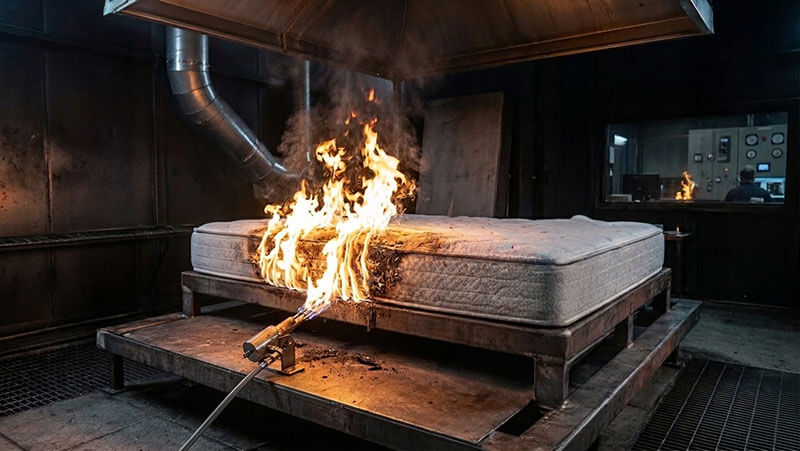
To pass the 16 CFR 1633 test, the mattress must stay within two strict limits:
Modern mattress manufacturing has moved away from heavy chemicals. Instead, manufacturers prioritize high-performance fibers that provide a “soft touch” with “hard defense.”
Viscose fibers, when engineered with inherent flame retardants, are among the most popular materials for fire-retardant (FR) socks. These fibers are naturally breathable and do not melt when exposed to high heat. Instead, they provide a stable thermal shield that stays intact, preventing flames from reaching the inner foam core.
Standard polyester is often criticized for melting and dripping in fire scenarios. However, specialized IFR Polyester used by industry leaders like Begoodtex is modified at the molecular level. This ensures the fabric is self-extinguishing—it will not fuel the fire and significantly reduces the risk of molten drips that cause secondary ignitions.
Wool is a high-end, natural solution. By applying durable FR treatments, manufacturers can enhance wool’s natural fire-resistance. It acts as a superb insulator, absorbing heat and slowing down the fire’s progression without releasing toxic gases.
For manufacturers looking for consistent compliance, Begoodtex offers specialized FR mattress fabrics and fire-retardant socks designed specifically for the US market. Their materials are engineered to form a robust heat-insulating barrier during fire exposure. This barrier isolates the internal foam and prevents the rapid heat release that leads to test failure.
While standard synthetic fibers might melt away and expose the bed’s fuel source, Begoodtex’s IFR fabrics are designed to maintain their structural integrity longer. Utilizing these pre-tested FR materials significantly reduces the risk of prototype failure and costly re-testing cycles.
16 CFR 1633 is a “total system” safety standard that limits how fast a mattress can burn. For manufacturers, the secret to success lies in choosing the right fire barrier materials—such as those provided by specialists like Begoodtex—and maintaining strict production records. Compliance isn’t just a hurdle; it’s the key to the North American market.
The standard tests the “set” together. If you change the foundation design, you may need a new prototype test.
Yes. Most manufacturers prefer using a high-quality fire barrier (sock or wrap) because it is often more cost-effective. Companies like Begoodtex offer high-performance FR socks that make this process easier.
Standard medical mattresses must comply. Custom mattresses prescribed by a physician can be exempt if they carry a specific “Exemption Label.”
Usually, no. Toppers are often covered under different rules like 16 CFR 1632, but it’s best to consult a lab for hybrid products.