Get in touch
Thank you for reaching out! Please tell us more about your needs — our expert team will get back to you within 24 hours.
Get in touch
Thank you for reaching out! Please tell us more about your needs — our expert team will get back to you within 24 hours.
This guide provides a systematic and in-depth analysis of the 10 best flame retardant fabrics currently available on the market. The article aims to offer an authoritative procurement and application reference for industries that require high-level fire safety solutions, such as the hospitality industry, medical institutions, public venues, and industrial protection fields. Starting from the two basic technical pathways—inherently flame retardant and treated flame retardant—the article details the chemical structure, flame retardant mechanism, physical properties, and applicability in specific environments for each fabric. The scope of materials discussed covers natural fibers like wool, as well as technologically improved or intrinsically superior fire-resistant synthetic fibers, including Modacrylic, FR Polyester, Aramids (such as Kevlar® and Nomex®), and PBI fiber.
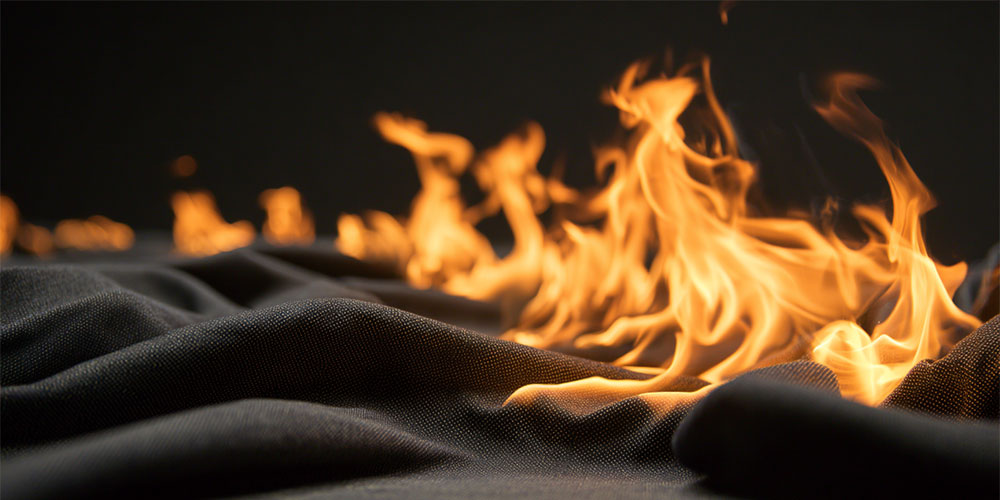
Fire, a disaster characterized by suddenness and immense destructive power, causes most casualties not directly from flames, but from the inhalation of toxic smoke and the rapid spread of the fire. In public places and specific industrial environments, seemingly ordinary textiles—such as curtains, carpets, seat covers, partitions, and staff uniforms—become materials whose performance during a fire directly determines whether people have precious time to escape. A common decorative fabric can become an incendiary “accomplice” in seconds, while a quality flame retardant fabric can effectively suppress flame spread and reduce smoke generation, thus establishing a crucial line of defense for life.
Therefore, understanding and selecting the correct flame retardant materials, especially deeply exploring the 10 best flame retardant fabrics, is a non-negotiable responsibility. This article will guide you through the complex world of material science, from the inherent advantages of natural fibers to the technical marvels of cutting-edge synthetic materials, revealing the scientific principles, performance characteristics, and most suitable application scenarios behind each top flame retardant fabric.
Before delving into specific fabrics, we must establish a foundational cognitive framework. All flame retardant fabrics, based on how they achieve their flame retardancy, can be clearly divided into two major camps: Inherently Flame Retardant (IFR) and Treated Flame Retardant (TFR). Understanding the fundamental difference between the two is the first step in making the right choice.
Inherently Flame Retardant (IFR), as the name suggests, means that the polymer constituting the fiber itself possesses a flame-retardant chemical structure. This flame retardant property is part of its “DNA,” an innate characteristic. Regardless of the number of washes, friction, or prolonged use, its flame retardant performance will not degrade or disappear. This is like a person’s skin color, which is determined by their intrinsic genes and cannot be “washed off”. Aramid (Nomex®, Kevlar®) and Modacrylic are examples of this category. When exposed to a flame, their molecular structure undergoes special reactions, such as carbonization and the release of inert gases, thereby interrupting the chemical chain reaction of combustion.
Treated Flame Retardant (TFR), on the other hand, refers to taking ordinary, inherently flammable fibers (such as cotton, polyester, nylon) and, after weaving them into fabric, applying flame-retardant chemicals via chemical dipping, coating, or other finishing processes to “attach” them to the fabric. This method is like giving the fabric a “fire-proof coat”. Initially, it provides equally effective fire protection. However, the durability of this “coat” is limited. Over time, especially after repeated washing, the flame retardant agent may gradually deplete, leading to a decrease or complete loss of flame retardant performance. Although modern finishing technologies (such as the Proban® process) have greatly improved wash durability, there is still a fundamental difference when compared to the permanence of IFR.
For a more intuitive understanding, we can compare them in the table below:
| Feature | Inherently Flame Retardant Fabric (IFR) | Treated Flame Retardant Fabric (TFR) |
| Flame Retardant Principle | The fiber polymer inherently possesses the FR gene. | Chemical FR agents are added to ordinary fabric. |
| Performance Durability | Permanent, throughout the entire lifespan of the fabric. | Limited; may degrade with washing and use. |
| Hand Feel & Comfort | Usually better, determined by the inherent properties of the fiber. | May be affected by the FR agent, resulting in a stiffer hand feel. |
| Initial Cost | Relatively high. | Relatively low. |
| Long-Term Cost | Low maintenance cost; no need for re-treatment. | May require professional maintenance or face performance degradation risks. |
| Environmental & Safety | Fiber is inherently stable; no risk of chemical shedding. | Need to consider the type of FR agent used and its environmental impact. |
| Typical Examples | Aramid, Modacrylic, FR Polyester. | FR Cotton, FR finished ordinary Polyester. |
This table clearly reveals the trade-offs between the two. Although IFR fabrics have a higher initial investment, they offer a “once-and-for-all,” absolutely reliable safety guarantee. This is particularly suitable for environments with extremely stringent safety requirements and frequent washing, such as hospitals, high-end hotels, and specialized industrial protective clothing. TFR fabrics, with their cost advantage, hold a place in applications with limited budgets and low washing requirements. However, as a responsible procurement party, one must be clearly aware of its performance degradation and establish corresponding inspection and replacement mechanisms. In today’s market trend, which increasingly values long-term value and absolute safety, Inherently Flame Retardant (IFR) fabrics are undoubtedly the more highly recommended choice.
Now, let’s explore these ten exceptionally performing flame retardant fabrics one by one. We will not only examine their fire resistance but also their comfort, durability, aesthetic value, and real-world applications to construct a comprehensive knowledge map for you.
| Fabric Name | FR Type | Limiting Oxygen Index (LOI) | Melting Drip | Advantages | Disadvantages | Primary Applications |
| Wool | Inherent FR | 25-29% | No | Natural, eco-friendly, moisture-wicking, anti-static. | Low strength, possible shrinkage, higher price. | High-end carpets, aircraft seating, interior decoration. |
| Modacrylic | Inherent FR | 28-32% | No | Soft hand feel, similar to wool, good dyeability. | Medium strength, degradation under UV light. | Hotel curtains, children’s sleepwear, faux fur. |
| FR Polyester | Inherent FR | 26-32% | No | High strength, durable, dimensionally stable, moderate cost. | Poor moisture absorption, prone to static electricity. | Hotel curtains, hospital cubicle curtains, public transport seating. |
| Aramid | Inherent FR | 28-41% | No | Extremely high strength, high temperature resistance, chemical corrosion resistance. | Difficult to dye, expensive, poor UV resistance. | Firefighter gear, body armor, industrial insulation. |
| PBI | Inherent FR | >41% | No | Excellent thermal stability, non-melting, soft. | Extremely expensive, single color (brown). | Space suits, top-tier firefighter gear, racing suits. |
| FR Cotton | Treated FR | 28-32% | No | Moisture-wicking, breathable, comfortable, lower cost. | FR property is non-permanent, performance decreases after repeated washing. | Industrial workwear, welding protection, tents. |
| Fiberglass | Inherent FR | 100% (Non-combustible) | No | Completely non-combustible, dimensionally stable, good insulation. | Brittle, skin irritant, not foldable. | Welding blankets, fire curtains, circuit board substrates. |
| FR Nylon | Inherent/Treated | 24-30% | Yes | High strength, excellent abrasion resistance. | Melts and drips when exposed to fire, potentially causing secondary injury. | Carpets, military equipment, some workwear. |
| FR Viscose | Inherent FR | 28-34% | No | Good moisture absorption, soft, biodegradable. | Low wet strength, poor dimensional stability. | Protective clothing lining, bedding, aircraft interiors. |
| FR Blends | Mixed | Varies by component | Varies by component | Customizable performance, balances cost and function. | Complex performance, requires specialized design and testing. | Multi-functional workwear, interior decoration, transportation vehicles. |
Before humanity explored synthetic fibers, nature had already provided us with an inherently flame retardant material—wool. Wool’s high nitrogen content (about 16%) and high moisture regain (standard regain about 13-16%) are key to its natural flame retardancy. When exposed to a fire source, wool does not burn rapidly like cotton or rayon. First, its high ignition temperature (about 570-600°C) makes it difficult to ignite. Second, upon combustion, the protein fiber swells and forms an unstable, porous carbon layer which insulates oxygen, thus inhibiting the spread of the flame. At the same time, the water vapor released during combustion also helps to dilute flammable gases and cool the material. A significant characteristic is that once the fire source is removed, wool will self-extinguish and will not melt or drip, preventing secondary skin burns.
Advantages: Wool’s greatest advantage as an FR material is its “natural” attribute. It is eco-friendly and biodegradable. It offers excellent comfort, capable of regulating the microclimate—warm in winter and cool in summer. Additionally, wool is naturally anti-static and does not readily attract dust.
Disadvantages: Compared to high-performance synthetic fibers, wool has poorer strength and abrasion resistance. It is also susceptible to microbial attack in humid environments, and improper washing can lead to severe shrinkage. Its relatively high price also limits its widespread use in certain cost-sensitive areas.
Given its elegant appearance, comfortable feel, and inherent safety, wool is widely used in settings with both high quality and safety requirements. Examples include the first-class seating and carpets of international airlines, high-end hotel interiors, and thick theater curtains. In these applications, wool not only meets strict aviation or public venue fire standards (such as FAR 25.853) but also provides an experience that combines luxury with peace of mind.
Modacrylic, often called “Modal Acrylic,” is a copolymer fiber developed to improve the flammability of ordinary acrylic. Its molecular chain incorporates a large amount of chlorine or bromine-containing monomers (usually vinyl chloride), with a content between 35% and 85%. These halogen elements are the core of its flame retardancy. When attacked by heat, the halogens are released as free radicals, which capture and neutralize the highly active hydrogen and hydroxyl free radicals necessary for maintaining the combustion chain reaction in the gas phase, thereby “poisoning” the flame and causing it to extinguish. Modacrylic typically has a Limiting Oxygen Index (LOI) between 28-32%. It will shrink and carbonize upon burning, but will not melt or drip.
Advantages: Modacrylic’s most appealing feature is its successful combination of safety performance with superior aesthetic performance. It has an extremely soft, fluffy hand feel, and its appearance and touch are very close to wool. Its dyeing performance is excellent, allowing it to be colored in a variety of vibrant hues with good color fastness. Compared to wool, it is more resistant to chemicals and microbial attack, and has good dimensional stability.
Disadvantages: Its strength is lower than polyester and nylon, and prolonged exposure to ultraviolet light can degrade its performance.
Modacrylic is used in children’s sleepwear, meeting the strict CFR 1615/1616 standards. In hotels and hospitals, curtains and cubicle curtains made from Modacrylic or its blends can satisfy high-level fire requirements such as BS 5867 Type C. It is also widely used in the production of high-simulation faux fur, wigs, and the lining of various types of protective clothing.
The material discussed here is Inherently Flame Retardant (IFR) Polyester. This is achieved by introducing phosphorus-containing comonomers during the polymerization process. The phosphorus element acts as a solid-phase flame retardant during combustion. It promotes the fiber’s dehydration and carbonization, forming a dense carbon layer that acts like a shield, blocking heat and oxygen. Since the flame retardant group is inside the molecular chain, the flame retardant performance is permanent and unaffected by washing.
Advantages: FR Polyester is one of the most popular FR fabrics in commercial applications due to its excellent overall performance. It has high strength, good abrasion resistance, wrinkle resistance, and dimensional stability. Curtains made from it drape well and are very durable. Its production cost is more competitive than high-performance fibers like Aramid. It can also undergo various post-processing treatments, such as printing and embossing, to achieve rich decorative effects.
Disadvantages: Its main drawbacks are poor moisture absorption, leading to less comfortable wear than natural fibers, and a tendency to generate static electricity.
FR Polyester is virtually the “standard configuration” for curtains and decorative fabrics in hotels, convention centers, theaters, cinemas, and hospitals worldwide. It is a first choice due to its excellent drape and durability, combined with its ability to meet major international fire standards like NFPA 701, BS 5867, DIN 4102-B1, and French M1.
Aramid is mainly divided into meta-aramid (such as Nomex®) and para-aramid (such as Kevlar®). Their molecular structure, composed of rigid benzene rings and amide bonds, grants them extraordinary thermal stability and strength. Aramid has an extremely high ignition temperature, and its LOI value is typically above 28%. In a flame, it does not melt, does not produce molten drips, but instead carbonizes directly, forming a solid insulating layer.
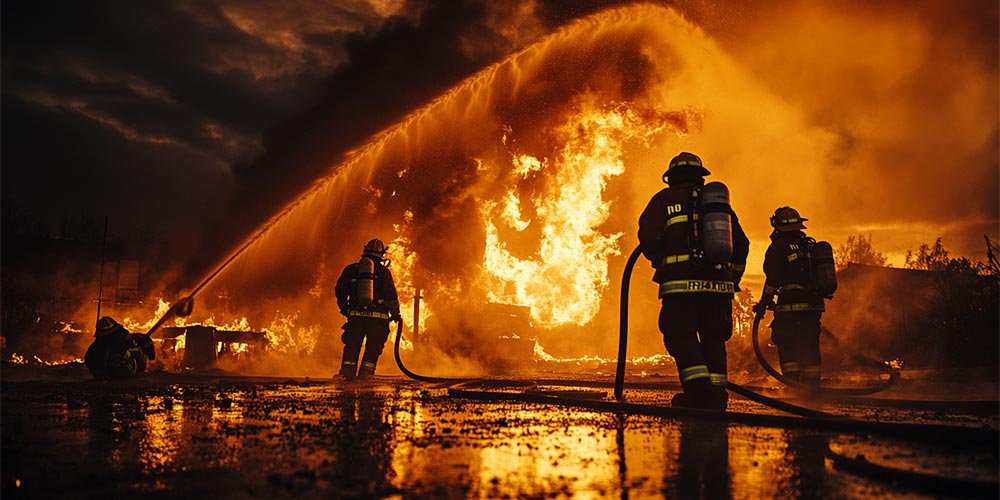
Advantages: Aramid’s advantage is its unparalleled performance. It can maintain structural integrity and performance stably for long periods at high temperatures above 200°C and can resist the attack of most chemicals. Its extremely high strength-to-weight ratio makes it indispensable in lightweight protection fields.
Disadvantages: The price is very expensive. Its highly crystalline molecular structure makes dyeing extremely difficult, and product colors are usually limited to its natural color (white for Nomex®, pale yellow for Kevlar®). Furthermore, Aramid fibers degrade and lose strength when exposed to UV light.
Aramid is used in firefighters’ bunker gear, race car drivers’ racing suits, and steelworkers’ insulated suits. Kevlar® is more commonly found in body armor, cut-resistant gloves, high-pressure hoses, and composite material reinforcement.
PBI’s chemical structure grants it the foremost thermal stability among all organic fibers. PBI’s Limiting Oxygen Index (LOI) is as high as over 41%, meaning it simply will not burn in normal air environments. It has no melting point and can maintain its fiber form and considerable strength at temperatures up to 700°C. Even in a flame, it only shrinks, does not melt or drip, and produces very little smoke with extremely low toxicity.
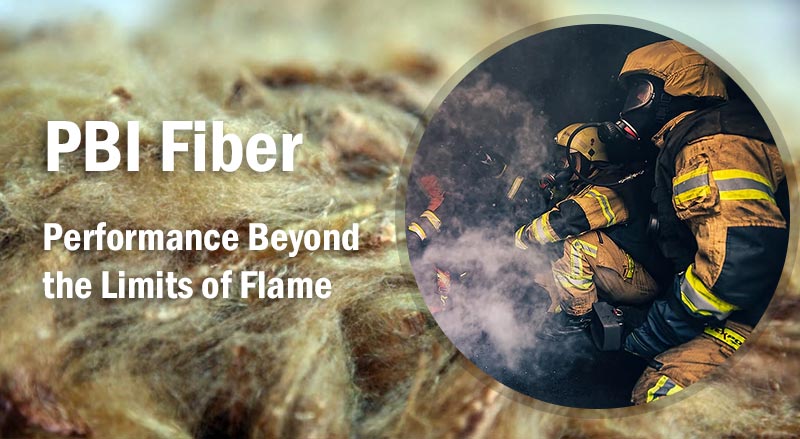
Advantages: PBI’s ultimate performance provides users with the highest safety margin when facing extreme thermal hazards. The fiber itself is surprisingly soft, with moisture absorption comparable to cotton, making its wearing comfort far superior to Aramid.
Disadvantages: PBI is extremely expensive, one of the most costly commercial fibers on the market. Its natural color is deep brown, and dyeing is almost impossible.
PBI was used in the NASA Apollo program space suits. PBI blended fabrics are the material of choice for the top-tier firefighter bunker gear. It is also used to manufacture racing suits, industrial high-temperature gloves, and specialized workwear.
FR Cotton is produced through finishing technology, where flame retardant agents are chemically bonded or physically adsorbed onto the cotton fiber. One of the most famous processes is Proban®. When exposed to a flame, the phosphorus element catalyzes the cotton fiber’s dehydration, forming an insulating carbon layer. Well-treated FR cotton can retain its flame retardant performance through dozens or even hundreds of industrial wash cycles.
Advantages: FR Cotton retains the original benefits of cotton fiber: excellent moisture absorption and breathability, a soft hand feel, and anti-static properties, making it very comfortable to wear. This is vital for workers engaged in long hours of physical labor. Its cost is also relatively low.
Disadvantages: Its core limitation is the non-permanence of the flame retardant property. Although it is highly wash-resistant, it will eventually degrade, requiring regular inspection or replacement. Furthermore, the FR finishing process can place a certain burden on the environment.
FR Cotton is one of the most widely used industrial protective workwear materials globally, especially in industries such as welding, metallurgy, oil and gas. It provides workers with basic flash fire and electric arc protection (must meet standards like NFPA 2112 or IEC 61482).
Fiberglass is drawn from molten glass, and its main components are inorganic oxides. Chemically speaking, it is the final product of combustion, and therefore, it is completely non-combustible. Its Limiting Oxygen Index (LOI) can be considered 100%. It will not burn at any temperature, only melt (melting temperature is usually above 1000°C). It has excellent dimensional and chemical stability and is a superior electrical insulator.
Advantages: Absolute non-combustibility is the irreplaceable advantage of Fiberglass. It provides an ultimate fire barrier. Its cost is also low compared to other high-performance fibers.
Disadvantages: Its texture is hard and brittle, has almost no drape, and cannot be folded or worn. Fine fiberglass fragments can easily irritate the skin and respiratory tract, posing a health risk.
Fiberglass is mainly used in applications where flexibility is not critical, but fire resistance and insulation requirements are extreme. The most common applications are welding fire blankets and fire curtains. It is also used as a thermal insulation layer for buildings, a filler material for fire doors, and a reinforcing substrate for composite materials.
Ordinary nylon melts rapidly and produces drips when exposed to fire. FR Nylon can be achieved through an inherent method (copolymerization) or a treated method. Its FR mechanism combines gas phase and solid phase effects. Even FR nylon will still soften and melt at high temperatures, although its dripping behavior will be greatly suppressed.
Advantages: FR Nylon inherits the excellent mechanical properties of the nylon family: high strength, high abrasion resistance, and good elastic recovery. This gives it an advantage in applications requiring robustness and durability.
Disadvantages: The melting issue is a major obstacle. High-temperature softening and shrinking may still cause skin injury. Therefore, it is rarely used alone for protective clothing directly exposed to flames.
FR Nylon’s best application scenario is where both high abrasion resistance and a certain FR level are required, such as carpets. It is also used in some military equipment, backpacks, and industrial ropes.
Viscose (Rayon) and Modal are both regenerated cellulose fibers. FR Viscose is made by blending phosphorus or silicon dioxide-containing flame retardants into the spinning dope, achieving permanent, inherent flame retardancy. Its mechanism is similar to FR cotton, promoting dehydration and carbonization in the solid phase.
Advantages: FR Viscose’s greatest selling point is the combination of natural-sourced comfort with permanent flame retardancy. It has better moisture-wicking ability than cotton, a silky, soft touch, and an excellent wearing experience. As a cellulose fiber, it is also biodegradable.
Disadvantages: Its main drawback is low wet strength (strength decreases significantly when wet), and poorer dimensional stability than synthetic fibers like polyester.
FR Viscose is very suitable for use as the inner layer of multi-layer protective clothing. It is often blended with Aramid and Modacrylic to create firefighter gear or industrial protective clothing. It is also used in the aerospace field for seat covers, blankets, and bedding.
Single fibers often struggle to perfectly satisfy all requirements. FR Blend Fabrics are created by mixing two or more different FR fibers (or one FR fiber and one ordinary fiber) in specific proportions, to create a “super fabric.”
Advantages: The greatest advantage of blending is its “customizability“. It can precisely balance performance, comfort, and cost. This synergistic effect can achieve a result where 1+1 > 2.
Disadvantages: The design and production of blended fabrics are more complex. Different fibers’ combustion behavior may interact, sometimes even leading to an “antagonistic effect,” where the blended FR performance is worse than that of a single component. Therefore, successful FR blending requires deep material science knowledge and extensive experimental verification.
FR blend fabrics are used extremely widely, covering almost all fields requiring FR textiles. Examples include multi-functional industrial workwear, hotel decorative fabrics, and public transport seating fabrics. Blending technology offers the most optimized solutions.
After learning about the 10 best flame retardant fabrics, you might ask: faced with so many choices, how should I decide? This is not a simple question of choosing the “best,” but a process of matching the “most suitable“. You can think through the following dimensions to build a decision matrix:
By systematically evaluating these factors, you will be able to find the perfect balance point among these 10 excellent fabrics for your specific project.
From the perspective of performance durability and reliability, yes. The fire protection performance of Inherently Flame Retardant (IFR) is permanent. Treated Flame Retardant (TFR) performance will decay over time.
Inherently Flame Retardant fabrics (such as FR Polyester, Modacrylic) can usually be cleaned following standard washing procedures. Treated Flame Retardant fabrics require special care; the manufacturer’s washing guidelines must be followed, avoiding chlorine bleach or certain softeners.
Warning: Any non-laboratory burn test carries risks; please perform this only in an absolutely safe environment (such as an outdoor clear area) and with fire extinguishing equipment present. Cut a small piece of fabric and ignite it from the bottom for 10-15 seconds, then remove the fire source.
Quality FR Fabric: will self-extinguish quickly, leaving behind crisp, black char, with little or no smoke, and no molten material dripping.
Poor Quality or Non-FR Fabric: will continue to burn after the fire source is removed, the flame will spread rapidly, producing a large amount of dense smoke, and chemical fiber fabrics will melt and drip burning molten material.
For Inherently Flame Retardant fabrics, the color (dye) itself has a negligible effect on flame retardancy. For Treated Flame Retardant fabrics, some dark dyes may slightly affect the final FR result.
The Limiting Oxygen Index (LOI) refers to the minimum oxygen concentration required for a material to sustain combustion. LOI values greater than 21% indicate a difficult-to-ignite material. A higher LOI value generally means the material is more difficult to burn.
Modern mainstream Inherently Flame Retardant fibers are safe for the human body. For Treated Flame Retardant fabrics, responsible manufacturers use safe, environmentally friendly, and new-type FR agents (e.g., those certified by Oeko-Tex Standard 100).
There are three main reasons: First, Aramid fibers degrade when exposed to UV light (sunlight). Second, Aramid is extremely difficult to dye, which limits color choice. Third, Aramid is very expensive.
It is recommended to purchase directly from specialized flame retardant fabric manufacturers or reputable suppliers. Choose those who can provide complete certification documents (such as test reports, ISO certificates, BSCI certification, etc.).
From natural wool to high-performance PBI, our exploration of the top ten flame retardant fabrics spans the boundary between nature and technology. More importantly, this is not a discussion about parameters, but a reflection on responsibility and conviction. Every flame retardant fiber embodies reverence for life; every inch of flame retardant textile is a solemn commitment to safety.