Get in touch
Thank you for reaching out! Please tell us more about your needs — our expert team will get back to you within 24 hours.




When manufacturing flame retardant (FR) protective clothing or FR sleepwear, fabric selection is often more critical than garment design. Even when labeled “flame retardant,” fabrics made from different materials, fibers, and processing techniques can have completely different levels of safety, durability, and comfort.
The core mission of industrial protective wear is to protect lives in high-heat, electric arc, or flash fire situations. Conversely, the primary duty of children’s sleepwear is to self-extinguish quickly upon contact with an ignition source and to be absolutely non-toxic and skin-friendly for close contact. A wrong choice can lead to protection failure or a drastic decrease in comfort.
To select a truly suitable FR fabric, one must make a systematic judgment from three perspectives: application, performance, and experience—not rely on a vague “feeling.”

Core Needs Comparison: Industrial Protective Wear vs. Home Sleepwear
| Feature | Industrial Protective Wear | Children’s Sleepwear |
| Core Risk | High heat, electric arc, molten metal, flash fire | Contact with open flames (stoves, candles), flammability |
| Protection Focus | Permanent FR, high-heat resistance, no melt/drip | Quick self-extinguishing, non-toxic, skin-friendly, durable to home laundering |
| Comfort Requirement | Abrasion-resistant, breathable (moisture-wicking) | Extremely soft, no chemical irritation, odorless |
The selection of FR fabric must always start with the use environment.
After choosing a direction, you must evaluate performance metrics. An FR fabric is not qualified just because it “doesn’t burn.” It must effectively stop flame spread, maintain its structural integrity, and remain effective long-term.
Interpreting Key Performance Indicators
| Key Indicator | Significance | Ideal Standard (Industrial / Home) |
| Self-Extinguishing Performance | Does it extinguish immediately after the flame source is removed? | Rapid self-extinguishing |
| No Melt, No Drip | Does it produce molten drips that can burn the skin at high heat? | Must Not Melt or Drip (Prevents secondary injury) |
| Wash Durability | Does it retain FR properties after multiple washes? | Home ≥ 30 washes; Industrial ≥ 50 washes |
| Hand-feel & Breathability | Is it comfortable to wear? | Sleepwear: Prioritize softness & breathability; Workwear: Can be thicker & more durable |
| Testing & Certification | Does it meet international standards? | Industrial: NFPA 2112, EN 11612; Home: CFR 1615/1616, Oeko-Tex 100 |
Different fabrics have different strengths. Selection requires finding the balance point between performance and cost.
Fabric Solutions for Different Priorities
| Priority | Recommended Fabric | Applicable Scenario | Key Features |
| Safety First | Aramid / PBI / PPS | High heat, electric arc, smelting, firefighting | Inherently FR, extremely high thermal stability, no melt/drip |
| Comfort First | FR Polyester | Home, children’s sleepwear, next-to-skin garments | (FR Treated or IFR), soft hand-feel, skin-friendly, low-toxicity, odorless |
| Balanced Cost | Proban® FR Cotton / IFR Polyester Fabric | General industrial, daily workwear | (FR Treated or IFR), cost-effective, abrasion-resistant, durable |
Purchasing Decision Logic
No matter how good the theory, it must be backed by verifiable data. A truly reliable FR fabric can “speak with data,” not just verbal promises.
Key Points for Supplier Vetting
Test Report Case Study: Begoodtex Inherently FR Fabric
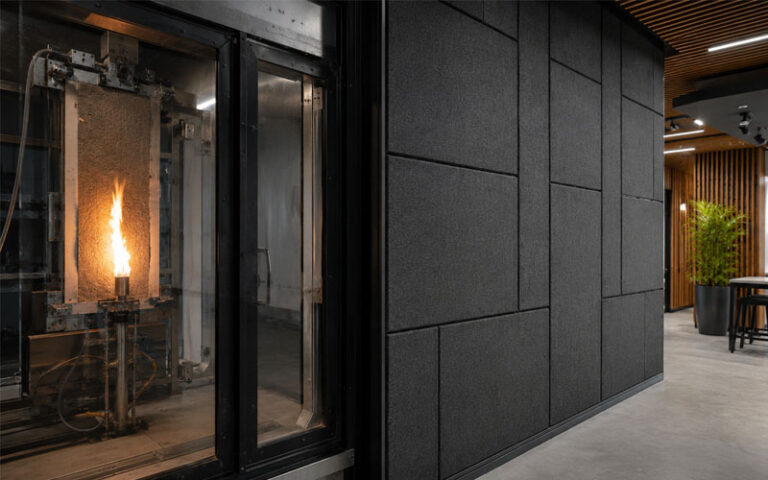
Take an actual product test report from Begoodtex as an example, which demonstrates the authority of data verification. This report was issued by the authoritative body TÜV SÜD (Report No. 87.405.23.45200.01), and the test sample was “100% Polyester Inherent flame retardant blackout fabric.”
This case study clearly shows that a reliable FR fabric supplier (like Begoodtex) uses transparent, rigorous third-party test data to prove its product’s professionalism and compliance.
A: Not necessarily. While traditional fireproof cloths were thick, modern technology can achieve FR properties in lightweight fibers. For example, eco-friendly recycled IFR polyester can be both light and soft, making it very suitable for home furnishings and children’s sleepwear. Thickness has no absolute direct relationship with the level of protection.
A: Only older types of protective fabrics had poor breathability. Many modern FR fabrics maintain good airflow through fiber modification or blending. For instance, IFR polyester can maintain good air circulation through different weave structures (like mesh or knit). Breathability and protection can coexist.
A: That is usually a low-quality FR-treated fabric that used halogenated flame retardants or was not properly cured. A qualified FR fabric (especially for sleepwear) should have no obvious chemical odor and must pass Oeko-Tex® Standard 100 certification. If it has an irritating smell, it is not recommended for next-to-skin garments.
A: There is no absolute “better,” only “more suitable.” Inherently FR (IFR) (e.g., Aramid, IFR Polyester) has the FR property built into the fiber, making it permanent for life. It is suitable for extreme industrial environments or high-requirement home products. FR Treated (e.g., Proban® or some treated polyesters) achieves its property through a chemical finish, which can offer advantages in cost and certain physical properties (like a cotton hand-feel), making it suitable for general industry and some workwear.
A: For FR Treated fabrics, the FR property will gradually diminish with an increasing number of washes. You must strictly follow the supplier’s washing instructions (e.g., avoid chlorine bleach and fabric softeners). When the garment is damaged or reaches its recommended wash limit, it should be replaced. The FR property of an IFR fabric will not be lost to washing, but physical damage to the fabric (like rips or holes) will compromise its protective barrier.
A: NFPA 2112 is the Standard on Flame-Resistant Clothing for Protection of Industrial Personnel Against Short-Duration Thermal Exposures from Fire, issued by the US National Fire Protection Association. It is a core safety standard for the oil, gas, and chemical industries. It requires that in a simulated 3-second flash fire test, the wearer’s total predicted body burn (second- and third-degree burns) must be 50% or less. Choosing fabrics that pass this certification is critical to protecting workers in high-heat environments from severe injury.
Choosing the right fabric is not just a technical issue; it is a reflection of corporate responsibility. Industrial protective wear must withstand high heat; home sleepwear must protect the skin.
Begoodtex have over 17 years of experience in the R&D and production of flame retardant fabrics. We deeply understand the differentiated needs of various scenarios, including petrochemicals, electric power, smelting, and children’s home furnishings. What we provide is not just fabric that meets international standards (NFPA 2112, EN 11612, CFR 1615/1616, Oeko-Tex 100, DIN 4102-B1), but a professional safety solution tailored to your specific working conditions.
Contact our technical consultants today for one-on-one fabric selection support and free samples.