Enter your details and we will send the requested document to your inbox.





BS 5852 (Crib 5) stands as one of the most critical fire safety standards for the commercial furniture industry in the UK. For manufacturers exporting to the UK or supplying international hotel projects, this is a compliance threshold that cannot be ignored.
The UK has what is widely recognized as the “world’s strictest” furniture flammability regulations. This guide provides an in-depth analysis of the BS 5852 technical details, the specific “Crib 5” testing process, and how to ensure your products qualify for Medium Hazard environments in the British market.
BS 5852 (Full title: Methods of test for assessment of the ignitability of upholstered seating) is the primary standard used to assess whether furniture materials will continue to burn when exposed to an ignition source.
It does not just test the fabric alone; it evaluates the three key components of soft furniture:
⚠️ Key Distinction: BS 5852 vs. BS 5867
Many buyers confuse these two standards. Please note:
The test subjects are completely different, and certifications are not interchangeable.
BS 5852 defines 8 ignition source levels of varying intensity. In commercial applications, the three most critical sources are:
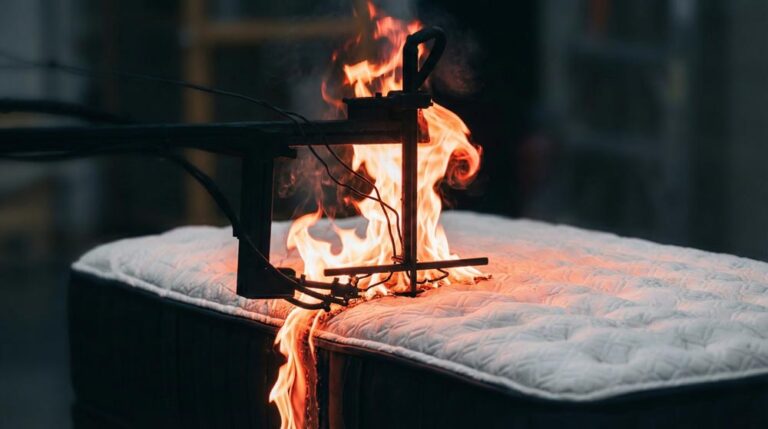
The term “Crib 5” comes from the specific wooden structure used as the ignition source in the test. Compared to a cigarette or small flame, it generates significantly higher heat and burns for longer.
Testers use a stack of 20 pine battens, glued together to form a “Crib” structure approximately 40mm high, resembling a small lattice or “Jenga” tower. This crib is placed at the junction between the seat and the backrest.

To pass the test, the material composite must meet the following conditions:
Crib 5 is the entry ticket for UK “Medium Hazard” environments. According to the BS 7176 specification, the following sectors must use Crib 5 compliant furniture:
Not all materials can withstand the intense heat of a wooden crib. Understanding fibre characteristics is crucial for procurement. Below is a breakdown of common materials:
| Material Type | Crib 5 Capability | Notes |
|---|---|---|
| FR Polyester | ✅ Usually Passes | The most cost-effective choice for hotel interiors. e.g., Begoodtex IFR Furniture Fabrics. |
| Modacrylic | ✅ High Pass Rate | Inherently flame retardant fibre with stable performance. |
| Aramid | ✅ Easily Passes | High-performance industrial-grade FR material. |
| Normal Polyester | ❌ Fails | Melts and drips easily. Must undergo chemical back-coating to pass. |
| Natural Cotton/Linen | ❌ Fails | Highly flammable. Requires strict chemical impregnation/treatment. |
Recommendation: For high-traffic commercial spaces, we recommend prioritizing IFR (Inherently Flame Retardant) Polyester (such as the Begoodtex collection). These fabrics pass Crib 5 naturally without requiring chemical back-coating, avoiding the risk of coating degradation over time while maintaining a softer touch.
British standards are renowned for their severity. Here is how BS 5852 compares to other mainstream international standards:
| Standard System | Test Intensity | Covers Crib 5? |
|---|---|---|
| BS 5852 Source 5 (UK) | ⭐⭐⭐⭐ (High) | Yes (Wood Crib Test) |
| EN 1021-1/2 (EU) | ⭐⭐ (Medium) | No (Equivalent to Cigarette/Match only) |
| CAL TB 117 (USA) | ⭐ (Low) | No (Primarily Cigarette/Smouldering) |
A: Most likely not. EN 1021 only includes cigarette and match tests. Its heat output is significantly lower than the Crib 5 wood crib. A Crib 5 test generates approximately 20 times the heat of a match test.
A: No. UK law (The Furniture and Furnishings Fire Safety Regulations) requires domestic furniture to pass Source 0 (Cigarette) and Source 1 (Match). Crib 5 is specifically for Commercial and Public environments (Medium Hazard).
A: No. BS 5852 is a “Composite Test.” Even if the fabric is flame retardant, if the foam underneath is standard non-FR foam, the test will likely fail. The fabric and foam must work together to prevent ignition.