Get in touch
Thank you for reaching out! Please tell us more about your needs — our expert team will get back to you within 24 hours.
Get in touch
Thank you for reaching out! Please tell us more about your needs — our expert team will get back to you within 24 hours.
In most commercial fire safety contexts, standards are designed to prevent “accidents.” However, in prisons, custody suites, and secure mental health units, fire safety must address a much darker threat: “Arson.” This guide analyzes BS 7175 Source 7—the UK’s most rigorous fire testing standard for bedding in high-risk environments—and clarifies the critical differences between BS 7177 and BS 5815.
BS 7175 (Full title: Methods of test for the ignitability of bedcovers and pillows by smouldering and flaming ignition sources) is the specific UK test method standard used to assess the flammability of bed covers, pillows, and duvets. It utilizes ignition sources ranging from 0 to 7 to simulate fire risks varying from a smouldering cigarette to deliberate arson.
Within this standard, Source 7 (Crib 7) represents the highest level of testing intensity, specifically designated for environments classified as “Very High Hazard.”
Source 7 exists to counter the risk of deliberate ignition in confined environments. In ordinary hospitals or hotels (typically Source 5), fire risks usually stem from accidental matches or cigarettes. However, in the following institutions, occupants may display aggressive or self-harming behavior and may attempt to create severe fires by piling up clothing or newspapers on a bed:
In these environments, standard fire retardancy is insufficient to prevent “Flashover.” Only products that pass Source 7 can ensure that, even in cases of arson, the fire remains contained within a minimal area.
BS 7175 uses an exponential numbering system (0-7) to classify risk. Understanding the energy difference between these sources is crucial for selecting the correct product.
| Ignition Source | Type | Energy Description | Typical Application |
|---|---|---|---|
| Source 0 | Lit Cigarette | Smouldering, no open flame. | Domestic, Low Risk. |
| Source 5 (Crib 5) | Wood Crib (~17g) | Medium intensity open flame. | NHS Wards, Hotels. |
| Source 7 (Crib 7) | Large Wood Crib (~35g) | Extreme intensity (2x energy of Source 5). | Prisons, Custody, Secure Units. |
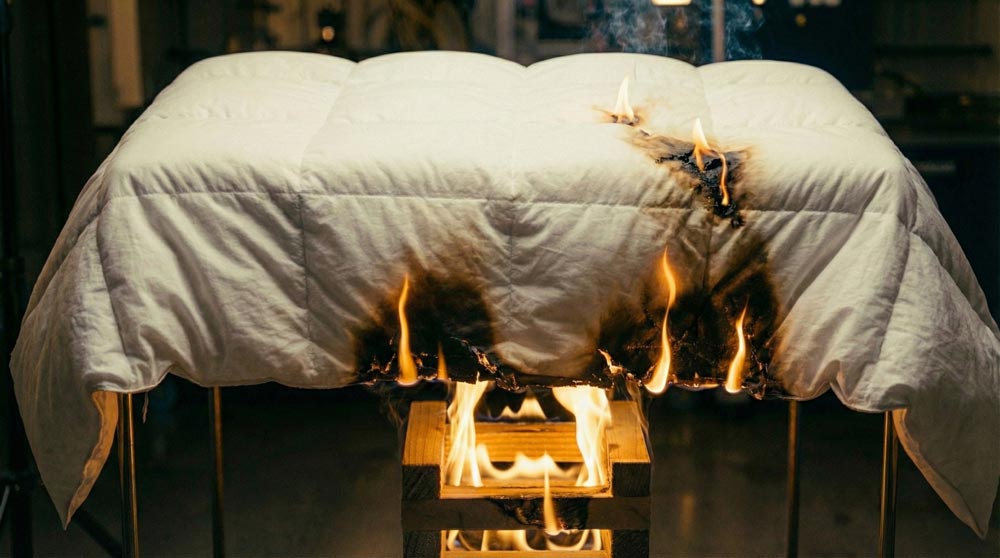
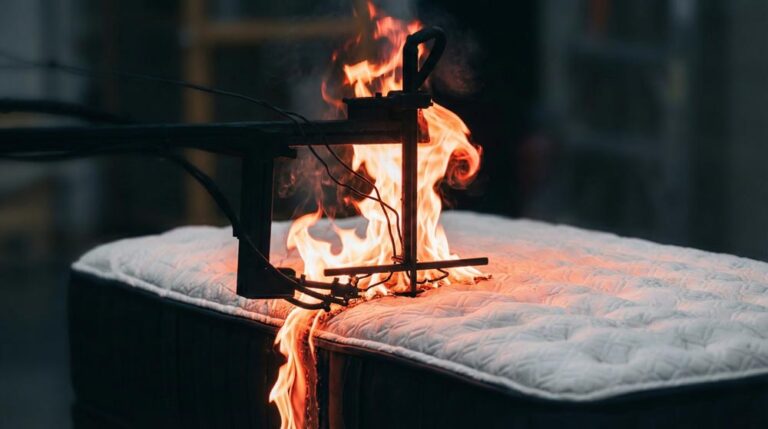
The Source 7 test is a highly destructive process designed to verify structural integrity under extreme heat radiation.
Testing must be conducted as a “Composite.” The actual pillowcase/duvet cover must be tested in combination with the specific inner filling (pillow core/duvet insert) intended for use. This ensures the test reflects the performance of the finished product.
Testers construct a large lattice crib made of specific pine wood (Crib 7) and add Isopropyl alcohol as an accelerant. Once ignited, this crib generates ferocious flames and sustained high-temperature radiant heat.
To pass, the sample must meet the following within 60 minutes: No Penetration (flame must not burn through to the underside), Self-Extinguishing (fabric flames must die out after the wood is consumed), and No Flaming Debris.
These three standards are frequently confused in procurement. To ensure compliance, it is vital to distinguish their test objects and applicable scenarios.
| Feature | BS 7177 (Mattress Spec) | BS 7175 (Bedding Test) | BS 5815 (Hospital Spec) |
|---|---|---|---|
| Test Object | Mattresses Divan Bases | Pillows Duvets (Quilts) Bedspreads | Sheets Duvet Covers Blankets |
| Max Source | Source 7 (Crib 7) *(For Very High Hazard)* | Source 7 (Crib 7) *(For Prison/High Risk)* | Source 5 (Typically) *(Weaker source, focus on wash)* |
| Key Feature | Fire resistance of the finished unit. | Anti-vandal & Arson resistance. | Durability over 50+ thermal washes. |
| Primary Scenario | All Locations (Graded by risk). | Primarily Prisons & Custody. | Primarily NHS Hospitals. |
Myth: “BS 7177 does not go up to Source 7; it is less strict than BS 7175.”
Fact: This is a critical error. The “Very High Hazard” classification within BS 7177 explicitly mandates testing with Source 7. In a prison cell, the mattress must comply with BS 7177 (Source 7), and the bedding must comply with BS 7175 (Source 7). They are a matching system, not substitutes.
To withstand “Hellfire,” BS 7175 Source 7 products typically rely on the following engineering:
A: No. BS 7175 tests the “Composite.” You must ensure the fabric and the filling together pass the test. Furthermore, the mattress underneath must independently comply with BS 7177 Very High Hazard.
A: To achieve extreme safety, these fabrics are typically stiffer, heavier, and less breathable (canvas-like) than domestic bedding. This is a necessary trade-off for preventing burn-through and vandalism.
A: Not necessarily. BS 7175 does not mandate wash cycles. In prison environments, to prevent the concealment of contraband and maintain hygiene, products increasingly feature “Wipe-clean” technology (using welded seams), requiring only surface disinfection rather than laundering.
A: Generally, no. Care homes are typically “Medium Hazard,” requiring BS 7175 Source 5 or BS 5815. Source 7 is too expensive and uncomfortable unless the specific unit houses residents with severe arsonist tendencies.