Get in touch

Thank you for reaching out! Please tell us more about your needs — our expert team will get back to you within 24 hours.

弹窗表单

Flame-Retardant Upholstery Fabric Solutions for Aircraft Seating Systems

In the aerospace sector, seat fabric is categorized not merely as an interior decorative element but as a systematic engineering component. It integrates safety, airworthiness compliance, physical performance, and long-term operational efficiency. Especially in high-density cabin environments, the performance of decorative seat fabrics directly determines the safety margins and operational costs of the aircraft.
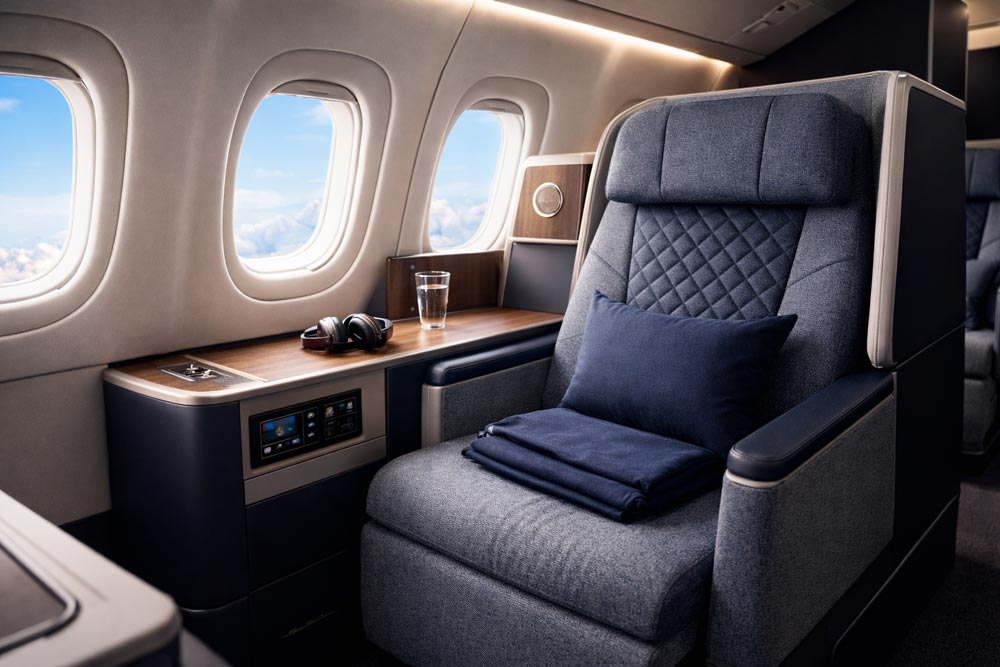
Aviation Flame Retardant Seat Fabric

I. Risk Assessment and Environmental Analysis of Aviation Flame Retardant Seat Fabric

The interior space of an aircraft is highly confined. In the event of a fire, personnel evacuation is difficult and time-sensitive. Consequently, aviation seat fabrics must be engineered to address the specificities of the aviation environment.

1. Combustion Out-of-Control Risk Assessment

In aviation fire scenarios, risk is derived from three core variables:

  • Flame Spread: Upon contact with a heat source, the material must possess self-extinguishing properties to prevent continuous propagation across the seat surface.
  • Heat Release Rate: High heat release from large-surface fabrics accelerates “flashover” within the cabin, significantly reducing the survival window for evacuation.
  • Smoke & Toxicity: Statistics indicate that most fatalities in aviation fires result from smoke inhalation or toxic gas asphyxiation. Fabrics must maintain extremely low smoke density and minimize the release of toxic gases such as $HCN$, $CO$, $NO_x$, $SO_2$, $HCl$, and $HF$.

2. Mechanical and Physical Stress Environment

Aviation seats are subjected to a much higher usage frequency than residential furniture:

  • Continuous Friction: Constant physical abrasion from passengers and rigorous cleaning protocols by maintenance crews.
  • Environmental Stress: High-altitude UV exposure and low-humidity environments can lead to fiber embrittlement and electrostatic accumulation.
  • Chemical Exposure: Aviation-grade disinfectants, food contaminants, and acidic or alkaline cleaning agents can potentially degrade the molecular structure of flame retardants.

II. Airworthiness Standards and Regulations: The Basis for Aviation Flame Retardant Seat Fabric

The development of aviation-grade fabrics must strictly adhere to airworthiness directives rather than general civilian textile standards.

1. Analysis of FAR 25.853 and its Subsections

FAR 25.853, established by the Federal Aviation Administration (FAA), is the recognized industry baseline:

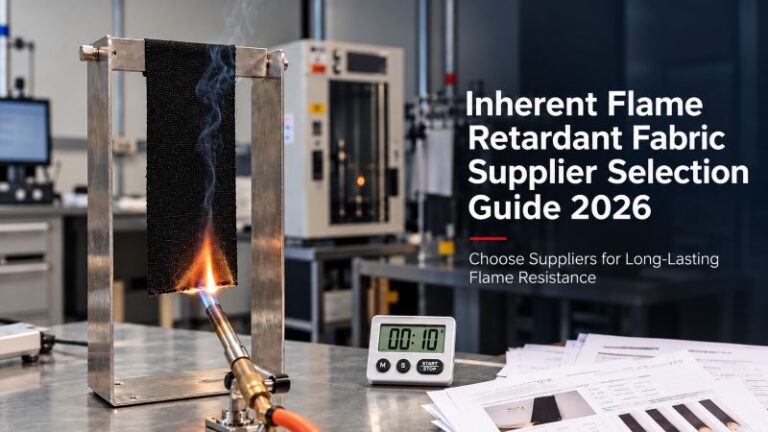
  • 25.853(a) Vertical Bunsen Burner Test: Fabrics must typically pass a 12-second or 60-second vertical burn test. Requirements include specific limits on Burn Length, After-flame Time, and Drip Flame Time.
  • 25.853(c) Kerosene Burner Test (Seat Cushion Test): This evaluates the complete seat cushion assembly (fabric, fire blocking layer, and foam). It requires weight loss and flame spread to remain within limits under high-intensity flame impingement for two minutes.
  • 25.853(d) Heat Release (OSU) and Smoke Density (NBS): For large transport aircraft, the peak heat release must be below $65 kW/m^2$ and the total heat release over two minutes must be below $65 kW \cdot min/m^2$.

2. International Equivalent Standards

In addition to the FAA, the Civil Aviation Administration of China (CAAC) CCAR-25 and the European Union Aviation Safety Agency (EASA) CS-25 specify highly consistent requirements. A globalized solution must ensure product compatibility across these various airworthiness systems.

III. Material Science Solutions: Technical Paths for Aviation Flame Retardant Seat Fabric

High-performance solutions originate at the fiber engineering level.

1. Inherent Flame Retardancy (IFR) Solutions

This is the advanced approach favored by specialized organizations like BEGOODTEX. By modifying the polymer molecular structure, flame-retardant elements (such as phosphorus or nitrogen) are embedded during the spinning stage.

  • Permanent FR Polyester: Modified polyester offering high thermal stability and physical strength.
  • Modacrylic: Possesses natural chemical resistance and excellent charring capabilities, often used in blends to enhance self-extinguishing properties.
  • Aramids: Used in specialized areas for extreme temperature resistance and mechanical durability, despite higher costs.

Advantages of Inherent Solutions: Flame retardancy does not degrade with laundering, carries no risk of toxic leaching, and maintains a consistent performance lifecycle.

2. Treated Flame Retardancy Solutions

This involves applying flame-retardant additives to the fabric surface via padding, coating, or spraying.

  • Limitations: While cost-effective, additives may detach during high-frequency washing or physical wear, leading to unpredictable airworthiness risks.
  • Application: Typically restricted to short-term service or localized decorative areas with rigorous secondary validation protocols.

IV. Structural Engineering: Systematic Design of Aviation Flame Retardant Seat Fabric

Solutions involve not only materials but also the physical structure of the weave and its synergy with other components.

1. Impact of Weave Structure on Combustion Behavior

  • Organization Density: High-density plain or twill weaves reduce the air content between fibers, thereby inhibiting the rate of flame spread.
  • Yarn Twist: Tight yarn structures are more prone to forming a protective carbonaceous char layer when exposed to fire, rather than supporting loose combustion.

2. Multi-layer Composite System Architecture

In advanced aviation seat design, the decorative fabric is treated as part of a system:

  • Decorative Layer: Provides the first line of fire defense and tactile comfort.
  • Fire Blocking Layer (FBL): Positioned between the decorative fabric and the foam, usually consisting of high-performance non-wovens or specialty fabrics. Its role is to prevent the foam from igniting even after the outer fabric is consumed, ensuring compliance with FAR 25.853(c).

V. BEGOODTEX Specialized Aviation Flame Retardant Seat Fabric Solutions

Leveraging 17 years of experience in functional textile R&D, BEGOODTEX has established a delivery system compatible with global aviation supply chains.

1. 17 Years of Technical Accumulation and Quality Control

The core competitiveness of the BEGOODTEX solution lies in supply chain stability. Aviation projects demand minimal batch-to-batch variance. BEGOODTEX ensures that the Limiting Oxygen Index (LOI) and airworthiness test results remain highly consistent through standardized production processes.

2. Engineering Application of Permanent FR Technology

The inherent flame retardant technology used by BEGOODTEX addresses critical airline pain points:

  • Anti-aging Performance: Under long-term high-altitude radiation, the molecular chains remain stable, preventing embrittlement and maintaining the original hand-feel.
  • Wash Durability Standards: After multiple industrial-grade launderings, the fabric continues to meet stringent requirements for char length and after-flame time.

3. Environmentally Friendly Design

While ensuring safety compliance, BEGOODTEX is committed to eliminating halogens and other harmful chemicals. This ensures that smoke toxicity during combustion remains far below the detection limits set by Airbus and Boeing, enhancing cabin safety.

VI. Physical Performance and Life Cycle: The Business Logic of Aviation Flame Retardant Seat Fabric

Airlines prioritize economic efficiency alongside safety when selecting solutions.

1. Durability Indicators (Martindale & Pilling)

  • Abrasion Resistance: Aviation-grade fabrics typically require Martindale tests exceeding 50,000 or even 100,000 rubs. High durability translates to longer replacement cycles and lower operating costs.
  • Pilling Resistance: Essential for maintaining the aesthetic integrity of the cabin and the brand image.

2. Cleaning Maintenance and Color Fastness

  • Chemical Resistance: Fabrics must withstand standard aviation disinfecting agents.
  • Light Fastness: For window-side seating, fabrics require high-level UV resistance (Grade 4-5 or higher) to prevent aesthetic degradation due to fading.

3. Operational Risk Management

BEGOODTEX provides partners with comprehensive data support, including original material certifications and performance degradation estimates post-wash. This transparent delivery supports airlines during regulatory audits.

VII. Passenger Experience and Ergonomics: Sensory Design of Aviation Flame Retardant Seat Fabric

Safety and comfort are integrated within high-end solutions.

1. Breathability and Thermal Management

Through microscopic weave adjustments, BEGOODTEX solutions improve air permeability, reducing heat accumulation for passengers during long-haul flights.

2. Anti-static Integration

In dry high-altitude environments (humidity often < 10%), static electricity can cause passenger discomfort and interfere with sensitive electronics. BEGOODTEX fabrics integrate conductive fibers or static dissipation technology to keep surface resistance within safe limits.

3. Tactile and Acoustic Properties

Fabric softness directly impacts passenger comfort ratings. Additionally, high-quality weave structures assist in absorbing high-frequency cabin noise, optimizing the flight environment.

VIII. Summary: Constructing a Systematic Defense for Aviation Flame Retardant Seat Fabric

Aviation seat decorative flame retardant fabric solutions are more than textile supplies; they represent a rigorous life-safety engineering project.

A mature solution must possess:

  • Deterministic Regulatory Compliance: Full adherence to FAR 25.853 and related airworthiness standards.
  • Intrinsic Material Safety: Represented by BEGOODTEX permanent FR technology, ensuring zero performance decay over the life cycle.
  • Systemic Structural Synergy: Minimizing fire risk through multi-layer protective design.
  • Long-term Commercial Sustainability: Achieving the optimal balance between durability, maintainability, and passenger comfort.

The core mission of BEGOODTEX is to provide global aviation clients with reliable, traceable, and operational flame-retardant fabric solutions through material innovation and stringent process control. In the aviation industry, a superior solution must not only “pass the test” but maintain absolute stability of the safety boundary throughout years of service.

FAQ

1. What is the primary advantage of Inherent FR vs. Treated FR in aviation seats?

The primary advantage is “Permanent Reliability.” Inherent FR fabrics (like those from BEGOODTEX) integrate flame retardant molecules into the fiber itself. Unlike treated fabrics, the FR properties will not degrade due to industrial laundering, dry cleaning, or mechanical wear, ensuring the seat remains compliant with FAR 25.853 throughout its entire service life.

2. Does the fabric comply with both FAR 25.853(a) and (c)?

Yes. While FAR 25.853(a) tests the fabric individually via a vertical burner, FAR 25.853(c) tests the complete seat assembly. Our solutions are engineered to work in synergy with Fire Blocking Layers (FBL) to ensure the total assembly passes the kerosene burner test with minimal weight loss and flame spread.

3. How does the solution address smoke and toxicity requirements?

Our aviation flame retardant seat fabrics are halogen-free. During combustion, they release significantly lower levels of specific optical smoke density (Ds) and toxic gases (such as HCN, CO, and SO2) compared to traditional treated polyesters, staying well below the limits set by Airbus and Boeing technical specifications.

4. Can the fabrics be customized for specific airline branding?

Absolutely. Inherent flame retardancy does not limit aesthetic flexibility. We provide a wide range of customized textures, weaves (Jacquard, Twill, Plain), and pantone-matched colors, all while maintaining high Martindale abrasion resistance and color fastness to light.

How do you ensure batch-to-batch consistency for large aircraft orders?

BEGOODTEX implements a closed-loop quality management system. Each production lot undergoes rigorous internal testing for Limiting Oxygen Index (LOI) and vertical burn length. We provide full traceability and third-party test reports to support airworthiness certification for every batch delivered.

6. What is the typical life cycle of BEGOODTEX aviation fabrics?

Depending on the cabin class and usage frequency, our fabrics are designed for high durability, typically exceeding 50,000 to 100,000 rubs in Martindale tests. Due to the inherent FR properties, the safety life of the fabric is equal to its physical life, reducing the frequency of unscheduled replacements.