Enter your details and we will send the requested document to your inbox.





The global HVAC industry is undergoing a paradigm shift from traditional rigid metal ductwork to high-performance, flexible Fire rated fabric ventilation ducts. This article provides a comprehensive technical analysis of the Flame Retardant Fabric Air Ducts Solution, emphasizing the critical balance between Air Distribution System efficiency and rigorous life safety standards. For high-occupancy environments such as schools and laboratories, selecting the correct HVAC fabric is essential to mitigate risks associated with fire spread and toxic smoke development. Begoodtex leverages advanced Inherently Flame Retardant (IFR) fibers to ensure permanent fire safety while optimizing Indoor Air Quality (IAQ). This guide serves as a technical reference for engineers to specify systems that meet global compliance, maximize Acoustic Damping, and eliminate Thermal Stratification through engineered permeability and superior physical performance.
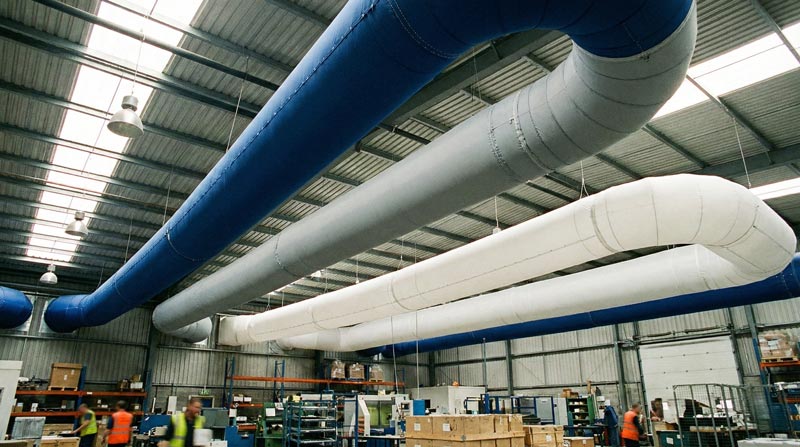
Modern Textile air duct fire safety protocols require that air distribution components serve as active barriers against thermal hazards rather than passive conduits. The integration of Fire rated fabric ventilation ducts into large-scale projects ensures that the Air Distribution System does not contribute to the building’s fuel load during an emergency. Technical integration involves matching the fabric’s aerodynamic permeability with the static pressure of the Air Handling Unit (AHU) while maintaining a surface that resists flame ignition and rapid heat transfer. This holistic approach is foundational for modern sustainable architecture.
Unlike galvanized steel, HVAC fabric offers a non-resonant surface that naturally enhances the environment. The engineering of these materials focuses on high-tenacity filament structures that maintain their fire-rated properties even under continuous high-velocity airflow.
The Begoodtex Flame Retardant Fabric Air Ducts Solution utilizes Inherently Flame Retardant (IFR) fibers, where the flame-extinguishing chemistry is synthesized directly into the polymer chain. This molecular integration ensures that the Self-extinguishing Property is a permanent physical characteristic of the material, unaffected by environmental wear, UV exposure, or industrial laundering. In contrast, fabrics treated with topical FR coatings are subject to chemical leaching, which can compromise safety over the system’s lifecycle and negatively impact IAQ – Indoor Air Quality through particulate release.
Selecting the appropriate HVAC fabric is a critical safety determination. While standard textiles may provide air distribution, only Fire rated fabric ventilation ducts provide the necessary protection against catastrophic fire spread. Standard fabrics act as a fuse, accelerating fire travel through a building’s ventilation network.
Table 1: Comparative Fire Performance of HVAC Ducting Materials
| Performance Metric | Inherently Flame Retardant (IFR) Fibers | FR Treated (Coated) Fabric | Standard Non-FR Fabric |
|---|---|---|---|
| Safety Rating | Class A / B-s1,d0 (Permanent) | Class A / B1 (Fades over time) | Unrated / Combustible |
| Fire Spread Behavior | Self-extinguishing; Rapid charring | Slow burning; properties degrade | Highly flammable; rapid fire spread |
| Smoke Development Index (SDI) | Extremely Low (< 50) | Variable (Chemical smoke risk) | High (Thick toxic smoke) |
| No Molten Dripping | Fully compliant; no flaming droplets | Risk of dripping as coating fails | Severe flaming droplets |
| Laundering Resistance | 100% Retained after 60+ washes | Significant loss of FR properties | Zero Protection |
Technical Insight: Utilizing standard non-FR materials in an Air Distribution System is a violation of international building codes such as NFPA 90A, as the airflow would convert the ducting into a high-speed flame delivery system.
The primary metrics for Textile air duct fire safety are the Flame Spread Index (FSI) and the Smoke Developed Index (SDI), measured via the ASTM E84 (UL 723) tunnel test. A high-tier Flame Retardant Fabric Air Ducts Solution must achieve a Class A rating, which requires an FSI of 25 or less and an SDI of 50 or less. These indices determine how quickly a fire can move across the surface of the duct and the density of smoke generated, which are the most critical factors for ensuring safe evacuation in schools and public auditoriums.
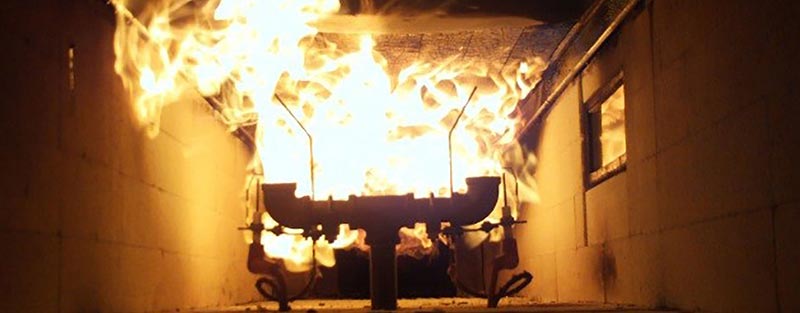
For Fire rated fabric ventilation ducts, the material is tested in a horizontal ceiling orientation to simulate real-world HVAC installations.
Table 2: Global Fire Classification Standards for HVAC Fabrics
| Regulatory Standard | FSI Limit | SDI Limit | Required Classification |
|---|---|---|---|
| ASTM E84 (USA) | 0 – 25 | 0 – 50 | Class A (Class 1) |
| EN 13501-1 (EU) | B (Limited Contribution) | s1 (Low Smoke) | B-s1, d0 |
| NFPA 701 | Pass/Fail | N/A | Flame Propagation Resistance |
In high-intensity fire scenarios, synthetic materials that melt and form flaming droplets pose a severe risk of secondary ignitions and human injury. Begoodtex Fire rated fabric ventilation ducts are engineered with a No molten dripping characteristic. Upon contact with extreme heat, the Inherently Flame Retardant (IFR) fibers undergo carbonization, forming a stable char layer that prevents the liquid phase of combustion. This property is mandatory for an effective Flame Retardant Fabric Air Ducts Solution in environments where occupants are positioned directly beneath the duct lines, such as educational institutions and manufacturing plants.
The carbonization process acts as a thermal barrier, insulating the core of the textile and preventing the release of flaming debris into the space below.
The Limiting Oxygen Index (LOI) provides a precise numerical value for the relative flammability of an HVAC fabric. It defines the minimum oxygen concentration required to support combustion. While ambient air contains ~21% oxygen, a high-performance Flame Retardant Fabric Air Ducts Solution requires an LOI between 28% and 34%. This high threshold ensures a robust Self-extinguishing Property, meaning the material will not support a flame in normal atmospheric conditions. This is the primary defense against localized ignition sources such as electrical faults or welding sparks during maintenance.
Because the forced air within an Air Distribution System can provide a surplus of oxygen to a fire, high LOI values are essential to counteract the “bellows effect” of HVAC fans.
Table 3: LOI Performance Values for Technical Textiles
| Fabric Material | LOI Value (%) | Flammability Performance |
|---|---|---|
| Standard Cotton | 18.5 | Highly Combustible |
| Standard Polyester | 21.0 | Supports Combustion |
| Begoodtex IFR HVAC Fabric | 31.0 – 32.5 | Self-Extinguishing |
| High-Performance Aramid | 35.0+ | Exceptional Heat Resistance |
Indoor Air Quality (IAQ) is directly linked to the mechanical stability of the materials used in the Air Distribution System. High-velocity systems can cause inferior fabrics to shed micro-fibers, which can become airborne contaminants. Begoodtex Fire rated fabric ventilation ducts utilize high-tenacity, continuous filament yarns that eliminate shedding and fiber migration. This ensures that the Flame Retardant Fabric Air Ducts Solution meets the particulate-free requirements of cleanrooms, healthcare facilities, and modern classrooms, where clean air is non-negotiable for occupant health.
The smooth internal surface of Inherently Flame Retardant (IFR) fibers minimizes friction and prevents the accumulation of dust and biological matter, which are common issues with internal metal insulation.
One of the significant advantages of the Flame Retardant Fabric Air Ducts Solution is its natural Acoustic Damping capability. Rigid metal ducts often generate “drumming” noises and transmit mechanical vibrations from the AHU throughout the building. HVAC fabric, being flexible and porous, acts as a broadband sound absorber that dampens air turbulence and motor noise. This technical feature is critical for educational institutions and theaters, where maintaining low ambient noise levels is essential for acoustic clarity and concentration.
The density and weave of Fire rated fabric ventilation ducts are engineered to maximize sound energy dissipation within the material’s structure.
Table 4: Decibel (dB) Reduction Performance
| Octave Band (Hz) | Metal Duct Noise Level (dB) | Begoodtex Fabric Noise Level (dB) | Acoustic Improvement (dB) |
|---|---|---|---|
| 250 Hz | 75 | 68 | -7 |
| 1000 Hz | 70 | 55 | -15 |
| 4000 Hz | 62 | 42 | -20 |
Thermal Stratification, where warm air accumulates at the ceiling while cold air stays at the floor, is a major source of energy waste in high-ceiling facilities. The Flame Retardant Fabric Air Ducts Solution solves this through engineered permeability and laser-cut micro-perforations. By delivering air uniformly through the entire surface of the duct or via precise jets, the Air Distribution System ensures total air mixing. This technology eliminates “dead zones” and allows for a more uniform temperature profile, significantly reducing the energy required for both heating and cooling.
Begoodtex offers multiple distribution models to tailor the HVAC fabric performance to the specific geometry of the space.
Energy Efficiency Note: Proper air mixing can reduce AHU run times by up to 15-20% by reaching setpoint temperatures more effectively.
Ensuring global compliance for a Flame Retardant Fabric Air Ducts Solution requires adherence to multiple international testing frameworks. Fire rated fabric ventilation ducts must be certified for flammability, smoke toxicity, and physical durability. Begoodtex ensures its products are tested by accredited third-party labs to meet the requirements of any regional building code, including UL, EN, and BS standards. This comprehensive certification process provides engineers with the documented proof of safety needed for project insurance and building occupancy permits.
Table 5: Essential Fire Safety Certifications by Region
| Geographic Region | Testing Standard | Classification Requirement |
|---|---|---|
| North America | UL 723 / ASTM E84 | Class A (FSI < 25, SDI < 50) |
| Europe | EN 13501-1 | B-s1, d0 (No Molten Dripping) |
| United Kingdom | BS 476 Part 7 | Class 1 (Surface Spread of Flame) |
| China | GB 8624 | B1 (Flame Retardant Materials) |
The mechanical and biological integrity of Begoodtex Fire rated fabric ventilation ducts is validated through standardized testing for strength, permeability, and antimicrobial properties. In active Air Distribution Systems, fabrics must withstand internal pressures while preventing biological growth and particulate shedding. Physical testing ensures the fabric resists structural failure under high-velocity airflow, while bio-resistance testing confirms that the IAQ remains uncontaminated even in humid or stagnant conditions. These attributes collectively define the long-term reliability and health-safety profile of the Flame Retardant Fabric Air Ducts Solution.
 Inherent Flame Retardant Air Duct Polyester Twill Fabric in Orange with Antibacterial Protection for OEM Production | 215 g/m² | 150 cm
 Flame Retardant Printed Polyester in Blue with Antibacterial Protection for Bulk Fabric Air Duct Projects | 215 g/m² | 150 cm
 Permanent Flame Retardant Air Duct Polyester Fabric with Antibacterial Protection for Wholesale Supply | 220 g/m² | 150 cm
 Inherent Flame Retardant Air Duct Polyester Fabric in Off-White with Antibacterial Protection for Export Supply | 220 g/m² | 150 cm
Mechanical performance is quantified by breaking strength and tearing strength, ensuring the HVAC fabric does not rupture during system start-up or sustained operation. Testing according to GB/T 3923.1-2013 and GB/T 3917.1:2009 provides a precise baseline for engineering safety factors.
Begoodtex Fabric Mechanical Performance Data
| Test Parameter | Warp Direction | Weft Direction | Test Standard |
|---|---|---|---|
| Breaking Strength (N) – White Woven | 1300 | 1100 | GB/T 3923.1-2013 |
| Breaking Strength (N) – 100% Polyester FR | 591 | 559 | GB/T 3923.1-2013 |
| Tearing Strength (N) – 100% Polyester FR | 29.6 | 25.2 | GB/T 3917.1:2009 |
| Breaking Elongation (%) | 29.8 | 22.5 | GB/T 3923.1-2013 |
Precisely controlled air permeability is vital for draft-free air distribution and condensation prevention. Begoodtex fabrics undergo testing via GB/T 5453-1997 at a pressure differential of 100Pa. Resulting permeability rates range from 7.6 mm/s in specialized woven fabrics to 17.6 mm/s in high-flow polyester air duct variants.
To ensure high Indoor Air Quality (IAQ), Begoodtex fabrics are engineered with antimicrobial agents like AEM5700. Mold resistance is critical to prevent fungal spores from circulating through the Air Distribution System.
Microbiological Analysis Results
| Testing Project | Result / Performance | Test Condition / Standard |
|---|---|---|
| Antibacterial Reduction (E. coli) | 90.30% | After 60 washes (AATCC 135) |
| Antibacterial Reduction (E. coli) | 92.50% | After 20 washes (AATCC 135) |
| Mould Resistance (Aspergillus niger) | Grade 1 (No Growth) | 7-day incubation (AATCC 30-2013) |
| Antifungal Capability (Red Al-H) | No Growth | AATCC 30-2013 |
When evaluated over a 10-year lifecycle, the Flame Retardant Fabric Air Ducts Solution provides a significantly lower Total Cost of Ownership (TCO) than metal ductwork. Savings are realized in the initial logistics (compact shipping), drastically reduced installation time, and lower maintenance costs. Furthermore, the sustainability profile of Begoodtex Fire rated fabric ventilation ducts is superior due to the use of recyclable polymers and the energy savings associated with improved air distribution and the mitigation of Thermal Stratification. This makes textile solutions the logical choice for LEED-certified and green building projects.
Table 7: 10-Year TCO Comparison (Textile vs. Metal)
| Lifecycle Cost Factor | Galvanized Metal System | Begoodtex HVAC fabric System |
|---|---|---|
| Initial Logistics | High (Bulky, heavy) | Low (Lightweight, collapsible) |
| Installation Speed | Slow (Mechanical hangers/joints) | Fast (Zip-on tracks) |
| Internal Cleaning | Expensive (Robotic brushing) | Low (Launderable) |
| Operational Energy | Baseline | 15% Reduction (Improved mixing) |
Yes. Our Fire rated fabric ventilation ducts achieve ASTM E84 Class A ratings, which are the highest possible for building materials used in educational and public assembly facilities.
Since the FR property is molecularly embedded in the Inherently Flame Retardant (IFR) fibers, it is permanent and will last for the entire service life of the duct, regardless of wash frequency
Absolutely. Our fabrics are tested to show zero mold growth even in optimal fungal conditions. Combined with permeability that prevents condensation, the system is ideal for pools and humid industrial sites.
Standard Begoodtex systems are rated for continuous operation up to 2,000 Pa, with a burst pressure safety factor of 5:1 based on our 1300N breaking strength data.
Yes. With an SDI of less than 50, our fabrics produce minimal smoke, ensuring that hospitals and cleanrooms maintain visibility and IAQ during fire emergencies.
