Get in touch
Thank you for reaching out! Please tell us more about your needs — our expert team will get back to you within 24 hours.




Limiting Oxygen Index (LOI) is one of the most critical indicators for evaluating the flame retardancy of textiles and polymer materials. This article aims to deconstruct the safety significance behind this professional value from the perspective of a textile R&D expert, covering physical definitions, calculation logic, testing standards, and industrial applications. For organizations procuring high-safety flame-retardant fabrics, understanding LOI is not only about regulatory compliance but also about finding the optimal balance between performance and sustainability. Simply put, the Limiting Oxygen Index refers to the minimum oxygen concentration required to maintain steady combustion of a material in an oxygen-nitrogen mixture; the higher the value, the stronger the flame retardancy of the material.
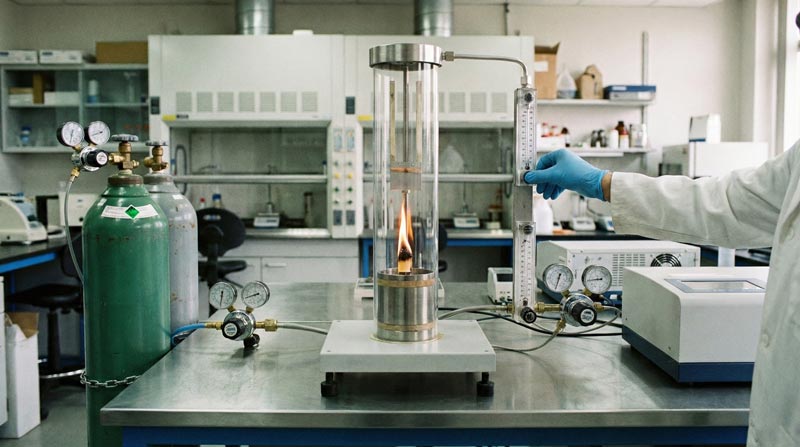
The Limiting Oxygen Index refers to the minimum concentration of oxygen in an oxygen-nitrogen mixture required for a material to just maintain a state of combustion under specified experimental conditions. It serves as a physical judgment benchmark for evaluating the ease of ignition of textiles and is typically expressed as a volume percentage of oxygen.
In the atmospheric environment, the concentration of oxygen is approximately 21%. If a material’s LOI is below 21%, it means it ignites easily and burns continuously in natural air. Conversely, if the LOI is significantly higher than 21%, the material requires additional oxygen to maintain combustion, a characteristic that provides self-extinguishing properties under normal atmospheric conditions.
In a laboratory environment, LOI is not determined by visual estimation but through precise control of oxygen and nitrogen flow rates using mathematical calculation logic. This value directly reflects the dynamic balance between the rate of combustible gas generation after thermal decomposition and oxygen consumption.
According to relevant technical standards, the calculation formula for the Limiting Oxygen Index is as follows:

By adjusting the flow meters in the glass chimney, technicians find a critical point where the specimen can continue burning for 2 minutes or the damaged length is exactly 40 mm. The oxygen percentage recorded at this moment is the final result.
The magnitude of the LOI value directly determines the ignition difficulty and the ability to sustain combustion of a material under specific environmental conditions. A higher numerical value indicates that a material is more resistant to ignition in low-oxygen environments and exhibits superior self-extinguishing properties once the external heat source is removed; conversely, a lower value signifies a higher dependency on lower oxygen levels, making the material highly prone to continuous combustion in standard air. This quantitative metric eliminates the qualitative ambiguity of “fireproof” and provides a precise classification for safety-critical venues.
Table 1: Material Combustion Performance Classification via LOI Intervals
| Classification | LOI Range (%) | Physical Judgment | Application Example |
|---|---|---|---|
| Highly Flammable | < 20% | Rapidly ignites and cannot self-extinguish in air. | Untreated Cotton / Rayon fabrics. |
| Combustible | 20% – 26% | Supports steady combustion in standard atmosphere. | Standard Industrial Polyester. |
| Flame Retardant (FR) | 26% – 34% | Self-extinguishes; provides high safety margins. | Begoodtex IFR Blackout Fabrics. |
| Non-combustible | > 35% | Extremely difficult to ignite; primarily chars. | Aramid / Glass Fiber composites. |
In vertical industry procurement, minor differences in LOI values represent fundamental material distinctions:
While the basic principles of LOI are universal, specific testing standards formulated for textiles in different regions vary in specimen size, ignition methods, and judgment criteria. Flame-retardant products developed and produced by Begoodtex usually pass multiple standard verifications to ensure global market compatibility.
ISO 4589 is currently the internationally recognized general principle for oxygen index testing of plastics and fabrics, while the American standard ASTM D2863 focuses more on dynamic monitoring of the ignition process. In China, GB/T 5454-1997 “Textiles – Burning behaviour – Oxygen index method” is typically implemented.
Table 2: Brief Comparison of Technical Parameters for Mainstream LOI Standards
| Standard Number | Scope of Application | Core Judgment Indicator | Environmental Requirements |
|---|---|---|---|
| ISO 4589-2 | Plastics, fabrics, films | Oxygen concentration for 180s burn | Room temp 23±2 degrees Celsius |
| GB/T 5454 | Chinese textile standards | Oxygen for 2min burn or 40mm damage | Humidity 65±5% pre-treatment |
| ASTM D2863 | Polymers, plastics | Minimum oxygen for specific burn rate | Extremely high flow control precision |
Executing a complete oxygen index test requires a rigorous laboratory process. Any neglect in operational details, such as environmental humidity control or verticality of specimen clamping, can lead to a deviation in the final LOI value by 0.5% to 1.5%.
Understanding the LOI values of various base fibers helps buyers identify the flame-retardant potential of fabrics from the source. The Inherent Flame Retardant (IFR) technology focused on by Begoodtex injects efficient flame-retardant elements during the polymerization stage, making its values far exceed those of ordinary synthetic fibers.
Table 3: Comparison of Measured LOI Values for Common and Functional Fibers
| Fiber Type | Measured LOI Range (%) | Combustion Morphology |
|---|---|---|
| Virgin Cotton | 17.0 – 18.5 | Burns rapidly with red-hot smoldering |
| Standard Polyester | 20.0 – 22.0 | Melts while burning, produces droplets |
| Wool | 24.0 – 25.0 | Natural flame resistance, foams and chars |
| Aramid | 28.0 – 30.0 | Heat resistant, non-melting, self-extinguishing |
| Begoodtex IFR Fabric | 32.0 – 35.0 | Highly stable, self-extinguishes, no droplets |
The micro-environment of the laboratory has a significant intervention effect on LOI test results. In actual R&D and production, the technical team at Begoodtex must exclude variables like temperature and humidity to ensure the authenticity and authority of the factory data.
When the laboratory temperature rises, the thermal motion of molecules within the fiber intensifies, and the activation energy for cracking into combustible gases decreases, leading to a lower measured LOI. Similarly, high humidity increases moisture content in the specimen; as moisture evaporates, it absorbs substantial combustion heat, causing the measured LOI to be higher.
Why does Begoodtex insist on producing flame-retardant fabrics with an LOI maintained above 32%? This is not just to meet testing standards but is based on safety redundancy considerations for extreme fire scenarios. High oxygen index means the fabric has a longer self-rescue time and lower risk of secondary fire in fire environments with fluctuating oxygen concentrations.
Traditional after-finish flame-retardant fabrics may have an initial LOI of over 30%, but as wash cycles increase and flame retardants leach out, the LOI can quickly drop below the 24% safety threshold. Begoodtex’s core technology lies in molecular-level modification:
Even with the same flame-retardant fiber, the physical structure of the fabric (weave, density, weight) can cause differences in LOI. This is a comprehensive manifestation of physical barrier effects and air permeability in textile engineering.
Generally, for fabrics of the same material, the greater the weight and thickness, the higher the LOI value. This is because thicker fabrics have larger heat capacities, capable of absorbing more feedback heat, and dense structures limit the rate of oxygen penetration into the fabric’s interior.
While the Limiting Oxygen Index is a key indicator, it is a laboratory test conducted in a static environment and cannot fully represent the full scope of a fire outbreak. In Begoodtex’s quality system, LOI must be analyzed collaboratively with other testing indicators.
Simply pursuing an extremely high LOI (e.g., over 40%) might sacrifice fabric hand-feel and strength. Therefore, professional flame-retardant evaluation must combine the following parameters:
The Limiting Oxygen Index (LOI) is the technical “yardstick” of the flame-retardant textile industry. By maintaining this value at a high level of 32% or above, Begoodtex has successfully established a solid technical barrier in the field of public safety protection. For buyers, while focusing on LOI, more attention should be paid to the durability of this value and the comprehensive performance of the material in actual fire scenarios, thereby providing more reliable safety protection for vertical application scenes.
27% is the theoretical bottom line for determining flame retardancy, but fire environments are extremely complex. Maintaining an LOI of over 32% is to establish safety redundancy, ensuring that the fabric remains stable—either not igniting or self-extinguishing immediately—under local high temperatures and oxygen disturbances generated by a fire.
For fabrics with coating or padding flame-retardant finishes, this is an inevitable phenomenon. However, for Begoodtex’s Inherent Flame Retardant (IFR) technology, the difference in LOI before and after washing is negligible because the flame-retardant molecules are embedded in the long polymer chains and do not leach out with detergents.
Not necessarily. Oxygen index is mostly used for material screening and grading at the R&D stage. Many engineering acceptance standards (such as US NFPA 701 or UK BS 5867) focus more on char length and smoldering performance in vertical burn tests; LOI is the core underlying data supporting these results.
This conclusion generally holds true for fabrics of the same material. Heavier fabrics have higher thermal inertia. However, when comparing across materials, a light Begoodtex flame-retardant sheer curtain (150gsm) may have a significantly higher LOI than a heavy standard cotton decorative cloth due to its efficient chemical flame retardancy.
Yes. If a specimen produces severe molten drops during testing, it may carry heat away and cause the flame to self-extinguish, leading to a falsely high LOI value. Fabrics developed by Begoodtex utilize thermal-melt contraction inhibition technology to effectively avoid this “droplet deception,” ensuring that test results reflect the true flame-retardant nature of the material.