Get in touch
Thank you for reaching out! Please tell us more about your needs — our expert team will get back to you within 24 hours.




Velvet is a favorite choice for luxury home decor. Whether it is a deep blue sofa, heavy theater curtains, or a stylish evening dress, velvet looks and feels expensive. However, many people forget to ask one vital question before buying: Is velvet flammable? Because of its unique structure and different material types, velvet can be a significant fire risk if you choose the wrong kind. This guide will help you understand why velvet burns, which materials are safest, and how to stay protected.

The short answer is yes. Most standard, untreated velvet is flammable. However, not all velvet burns the same way. The danger depends mostly on what the fabric is made of and how it is built. Some velvet will catch fire and turn to ash in seconds, while others might melt and put themselves out.
If you buy velvet that has not been treated with fire-retardant chemicals, it is generally considered a high-risk fabric. Natural fibers like cotton or rayon catch fire very quickly. Once a flame touches the surface, it can spread across the entire piece of furniture or curtain much faster than a flat fabric like denim or canvas.
Velvet has a unique danger called “surface flash.” Because velvet has a raised pile (the fuzzy top layer), there is a lot of air trapped between the tiny fibers. When a flame hits, it can “race” across the surface of the fabric without immediately burning through the base. This can lead to a fire growing out of control before you even realize the main fabric is burning.
Important Note: Surface flash is why velvet curtains are often required by law to meet strict fire codes in public buildings like hotels and theaters.
The material used to make the velvet is the most important factor in how it reacts to fire. Here are the most common types:
Cotton velvet is very popular because it is soft and breathable. However, cotton is a natural plant fiber. It burns just like paper. It ignites easily, burns quickly, and leaves behind fine grey ash. It does not melt; it just keeps burning until the fuel is gone.
Most modern velvet is made from polyester. Polyester is a type of plastic. When it meets fire, it usually melts rather than burning with a huge flame. While melting plastic can cause nasty burns if it touches your skin, it is often slower to spread a fire than cotton is.
Silk is naturally a bit more fire-resistant than cotton, but it is often blended with rayon. Rayon is extremely flammable. If your velvet is a rayon blend, it should be kept far away from candles, heaters, or any open flames.
It is not just the material; it is the “pile” structure. Velvet is made by weaving two layers of cloth together and then cutting them apart. This leaves millions of tiny threads sticking straight up.
These vertical threads (the pile) act like tiny pieces of kindling wood. Just as small twigs catch fire faster than a heavy log, these tiny fibers ignite much faster than a flat-woven fabric.
Fire needs oxygen to grow. The structure of velvet allows oxygen to surround almost every individual fiber. Because there is so much surface area exposed to the air, the fire has “plenty of room to breathe,” making it spread with high intensity.
When choosing velvet for your home or project, you need to know the difference in how these two materials behave during a fire.
| Feature | Cotton Velvet | Standard Polyester Velvet | Inherent FR Polyester |
|---|---|---|---|
| Ignition Speed | Very Fast | Medium | Very Slow / Resists |
| Reaction to Flame | Burns with yellow flame | Melts and drips | Charcoals and stops |
| Smell | Like burning paper | Like burning plastic | Chemical/Minimal |
| After-glow | Leaves glowing embers | Hard black bead | Self-extinguishes |
Cotton velvet does not give you much time to react. Once it starts, it produces a lot of heat and smoke. It also leaves “after-glow” embers that can reignite a fire later if not fully soaked in water.
Polyester might seem safer because it doesn’t “burst” into flames as easily, but the “melt and drip” effect is a different kind of hazard. The hot, liquid plastic can catch other items on fire (like carpets) as it drips down.
You don’t need to be afraid of all velvet, but you should be extra careful in certain areas of your home or business.
Curtains are the biggest risk because they hang vertically. Fire naturally travels upward. If the bottom of a velvet curtain catches fire, the flames will climb the fabric like a ladder, reaching the ceiling in seconds. Always use fire-retardant velvet for curtains.
Upholstery is usually backed by foam. If the velvet cover catches fire, it can heat up the foam inside. Many modern sofas use “interliners” (a fireproof layer between the velvet and the foam) to prevent the whole sofa from becoming a fireball.
In public spaces, the law usually requires “Inherent Flame Retardant” (IFR) velvet. This means the fabric is safe by design, not just sprayed with a temporary chemical.
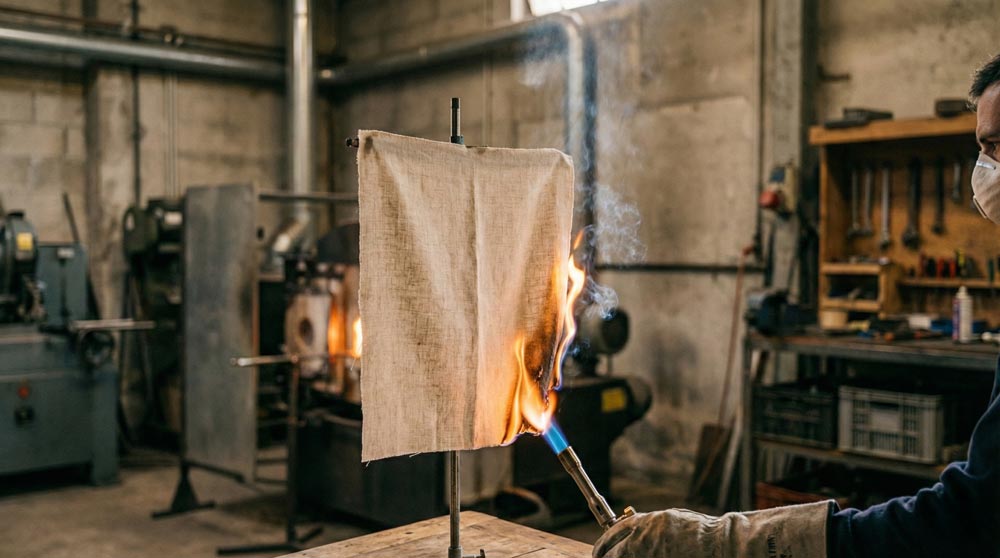
When buying velvet, look for these specific codes on the tag to ensure you are getting a safe product:
If you have your heart set on velvet, you have two main options for safety.
This is the gold standard. The fibers are made to be fire-resistant at a molecular level. The best part? You can wash these fabrics 100 times and they will still be fire-resistant. They are perfect for hotels and high-use areas.
You can spray or dip standard velvet in fire-retardant chemicals (often called “Topical FR”). This is cheaper but has a downside: the protection can wear off or wash away. If you dry clean or wash these fabrics, you usually have to re-apply the treatment.
If you are unsure if your velvet is safe, here is how to check.
Look for terms like “FR,” “IFR,” or “Fire Rated.” If the label says “100% Cotton” and doesn’t mention fire safety, assume it is highly flammable.
If you have a scrap piece of the fabric, you can perform a burn test outdoors. Hold a small strip with metal tongs and light the bottom corner with a lighter.
Safety Warning: Always perform burn tests outdoors over a bucket of water. Never test fabric that is already attached to furniture.
Velvet is a beautiful but complex fabric. Its “pile” structure makes it naturally more flammable than flat fabrics due to the “surface flash” effect. Cotton velvet is the most dangerous untreated type, while polyester is slightly safer because it melts. For the best safety, especially for curtains or commercial use, always choose Inherent Flame Retardant (IFR) velvet that meets standards like NFPA 701 or CAL 117. Checking the label and understanding the material is the best way to enjoy the luxury of velvet without the fire risk.
No, not automatically. Standard polyester will melt, but it can still support a flame. You must check if it has been specifically treated or manufactured as “Inherent Flame Retardant” to be truly safe.
It depends. If it is “Inherent” (IFR), yes, it stays safe after washing. If it has a “Topical” chemical coating, washing will likely remove the protection, and you will need to retreat it.
Because they hang vertically. This creates a “chimney effect” where the fire can quickly travel up the fuzzy surface of the fabric, reaching the top of a room in seconds.
Yes. Synthetic velvet (polyester/rayon) produces thick, black, toxic smoke when it burns or melts. Natural cotton velvet produces grey smoke that smells like burning paper.
Look for velvet that passes the CAL 117 or BS 5852 standards. Usually, a polyester velvet with a fire-resistant interliner underneath is the safest choice for home furniture.