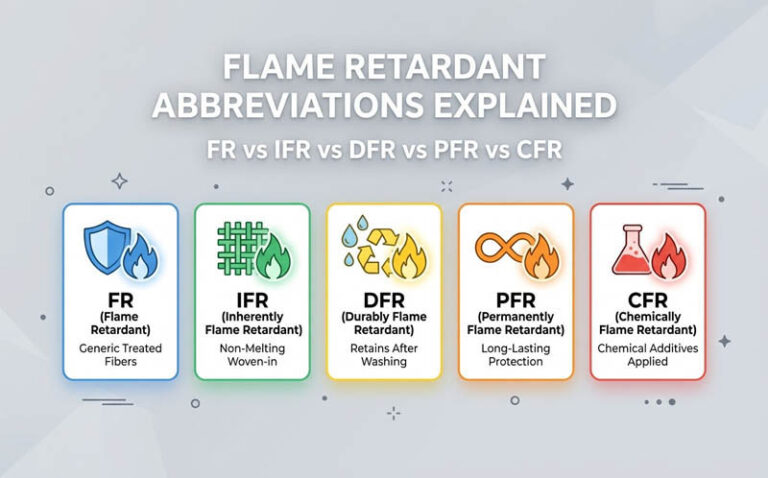
The commonly seen term “FR Fabric” stands for “Flame Retardant Fabric.” However, this article discusses an ambiguous aspect of “FR” because it also abbreviates Flame Resistant, Fire Resistant, Fire Retardant, and Flame Retardant, four terms that seem identical but have different meanings.
First, “Flame” refers to a flame, indicating small-scale combustion tests (with a small ignition source), while “Fire” denotes any combustion, reflecting larger-scale combustion tests (simulating real fire scenarios).
Next, the focus of this article is the distinction between “Retardant” and “Resistant,” or the difference between Flame Retardant and Fire Resistant.
“Retardant” literally means slow or delayed. Fire/Flame Retardant materials or components are designed to inhibit, slow down, or stop flame propagation, functioning primarily to “obstruct burning.” They are not meant to completely prevent flames but to decelerate their spread, reducing burn intensity. This often involves flame retardants in polymer plastics or textiles treated with flame-retardant coatings. The standard also considers whether the material self-extinguishes when removed from the flame.
“Resistant” means refusal or non-combustibility. Fire/Flame Resistant materials refer to products or components capable of maintaining stability, integrity, and insulation for a specified duration during standard fire-resistance tests. Fire-resistant materials emphasize the non-flammable nature of the material and its ability to retain properties under high temperatures.
Thus, a simple conclusion emerges: Flame Retardant fabrics allow combustion to some extent, unlike Fire Resistant fabrics.
In short:
Flame Retardant fabric is like applying a “brake” to fire, slowing its spread.
Fire Resistant fabric is akin to building a “wall” to block the fire’s advance.
We will discuss the differences between Flame Retardant Fabrics and Fire Resistant Fabrics from the following aspects: principles, classifications, applications, and examples.
1. Flame Retardant Fabrics
Flame Retardant fabrics are designed to “impede combustion.” Their purpose is not to stop fire entirely but to delay its spread and reduce burn intensity, offering valuable escape time.
Principles of Flame Retardant
Chemical Modification: The most common flame-retardant method involves adding specific flame-retardant chemicals (typically phosphorus-, halogen-, or nitrogen-containing compounds) to textile fibers to alter their combustion characteristics. These chemicals react under high temperatures.
Using Flame Retardant Fibers: Certain synthetic fibers, such as Begoodtex® Flame Retardant Fibers, aramids, and modified acrylics inherently exhibit flame retardancy due to their high thermal stability and resistance to burning, melting, or decomposition.
Categories of Flame Retardant Fabrics
Permanent Flame Retardant Fabrics: Achieve long-lasting flame-retardant properties through chemical modification or flame-retardant fibers. Performance remains effective even after multiple washes.
Non-Permanent Flame Retardant Fabrics: Treated with flame-retardant coatings that diminish after repeated washing.
Natural Fiber Flame Retardant Fabrics: Natural fibers like flame-retardant cotton and wool treated to resist fire.
Synthetic Fiber Flame Retardant Fabrics: Made from modified synthetic fibers such as flame-retardant polyester or nylon.
Applications of Flame Retardant Fabrics
Workwear: Used in hazardous industries like chemical plants, steel mills, and power plants to reduce fire risks.
Protective Clothing: Firefighters and welders wear flame-retardant gear for personal protection.
Children’s Sleepwear: Some countries require children’s pajamas to be flame-retardant by law.
Curtains: Flame-retardant curtains help prevent fire spread, allowing more time for escape.
Carpets: Flame-retardant carpets resist ignition and reduce smoke generation, improving visibility during fires.
Bedding: Hotels and public spaces may use flame-retardant bedding for safety.
Theater and Cinema Seats: Public venue seating often uses flame-retardant fabrics to minimize fire risks.
Aircraft and High-Speed Rail Interiors: Seats, curtains, and carpets in aircraft and trains typically use flame-retardant materials.
Tents: Outdoor camping tents use flame-retardant fabrics to reduce fire hazards from open flames.
Automobile Interiors: Flame-retardant materials are used in vehicle seats and carpets to enhance safety.
Examples of Flame Retardant Fabrics
Flame-Retardant Cotton: Treated cotton used in workwear, protective gear, and children’s sleepwear.
Flame-Retardant Polyester: Treated polyester used in curtains, upholstery, and vehicle interiors.
2. Fire Resistant Fabrics
Fire Resistant fabrics focus on “resisting flames,” designed to withstand extreme temperatures without burning, melting, or decomposing easily, offering advanced protection.
Principles of Fire Resistance
High-Temperature Materials: Made from materials with extremely high melting and decomposition points, maintaining chemical stability under high temperatures.
Special Weaving Structures: Some fire-resistant fabrics use unique weaves to enhance strength, abrasion resistance, and thermal performance.
Categories of Fire Resistant Fabrics
Inorganic Fire Resistant Fabrics: Made from materials like glass fiber, ceramic fiber, or metal fiber with high-temperature resistance and chemical stability.
Organic Fire Resistant Fabrics: Made from high-performance aramid or polyimide fibers, offering excellent flame resistance and mechanical strength.
Applications of Fire Resistant Fabrics
Firefighting Suits: Firefighters wear fire-resistant suits to protect against high temperatures and flames.
High-Temperature Protective Gear: Used in industries such as metallurgy, foundry, and glass manufacturing.
Welding Protection: Welders wear fire-resistant clothing or use protective aprons and gloves to prevent injuries from sparks and molten metal.
Spacesuits: Astronauts’ suits need extreme resistance to heat, radiation, and wear to ensure safety in space.
Industrial Furnaces: Insulation linings of furnaces and kilns use fire-resistant materials to reduce heat loss and enhance efficiency.
Examples of Fire Resistant Fabrics
Glass Fiber: Used for fire blankets, insulation, and high-temperature filters.
Metal Fiber: Utilized for high-temperature filtration and heating elements.
Carbon Fiber: High-strength, heat-resistant fiber used in high-temperature protective gear and aerospace materials.
Comparison Table
Feature
Flame Retardant Fabrics
Fire Resistant Fabrics
Main Function
Slow down combustion, delay flame spread
Withstand high temperatures, prevent flame penetration
Burning Behavior
Burns in flames, but slowly, self-extinguishes
Not easily burned, melted, or decomposed
Material
Combustible material treated or flame-retardant fibers
High-temperature resistant materials
Heat Resistance
General
Extremely high
Main Application
Daily clothing, furniture, home textiles, etc.
Firefighting suits, high-temperature protective clothing, aerospace, etc.
Durability
Some treatments may lose effectiveness after washing
Usually do not lose effectiveness due to washing
Summary
Flame Retardant Fabrics focus on slowing the spread of flames, typically achieved through chemical modification or flame-retardant fibers.
Fire Resistant Fabrics emphasize resisting flames and high-temperature damage, achieved using heat-resistant materials.
Flame Retardant Fabrics have broader applications, including everyday clothing and public spaces.
Fire Resistant Fabrics are used in specialized fields like firefighting, high-temperature industries, and aerospace.