Get in touch
Thank you for reaching out! Please tell us more about your needs — our expert team will get back to you within 24 hours.
Get in touch
Thank you for reaching out! Please tell us more about your needs — our expert team will get back to you within 24 hours.
Introduction: Flame Retardancy and Health Safety
In high-risk industries such as firefighting, metallurgy, rail transport, and oil refining, flame-retardant protective clothing is the first line of defense.
However, beyond resisting flames and heat, another question matters just as much:
Are these flame-retardant chemicals safe for the human body?
In the past, certain flame-retardant fabrics were criticized for using halogen-based chemicals that could be toxic.
Today, with advances in green chemistry and molecular material engineering, “flame-resistant” and “non-toxic” no longer conflict.
This article explores the full lifecycle of a flame-retardant garment — from fiber molecules and flame-retardant agents to testing standards and human health — to reveal the scientific truth behind “Flame-Resistant ≠ Toxic.”
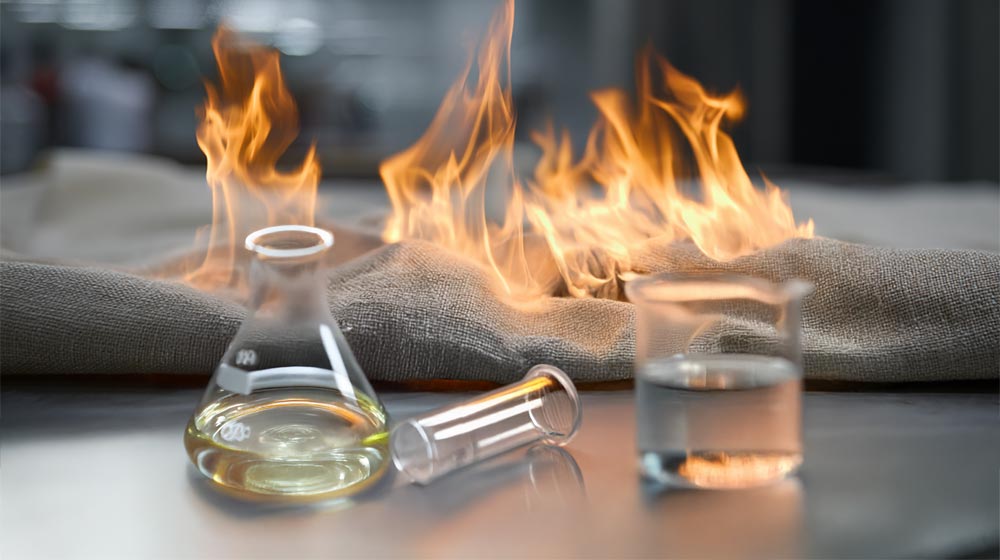
These fibers are naturally flame-resistant, with flame-retardant elements (phosphorus, nitrogen, aromatic rings) integrated directly into the polymer chain during synthesis.
When exposed to fire, the fibers carbonize rapidly, forming a protective char layer that blocks heat and oxygen.
Typical fibers: Aramid 1313, Aramid 1414, Modacrylic, FR Polyester
Advantages:
- Permanent flame resistance (won’t wash out)
- No chemical additives, odorless and non-toxic
- Combustion releases only CO₂ and water vapor (low toxicity)
These fabrics gain flame resistance through chemical finishing processes that modify the fiber surface or interior.
Common technologies: Proban® (THPC process) and Pyrovatex® (phosphorus–nitrogen crosslinking system)
Pros and Cons:
| Feature | Inherent FR (IFR) | FR-Treated |
|---|---|---|
| Flame source | Molecular structure | Surface or chemical finish |
| Wash durability | Permanent | Decreases after multiple washes |
| Chemical residue | None | Depends on formulation |
| Eco-safety | ✅ Halogen-free, formaldehyde-free | Requires certification |
| Cost | Higher | Lower |
| Applications | Firefighting, railway uniforms | Industrial workwear |
In the mid-20th century, flame retardancy relied heavily on halogenated compounds (chlorine, bromine).
They were highly effective but produced toxic smoke and persistent pollutants such as PBDEs, HBCD, and TDCPP — later proven carcinogenic and environmentally hazardous.
With stricter global regulations such as REACH (EU) and OEKO-TEX®, the industry has shifted toward halogen-free, low-smoke, eco-friendly flame retardant systems.
| Retardant Type | Representative Compounds | Characteristics | Safety |
|---|---|---|---|
| Halogen-based | PBDEs, TDCPP | High efficiency, high toxicity | ❌ Banned |
| Phosphorus–Nitrogen | APP, Pyrovatex®, DOPO | Halogen-free, low smoke, durable | ✅ Mainstream |
| Inorganic | ATH, MDH | Non-toxic, releases water when heated | ✅ Safe but affects hand feel |
| Nitrogen-based | Melamine, MCA | Stable, low toxicity | ✅ Safe |
| Inherent structure | Aramid, FR Polyester | Built-in molecular protection | ✅ Optimal solution |
In short:
The industry has evolved from “chemical coating” to molecular-level flame resistance, integrating fire safety and environmental health.
The key to safety lies in one word — compliance.
Safety Compliance Checklist:
| Test Item | Standard | Safe Limit |
|---|---|---|
| Formaldehyde content | GB 18401 Class A | ≤ 75 mg/kg |
| Aromatic amines | OEKO-TEX® | Not detectable |
| pH value | GB 18401 | 4.0–7.5 |
| Smoke toxicity | BS 6853 / NES 713 | Meets low-toxicity standards |
| Heat transfer index | NFPA 2112 | ≥ 24 |
| Char length | ISO 15025 | ≤ 100 mm |
Conclusion:
Certified flame-retardant clothing is safe for long-term skin contact without harmful effects.
| Category | Standard | Description |
|---|---|---|
| Flame resistance | ISO 11612 / NFPA 2112 / GB 8965.1 | Heat, molten droplets, and limited flame testing |
| Chemical safety | OEKO-TEX® 100 / REACH / GB 18401 | No harmful substances; skin contact safety |
| Smoke toxicity | NES 713 / BS 6853 / DIN 5510 | Control of smoke and combustion toxicity |
| Child safety | CFR 1615/1616 | U.S. standard for children’s sleepwear |
| Comfort & usability | EN ISO 13688 | Sizing, pH, breathability, labeling |
A garment that passes ISO 11612 and OEKO-TEX® 100
guarantees both fire protection and human safety.
At the Begoodtex® Functional Fiber Laboratory, flame retardancy is not a surface treatment —
it is a molecular design philosophy.
By incorporating phosphorus–nitrogen units directly into polyester chains, Begoodtex® fabrics achieve:
Our philosophy:
Flame Retardant ≠ Chemical Coating
Flame Retardant = Molecular Safety
A: Certified fabrics under OEKO-TEX® or REACH are non-toxic and safe for skin contact.
A: Halogen-based compounds such as PBDEs and TDCPP are banned globally.
A: Check for OEKO-TEX® certification or compliance with GB 18401 and ISO 11612.
A: Inherent FR fibers maintain performance permanently; treated fabrics may weaken with washing.
A: OEKO-TEX® Standard 100, Global Recycled Standard (GRS), and ISO 9001.
A: Yes. Class II and III certified fabrics are approved for direct skin contact.
BEGOODTEX® Functional Fabric Series
Safety Woven into Every Fiber.
Learn more about advanced flame-retardant fabrics — contact the Begoodtex® Technical Team today.