Get in touch
Thank you for reaching out! Please tell us more about your needs — our expert team will get back to you within 24 hours.
Get in touch
Thank you for reaching out! Please tell us more about your needs — our expert team will get back to you within 24 hours.
In the UK Contract Textiles market, BS 5867-2 is the core standard determining the compliance of curtain fabrics. Within this standard, BS 5867-2 Type C represents the highest safety classification available. It is the mandatory “Gold Standard” for NHS hospitals, care homes, and high-risk commercial spaces. This guide provides a deep dive into the technical requirements of Type C, its essential differences from Type B, and the rigorous logic behind the 50-wash cycle test.
BS 5867-2 Type C is the highest flame retardant rating for curtains and drapes in the UK. Its core definition is “a fabric that retains rapid self-extinguishing properties after 50 industrial wash cycles.”
Unlike lower standards that require only basic testing, Type C ensures that a fabric maintains its flame retardant performance throughout its entire lifecycle, regardless of frequent high-intensity laundering. It requires that, after exposure to flame, the mean afterflame time must be less than 2.5 seconds, and damage must not spread to the edges. This makes it the only viable choice for environments that cannot tolerate any fire risk.
The most common point of confusion in engineering procurement is between Type B and Type C. The fundamental difference lies not in “whether it is flame retardant,” but in the “durability of the retardancy” and the “speed of self-extinguishing.”
| Comparison Dimension | Type B (Standard Durability) | Type C (High Risk / Maximum Safety) |
|---|---|---|
| Applicable Scenarios | Hotels, Offices, Schools, General Public Buildings. | NHS Hospitals, Care Homes, Prisons, Mental Health Units, Offshore Facilities. |
| Pre-treatment (Laundering) | Usually tested after 12 standard wash cycles (BS EN ISO 10528). | Must be tested after 50 industrial wash cycles (BS EN ISO 10528). |
| Ignition Times Tested | 15 seconds only. | 5s, 15s, 20s, and 30s (Multi-point testing). |
| Afterflame Limit | No specific time limit, provided the flame does not reach the edges. | Rapid Self-Extinguishing: Mean afterflame time must be ≤ 2.5 seconds. |
| Fabric Recommendation | Can be FR Treated (Chemical finish), which may degrade over time. | Typically must be IFR (Inherently Flame Retardant), such as Trevira CS or Modacrylic, to ensure physical properties remain intact. |
The strict requirements imposed by the NHS and care institutions on curtain fabrics are driven by a dual consideration of Infection Control and Evacuation Tolerance.
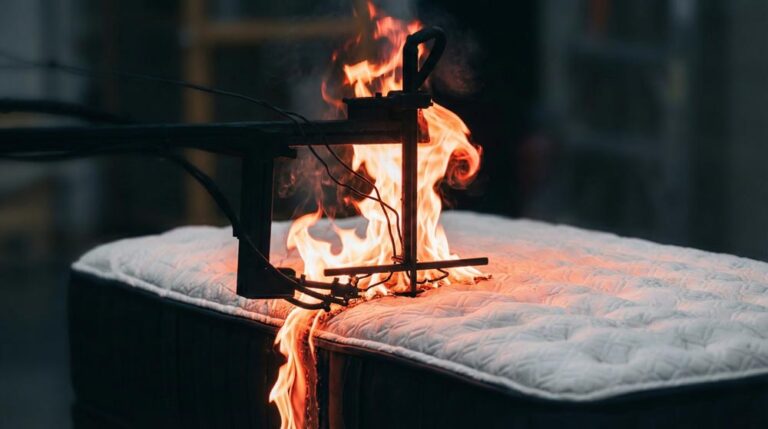
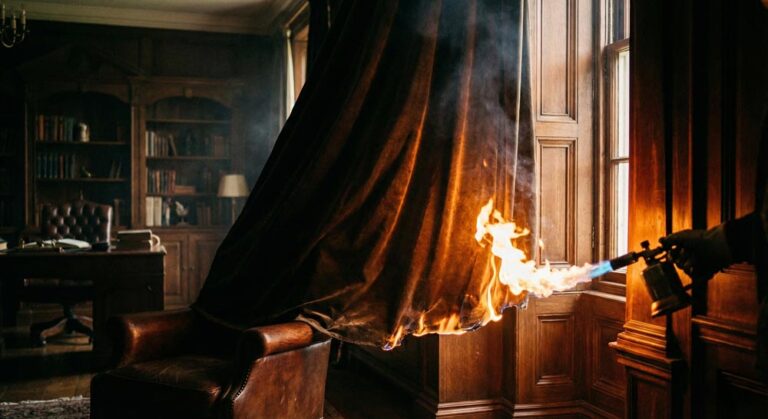
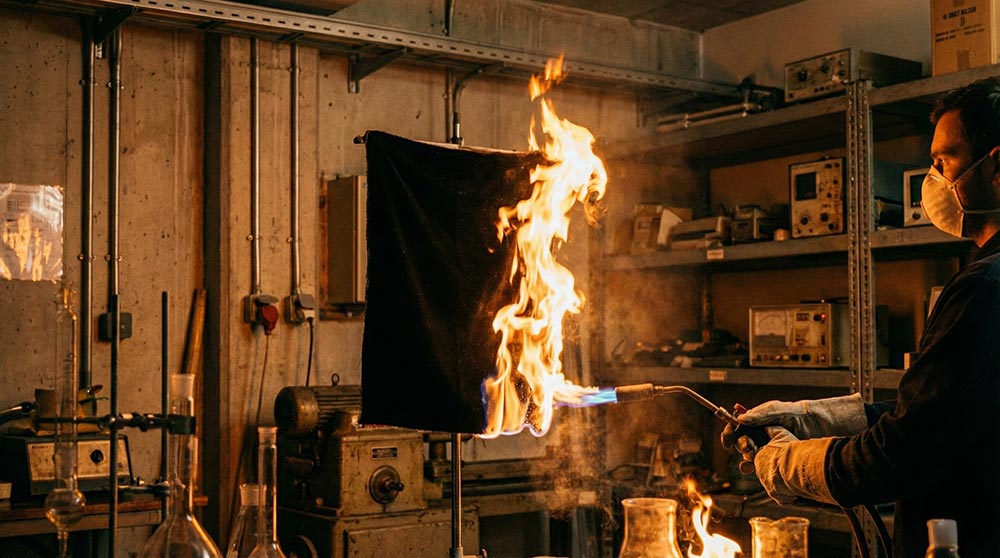
The testing process for Type C is executed according to BS EN ISO 15025 (Limited Flame Spread) and must be conducted after rigorous “pre-treatment.” Below are the three critical stages:
This is the litmus test that separates “true” Type C from the rest. All fabrics claiming Type C compliance must first undergo 50 complete washing and drying cycles according to BS EN ISO 10528. If the fabric is not washable, it must undergo equivalent dry-cleaning cycles. Any cheap FR fabric relying on surface coatings will typically fail at this stage due to the chemical washout.
Using the face ignition method (vertical suspension), a propane burner is applied directly to the fabric surface. Unlike Type B, which tests only at 15 seconds, Type C must pass testing at four distinct ignition times:
After the removal of the ignition source at any of the above times, the fabric must meet all of the following conditions to achieve Type C certification:
According to the BS 5867-2:2008 specification, compliance is not just about a test report. All Type C curtains installed on-site must bear a permanent label clearly stating:
Expert Tip: If a Fire Officer inspecting the premises finds curtains missing this label, you face a high risk of being issued a rectification notice, even if you can produce a paper test report.
Targeting the UK high-end healthcare and contract markets, we offer a full range of BS 5867 Type C compliant solutions. All products are tested by UKAS-accredited laboratories and guaranteed to retain FR performance after 50 washes.
Need to view specific specs or request samples?
A: No, they are not equivalent and cannot be used interchangeably. While NFPA 701 is a US standard for flame retardancy, its testing methodology (particularly regarding wash cycles) differs from BS 5867. Type C mandates performance retention after 50 wash cycles, which is significantly more rigorous regarding durability than the standard NFPA 701 Method 1. For UK projects, Fire Officers typically only accept BS 5867 certificates.
A: No, Type C is primarily designed for water washing. The standard was established to accommodate the high-frequency water washing and disinfection required in healthcare environments. Genuine Type C fabrics (usually IFR Polyester) can withstand standard 40°C – 75°C industrial water washes. This is a massive advantage for cost-sensitive care homes, as water washing is far cheaper than dry cleaning.
A: Check the “Wash Cycles” and “Afterflame Time”. Look at the details page of the laboratory report: 1. Wash Cycles: A Type C report must state “Tested after 50 wash cycles”. If it only states 12 cycles or “Cleaned as per instructions,” it is likely only Type B. 2. Afterflame Conclusion: A Type C report will explicitly record the afterflame time, with a conclusion of Pass (≤ 2.5s).
A: Yes. Type C is the highest level of the standard. If a fabric can pass the rigorous testing after 50 washes, it naturally meets the requirements for Type B (12 washes). Therefore