Get in touch
Thank you for reaching out! Please tell us more about your needs — our expert team will get back to you within 24 hours.
Get in touch
Thank you for reaching out! Please tell us more about your needs — our expert team will get back to you within 24 hours.
BS 7177 is the core technical specification for mattress and bed base fire safety in the United Kingdom, directly determining whether a product can legally enter the UK domestic and contract markets. For furniture manufacturers, hotel procurement teams, and international traders, a deep understanding of this standard is critical. This article provides a detailed, rigorous industry guide to BS 7177, analyzing the risk classification system, the reality of Crib 5 testing, labeling specifications, and fabric selection strategies from a professional compliance perspective.
BS 7177, fully titled “Specification for resistance to ignition of mattresses, mattress pads, divans and bed bases,” is the primary fire safety standard for sleeping furniture in the UK. It operates in conjunction with the Furniture and Furnishings (Fire) (Safety) Regulations 1988 and the Regulatory Reform (Fire Safety) Order 2005. This standard is not merely a testing manual but a rigorous risk-based classification system based on end-use environments. Its core logic dictates that products must resist specific ignition source intensities corresponding to the fire risk level of their intended location (e.g., homes, hotels, prisons).

BS 7177 clearly defines its jurisdiction, primarily targeting the main components of sleeping support structures. The standard does not cover all textiles on a bed; rather, it strictly targets those containing flammable filling that could constitute a significant Fuel Load. The specific scope is as follows:
The following products are mandatorily required to comply with BS 7177:

To avoid compliance errors, it must be clarified that the following products are not governed by BS 7177:
BS 7177 categorizes application scenarios into four levels: Low, Medium, High, and Very High Hazard. This classification is the core basis for procurement specifications. Any mattress product entering the UK market must clearly state the hazard category it complies with.
| Hazard Category | Typical Application Scenarios | Required Test Ignition Sources |
|---|---|---|
| Low Hazard | Domestic dwellings, non-motorized caravans, domestic guest rooms. | Must pass BS EN 597-1 (Source 0: Cigarette) and BS EN 597-2 (Source 1: Match). |
| Medium Hazard | Hotels, Hospital general wards, Care Homes, Boarding schools, University halls of residence, Holiday camps. | In addition to Source 0 and Source 1, must pass BS 6807 Source 5 (Crib 5). |
| High Hazard | Specific hospital wards (e.g., high-dependency units), offshore installations, high-risk hostels. | In addition to Source 0 and Source 1, must pass BS 6807 Source 7 (Crib 7). |
| Very High Hazard | Prisons, Locked psychiatric units, Police custody cells. | Must pass Source 0, Source 1, and Source 7. May require additional anti-vandal or tear-resistance testing based on project specs. |
As a specification document, BS 7177 dictates “what to test,” while the specific “how to test” procedures are referenced from three core method standards: BS EN 597-1, BS EN 597-2, and BS 6807. Testing is typically conducted in controlled laboratories using finished mattresses or scaled-down Test Rigs.
BS 7177 employs a “Pass/Fail” binary mechanism rather than a numerical score. Testers focus on the product’s “Ignitability” and “Self-extinguishing capability.”
The primary criteria for a pass include:
Understanding the distinction between BS 7177 and other British Standards is crucial for project procurement. These standards govern different areas of soft furnishings and cannot be interchanged.
| Comparative Standard | Core Difference Explained |
|---|---|
| VS BS 5852 (Upholstery) | BS 5852 applies to upholstered seating (sofas, chairs). While both use the Crib 5 source, BS 7177 is designed for horizontal mattress structures with different test positioning and failure criteria. A BS 5852 certificate cannot substitute for a mattress certificate. |
| VS BS 5867 (Curtains) | BS 5867 applies to curtains and drapes, utilizing vertical flammability testing methods. For hotel procurement, valid certificates for both BS 7177 (Beds) and BS 5867 (Curtains) must be provided separately. |
Procurement officers must strictly enforce BS 7177 hazard classifications based on the Premises Type. Purchasing the wrong grade poses severe legal compliance risks.
To pass the BS 7177 Crib 5 or Crib 7 tests, the fabric and filling must function as an integrated system. Technical requirements for the fabric focus heavily on char formation and durability.
Manufacturers and traders often fall into compliance traps due to incomplete understanding of the clauses. The following are two critical misconceptions that must be corrected.
A: A compliant label must include: A clear statement of hazard classification (e.g., “Resistant to ignition source 5”), the specific graphic symbol (Blue for Low Hazard, Red for Medium/High Hazard), the manufacturer’s name and address, batch ID/production date, and a declaration regarding whether the fabric is “FR Treated” or “Inherently FR”.
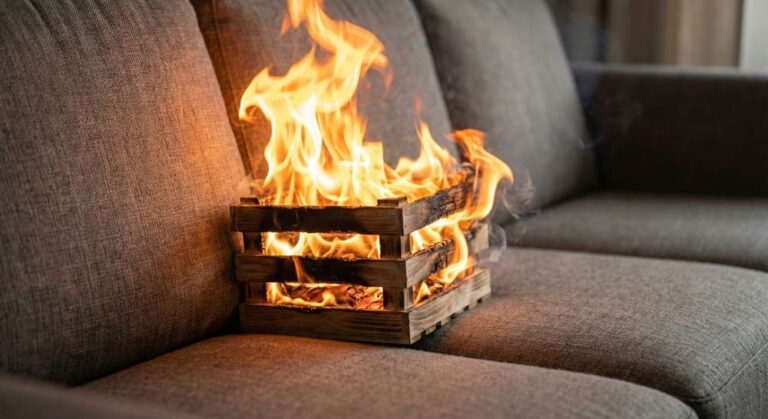
A: They refer to the same thing. “Source 5” is the ignition source number in the BS 7177 standard, while “Crib 5” describes the physical form of that source (a 5-tier wooden crib made of 20 sticks). The terms are used interchangeably in commercial contracts.
A: Generally, if only the color changes while the fiber composition, weight, and FR treatment process remain identical, it may be considered the same product range. However, if the color change involves different dye chemistries or slight structural weaves that could alter flammability, a verification test is strictly recommended to ensure continued compliance.
A: Yes. Under fire safety regulations, Care Homes are classified as Medium Hazard premises. Given the limited mobility of residents and potential risks (e.g., smoking in bed), the use of mattresses passing the Crib 5 test is mandatory.
A: They can pass the initial test. However, for commercial applications (especially hotels), wash durability must be considered. If the FR treatment is not durable, the flame retardancy may wash out over time, rendering the product non-compliant. Therefore, Inherently FR materials are often the superior choice for contract use.