Get in touch
Thank you for reaching out! Please tell us more about your needs — our expert team will get back to you within 24 hours.
Get in touch
Thank you for reaching out! Please tell us more about your needs — our expert team will get back to you within 24 hours.
CAN/ULC-S109 is the mandatory flame test standard for fabrics and films used within buildings and specific outdoor structures in Canada. Developed by ULC Standards (Underwriters Laboratories of Canada) and directly referenced by the National Building Code of Canada, this standard assesses the flame propagation characteristics of materials when exposed to flame sources of varying intensities.
The full title of CAN/ULC-S109 is the Standard Method for Flame Tests of Flame-Resistant Fabrics and Films. Within the Canadian regulatory framework, it stands as a standard with independent jurisdiction. Unlike American standards, CAN/ULC-S109 serves as the primary basis for textile compliance in public spaces under Federal and Provincial Fire Codes. Products that fail to meet this standard are typically legally prohibited from installation in Canadian hotels, schools, theaters, or places of public assembly.
CAN/ULC-S109 defines a dual-test procedure designed to measure the flame resistance of textiles and films in a vertical orientation. The standard does not evaluate toxicity or smoke generation; instead, it focuses on three core physical metrics: Afterflame (time the material continues to burn after the ignition source is removed), Damaged Length (length of char or destruction), and Flaming Drippings (whether molten residue ignites the floor). Its core logic involves evaluating fire safety through two simulated scenarios: a small ignition source (e.g., a match) and a large ignition source (e.g., a wastebasket fire).
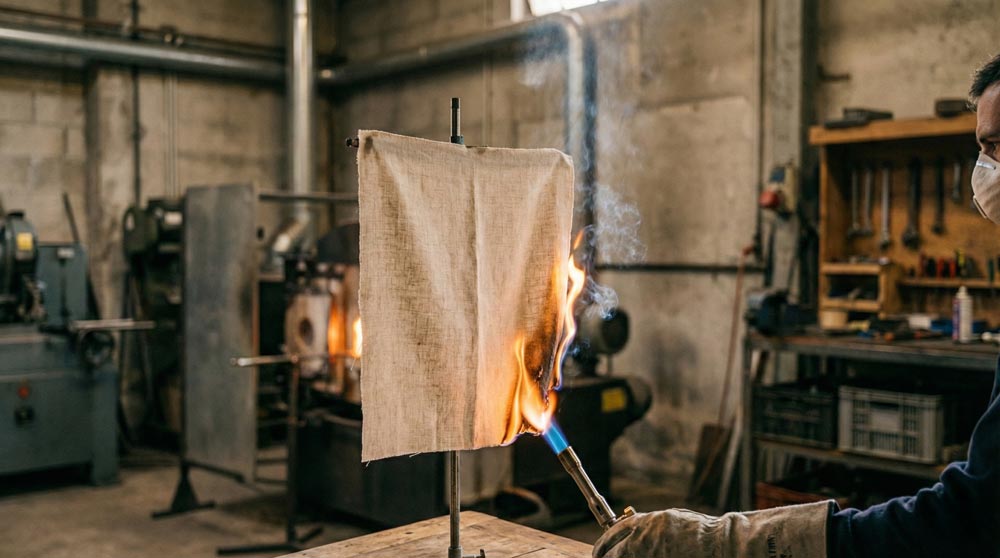
The standard explicitly applies to soft materials used in a vertical orientation or as coverings within places of Public Assembly. If a product falls into the following categories, compliance with CAN/ULC-S109 is generally mandatory:
CAN/ULC-S109 does not utilize an “A/B/C” classification system similar to ASTM E84; instead, it operates on a strict “Pass/Fail” model. The standard comprises two independent test procedures. Most curtains and decorative fabrics are required to pass both procedures to ensure safety across different fire scales:
Testing must be conducted in a controlled laboratory environment, covering samples in both the warp (machine) and weft (cross) directions. The specific test parameters are as follows:
A product must simultaneously meet all the following quantitative metrics to be deemed compliant. Exceeding the limit value in any single category results in a failure.
| Test Type | Metric | Maximum Allowable Limit |
|---|---|---|
| Small-Flame Test | Afterflame Time (Single Specimen) | 2.0 Seconds |
| Small-Flame Test | Flaming Drippings | Residue shall not burn on the floor for more than 2.0 Seconds |
| Small-Flame Test | Average Damaged Length (10 Specimens) | 165 mm |
| Small-Flame Test | Maximum Damaged Length (Single Specimen) | 190 mm |
| Large-Flame Test | Afterflame Time (Single Specimen) | 2.0 Seconds |
| Large-Flame Test | Flaming Drippings | Residue shall not burn on the floor for more than 2.0 Seconds |
| Large-Flame Test | Damaged Length – Flat Specimen | 250 mm |
| Large-Flame Test | Damaged Length – Folded Specimen | 635 mm |
Although CAN/ULC-S109 and the US NFPA 701 standard share similar testing principles, significant differences in test configuration and strictness exist, meaning certificates are generally not interchangeable.
| Comparison Dimension | CAN/ULC-S109 (Canada) | NFPA 701 (USA) |
|---|---|---|
| Test Combination | Usually mandates both Small-Flame and Large-Flame tests simultaneously. | Selects either Method 1 or Method 2 based on fabric density/use; rarely requires both. |
| Folded Testing | Mandatory testing of folded specimens in the Large-Flame test; high difficulty. | Method 1 excludes folded testing; only Method 2 involves a similar concept. |
| Damage Criteria | Extremely strict millimeter-level limits for the Small-Flame test. | Method 1 relies on weight loss percentage; Method 2 relies on char length; relatively more lenient. |
| Territorial Validity | Mandatory standard across Canada. | US Standard; accepted in Canada only at the discretion of specific local authorities. |
According to Canadian provincial fire codes, fabrics within any facility classified as “Public Assembly” must hold a CAN/ULC-S109 certificate. Typical scenarios include:
Fabrics submitted for CAN/ULC-S109 testing must demonstrate flame resistance not only in their original state but also after cleaning or weathering. The standard prescribes specific sample preparation protocols:
When implementing the CAN/ULC-S109 standard, buyers and suppliers often confuse scope and certificate validity. The following technical misconceptions require correction:
A: The standard itself does not specify a hard expiration date. However, Authorities Having Jurisdiction (AHJ) typically require reports issued within the last 1 to 3 years to ensure the tested sample represents current production quality. If the manufacturing process or raw materials change, re-testing is mandatory immediately.
A: Yes. Inks, dyes, and transfer papers are often flammable chemicals. A base fabric that passed the test may fail after being printed. Therefore, the standard requires the final product (after printing or dyeing) to be tested to ensure the added chemicals have not compromised flame resistance.
A: No. The Large-Flame test requires specimens that are 750mm long, and the folded test requires wide panels to form the necessary layers. An A4 sample is insufficient for the mandatory testing configuration. Full-width yardage is required.
A: If the fabric is FR treated (chemically coated), it may be possible to re-treat the material with a higher concentration of flame retardant and re-test. However, if the fabric is an untreated natural fiber (like standard cotton or linen) without any chemical finish, it will almost certainly fail; it cannot pass without the application of an FR treatment.
A: Generally, the National Building Code does not mandate S109 for single-family private residences. However, it is mandatory for high-density residential buildings (such as condos or apartments) in common areas like lobbies and corridors, as well as for all commercial and public institutional buildings.