Get in touch
Thank you for reaching out! Please tell us more about your needs — our expert team will get back to you within 24 hours.
Get in touch
Thank you for reaching out! Please tell us more about your needs — our expert team will get back to you within 24 hours.
Introduction
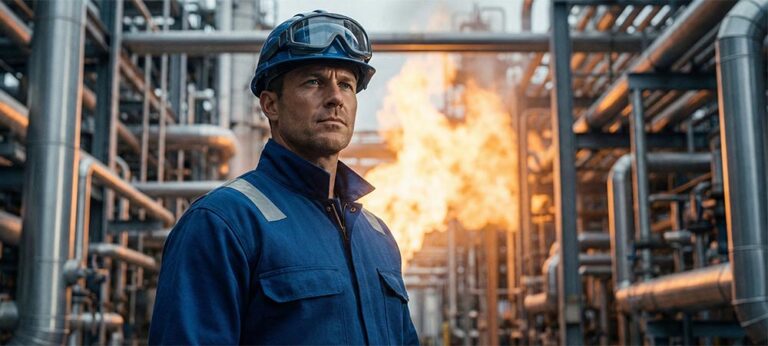
In high-risk industries such as electricity, welding, petrochemicals, and metallurgy, protective clothing is the last line of defense for workers against thermal hazards. The core value of a qualified protective suit lies not only in its instantaneous flame resistance but also in its comfort during daily wear and durability over long-term use. If protective clothing is stuffy and stiff, workers may wear it less frequently or incorrectly due to discomfort, rendering the safety protection ineffective.
Therefore, finding a fabric that combines excellent protection, high comfort, and economic benefits has become a core demand in the industry. Cotton flame-retardant fabric, with its unique concept of “flexible protection,” stands out among many materials as the ideal choice for balancing safety, comfort, and cost.

| Comparison Item | Cotton Flame-Retardant Fabric | Synthetic Flame-Retardant Fabrics (Polyester/Nylon, etc.) |
| Reaction to Fire | Rapidly carbonizes to form an insulating layer, does not melt, no molten drips. | Molten drips may cause secondary burns to the skin. |
| Breathability | Excellent, keeps skin dry. | May cause heat buildup. |
| Moisture Absorption | Good, can absorb sweat. | Feels sticky when worn. |
| Feel Against Skin | Soft and natural, good skin-friendliness. | Easily rubs against the skin. |
| Long-Term Wearing Experience | Comfortable, no stuffiness or stickiness, suitable for long hours of work. | Prone to sweating and heat retention. |
The fundamental logic of protection lies in effectively responding to flame and high-temperature threats. The protective mechanism of cotton flame-retardant fabric is not about “brute force” resistance with heavy materials, but rather about actively building a safety barrier through the fiber’s internal chemical reactions.
Unlike synthetic fibers such as polyester and nylon, which melt and produce molten drips when exposed to heat, cotton fibers rapidly dehydrate and carbonize upon contact with flames, forming a dense char layer. This char layer serves two key functions:
To impart stable and reliable flame retardancy to cotton fibers, mature finishing technologies such as Proban® and Pyrovatex® CP New are widely used in the industry. These technologies create a durable phosphorus-nitrogen polymer inside the cotton fibers through a chemical reaction, making the flame-retardant property a part of the fiber itself.
Treated fabrics exhibit the following performance in flame tests:
These performance characteristics ensure full compliance with major international standards such as NFPA 2112 (Standard on Flame-Resistant Garments for Protection of Industrial Personnel Against Flash Fire) and EN ISO 11612 (Protective clothing – Clothing to protect against heat and flame).
The effectiveness of personal protective equipment (PPE) depends not only on its performance in extreme conditions but also on whether it is used correctly and consistently in daily work. In reality, because protective clothing can be stuffy, stiff, and non-breathable, workers often unbutton their collars, roll up their sleeves, or even take it off altogether, rendering even the most advanced protection useless.
The natural properties of cotton fiber perfectly address this pain point.
| Comparison Item | Cotton Flame-Retardant Fabric | Polyester/Nylon Flame-Retardant Fabric |
| Breathability | ●●●●● | ●● |
| Moisture Absorption | ●●●● | ●● |
| Feel Against Skin | Soft and natural | Slightly stiff, stuffy |
| Long-Term Wearing Experience | Comfortable, no sticky feeling | Prone to sweating and heat buildup |
In high-temperature work environments such as welding, electrical inspections, or petrochemical operations, cotton fabric effectively wicks away moisture and heat, keeping the body dry. This greatly enhances long-term wearability and operational flexibility, transforming safety protection from a “burden” into a sustainable “habit.”
As frequently used equipment, whether the protective performance of a garment diminishes with repeated washing is a key measure of its long-term value. With common coating or immersion flame-retardant treatments, the fire-retardant agent on the surface can easily be lost during washing.
The advanced nature of Proban® and Pyrovatex® CP New technologies lies in the fact that they are not simply applied to the fiber’s surface. Instead, they form a stable phosphorus-nitrogen covalent bond structure within the cotton fibers. This deep integration means the flame-retardant component becomes a part of the fiber, giving it excellent wash durability.
Authoritative test data shows that even after 50 industrial wash cycles, cotton flame-retardant fabric can still maintain a stable performance of 0 seconds afterflame and less than 2 seconds afterglow, continuously meeting international standard requirements. This proves it is a reliable piece of long-term protective equipment, not a disposable or short-term emergency item.
In modern corporate management, production safety and environmental protection are inextricably linked. From raw materials to production processes, cotton flame-retardant fabric reflects a commitment to environmental responsibility.
In real work environments, risks are often multi-dimensional. Besides flames, workers may face multiple threats such as static electricity, oil stains, liquid chemicals, and ultraviolet radiation. The excellent physical properties and potential for chemical modification make cotton flame-retardant fabric an ideal “base material” for integrating multiple protective functions.
Through composite finishing technologies, it is possible to achieve:
This powerful functional extensibility allows it to flexibly meet the diverse and personalized protection needs of various industries, including electricity, chemical, metal processing, and emergency rescue.
Although inherently flame-retardant fibers like aramid (e.g., Nomex®) and PBI offer top-tier high-temperature resistance, their high cost limits their application in a wider range. Protection should not be a luxury.
With mature production processes and a stable supply of raw materials, cotton flame-retardant fabric achieves excellent cost control while ensuring that its protective performance meets the standards.
| Item | Cotton Flame-Retardant Fabric | Aramid-Type Inherently Flame-Retardant Fabric |
| Cost Per Meter | Lower | Higher (Typically 3–5 times that of cotton) |
| Flame Retardancy Level | High (Meets mainstream standards like EN ISO 11612) | Extremely High (Suitable for extreme high-temperature environments) |
| Wearing Comfort | Excellent, breathable and moisture-wicking | Average, slightly less breathable |
| Life Cycle Cost | Excellent Performance, low procurement and maintenance costs | High initial investment cost |
Its durability, wash-resistance, and ease of maintenance further reduce the long-term protection costs for enterprises, making high-quality safety protection accessible to more frontline workers and achieving the universal value of safety.
A: Cotton flame-retardant fabric obtains its flame retardancy through a finishing treatment. Its FR performance is durable for the effective service life of the garment. The core differences between it and aramid (inherently flame-retardant fiber) are:
Different Principles: Aramid fibers are inherently resistant to high temperatures by their very nature; FR cotton acquires its flame retardancy through chemical finishing.
Different Focus: Aramid offers superior protection in extreme high temperatures but is expensive and offers average comfort. FR cotton provides adequate protection while having significant advantages in comfort and cost-effectiveness.
A: Yes. FR cotton fabric of a specific weight and finish can provide arc flash protection. FR cotton protective clothing that has been tested according to ASTM F1959 to obtain an ATPV (Arc Thermal Performance Value) and meets the requirements of NFPA 70E (Standard for Electrical Safety in the Workplace®) can effectively mitigate the burn risks associated with an arc flash explosion.
A: It is recommended to follow the washing instructions on the garment’s label. Generally, you should avoid using chlorine bleach and fabric softeners, as they can affect the flame-retardant performance. It is advisable to use a neutral detergent and wash at a water temperature not exceeding 60°C, either in an industrial or home laundry setting. Proper maintenance can ensure stable performance for a service life of 1-2 years or even longer.
A: This is mainly due to two aspects: First, cotton is a natural, renewable, and biodegradable plant fiber. Second, modern flame-retardant processes use eco-friendly, halogen-free, and low-formaldehyde chemicals, and are certified by standards like OEKO-TEX®, ensuring the product is safe and harmless to both people and the environment.
A: You should focus on the following points:
Flame-Retardant Standards: Whether it is certified to industry standards like EN ISO 11612, NFPA 2112.
Wash Durability: Whether the FR performance still meets the standard after 50 or 100 industrial washes.
Environmental Certifications: Whether it has certifications like OEKO-TEX® Standard 100.
Multi-Functionality: Whether it provides additional functions as needed, such as anti-static or oil and water repellency.
In the true philosophy of protection, safety is not cold isolation but a warm guardianship. The value of cotton flame-retardant fabric lies not only in the moment of “fire protection” but also in making protective clothing an extension of the wearer’s body—lightweight, reliable, eco-friendly, and sustainable.
BEGOODTEX always places “Safety, Comfort, Eco-friendliness, and Durability” at the core of its product development. Through a global certification system and sustainable production standards, we provide trustworthy, high-performance flame-retardant solutions to protective clothing manufacturers worldwide.