Get in touch

Thank you for reaching out! Please tell us more about your needs — our expert team will get back to you within 24 hours.

弹窗表单

EN 1021: EU Furniture Upholstery Fire Test Standard

DIN EN 1021 (EN 1021) is one of the most critical fire safety standards for upholstered furniture in Europe. It is designed to assess the flammability of fabric and filling combinations (composites) when exposed to common ignition sources—such as cigarettes and match flames—serving as the fundamental safety threshold for entering the EU market.

What Is the EN 1021 Standard?

EN 1021 is a technical benchmark used to evaluate the ignitability of upholstered furniture materials. While often referred to simply as the “European Standard,” it acts as the mandatory entry requirement for most EU countries’ fire safety regulations.

ℹ️ Understanding the Terminology (Nomenclature)

In technical documents and tender specifications, you may see this standard referred to by different names. They all refer to the same technical standard:

  • EN 1021: The general European abbreviation.
  • DIN EN 1021: The German adoption of the standard (Deutsches Institut für Normung).
  • DIN EN 1021 Teil 1 / Teil 2: “Teil” is the German word for “Part”. If you see “Teil 1” in a report, it is identical to “Part 1”.

The standard is divided into two distinct parts, each testing against a specific ignition source:

  • EN 1021-1 (Part 1 / Teil 1): Smouldering Cigarette Test – Simulates a smouldering ignition source without open flame.
  • EN 1021-2 (Part 2 / Teil 2): Match Flame Equivalent Test – Simulates a small open flame ignition source.

Scope of Application:

  • Domestic Furniture: Sofas, upholstered chairs for home use.
  • Commercial/Office Furniture: Office chairs, task seating, conference room furniture.
  • Public Seating (Contract): Airport seating, hospital patient chairs, theater seats, school furniture.
  • Hospitality: Hotel lobby sofas, upholstered headboards, guest room furniture.

Core Testing: Part 1 vs. Part 2

Understanding the specific procedures and pass/fail criteria is essential for buyers. Tests are typically conducted using standard PU Foam (Polyurethane Foam) as the substrate.

1. EN 1021-1: The Cigarette Test

Scenario: Simulates a lit cigarette accidentally falling into the crevice of a sofa or chair.

  • Procedure: A lit standard cigarette is placed in the junction between the seat and backrest of the test rig and allowed to burn its full length.
  • Pass Criteria:
    • No Spread: Combustion must not spread to the edges of the test rig or burn through to the padding.
    • No Progressive Smouldering: All smouldering must cease within 60 minutes (1 hour) of the start of the test.
    • No Open Flame: No flaming ignition is allowed at any point.
  • Difficulty: Low. Most heavyweight fabrics or natural blends pass this naturally.
EN 1021-1 Cigarette Test

2. EN 1021-2: The Match Test

Scenario: Simulates a lighter or a burning match accidentally contacting the furniture.

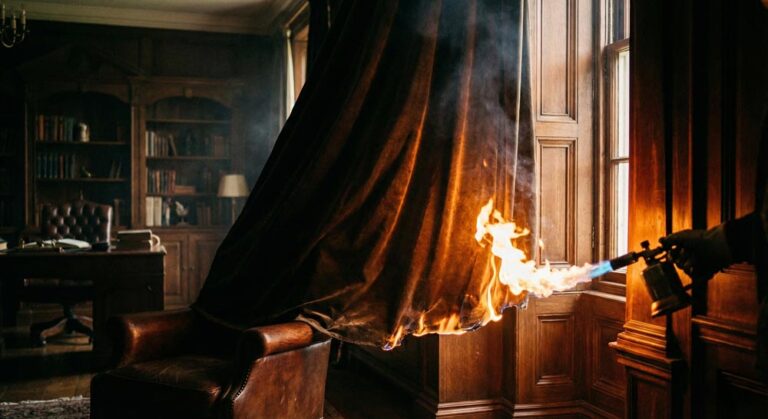
  • Procedure: A butane gas flame (approx. 35mm high, simulating a match’s heat output) is applied directly to the fabric surface/crevice for 15 seconds, then removed.
  • Pass Criteria:
    • Self-Extinguishing: Any flame on the fabric must self-extinguish within 120 seconds (2 minutes) after the removal of the ignition source.
    • No Burn-Through: The flame must not burn through into the filling material or spread to the edges.
  • Difficulty: Medium. Typically requires fabrics with IFR (Inherently Flame Retardant) properties or chemical FR treatment.

Key Differences: EN 1021 (EU) vs. UK & US Standards

A common purchasing mistake is confusing standards from different regions. Below is a comparison between DIN EN 1021, the UK’s BS 5852, and US standards:

Standard SystemDIN EN 1021-1/2BS 5852 (Crib 5)CAL TB 117 / NFPA 260
RegionEU (Germany, France, Italy, etc.)United Kingdom (UK)United States (USA)
StrictnessMedium (Baseline)Very High (High Hazard)Medium (Focus on Smouldering)
Ignition SourceCigarette + Match FlameCigarette + Match + Wooden Crib 5Primarily Cigarette (Open flame removed)

Conclusion: EN 1021 is the “Universal Pass” for mainland Europe. However, if you are exporting to the UK, you must upgrade to BS 5852; if exporting to the USA, compliance with CAL TB 117 is required.

Why Do Tests Fail? The “Composite Effect”

EN 1021 does not test the fabric in isolation; it tests the “Fabric + Filling” composite.

  • The Foam Risk: Even if your fabric is flame retardant, if the foam underneath is low-quality and highly flammable, heat can penetrate the fabric, ignite the foam, and cause a failure.
  • Lab Practice: When certifying fabric, labs use standard Combustion Modified High Resilience (CMHR) foam to eliminate variables. However, for mass production, you must ensure your furniture manufacturer also uses compliant foam.

Buyer Guide: How to Select EN 1021 Compliant Fabrics

Professional buyers should verify the following checklist when sourcing upholstery fabrics:

Buyer Checklist

  • 1. Confirm Compliance Level: Do you need only Part 1 (Domestic) or Part 1 + Part 2 (Contract/Office)?
  • 2. Choose Technology Route:
    • IFR (Inherently Flame Retardant): Molecularly modified fibers. Permanent protection that does not wash out. Non-toxic.
    • FR Treated (Coated): Chemical back-coating. Cost-effective but requires attention to environmental standards.
  • 3. Environmental Compliance: Does the fabric have OEKO-TEX Standard 100 or REACH certification? Ensure no harmful chemicals are present.
  • 4. Wash Durability: If the covers are removable/washable, the fabric must pass EN 1021 after multiple wash cycles.

Frequently Asked Questions (FAQ)

Q: Does IFR Polyester fabric pass DIN EN 1021?

A: Yes, with excellent results. High-quality IFR polyester (like the Begoodtex series) typically passes both EN 1021-1 and EN 1021-2 consistently due to its molecular structure, without the odors or formaldehyde risks associated with traditional chemical treatments.

Q: Can I use fabric with only a Part 1 certificate for a hotel lobby?

A: Generally, no. Hotel lobbies are classified as “Public Spaces” or “High Hazard Areas.” Fire codes usually mandate resistance to open flames (Part 2). Fabrics that only pass Part 1 (Cigarette) are typically restricted to domestic use.

Q: Is the EN 1021 certificate valid in the USA?

A: No. While the principles are similar, the USA primarily enforces CAL TB 117-2013 or NFPA 260. These standards differ in test rigs, ignition times, and pass/fail criteria. Certificates are not interchangeable.