Get in touch
Thank you for reaching out! Please tell us more about your needs — our expert team will get back to you within 24 hours.
Get in touch
Thank you for reaching out! Please tell us more about your needs — our expert team will get back to you within 24 hours.
In the European Contract Textiles market, EN 13773 Class 1 represents the highest safety standard for curtains and suspended fabrics. For suppliers participating in public building tenders across EU countries (such as France, Germany, Spain, and the Netherlands), providing fabrics with certified EN 13773 Class 1 compliance is a core requirement for meeting fire safety regulations.
EN 13773 Class 1 is a unified European classification standard designed specifically for the burning behaviour of curtains and drapes.
The standard aims to coordinate the differing fire safety codes across EU member states through a common technical language. EN 13773 is not a single test method but a comprehensive classification scheme. It categorizes fabric flame retardancy from Class 1 (highest) to Class 5 (lowest) based on the combined results of two specific laboratory tests: EN 1101 (Ignitability) and EN 13772 (Flame Spread). Class 1 represents the highest safety level within this system, requiring that the fabric resists ignition and exhibits minimal flame spread even under radiant heat conditions.
The EN 13773 standard explicitly applies to vertically suspended interior textiles, primarily covering curtains, drapes, and fabric blinds.
This standard applies to all forms of vertically hanging fabrics, regardless of fibre composition or weave structure. It is important to note that EN 13773 does not apply to upholstery fabrics (which typically fall under EN 1021) or flooring materials (which fall under EN 13501-1 Flooring). Clarifying the scope of the standard helps procurement officers avoid the misapplication of testing standards across different textile categories.

EN 13773 divides the flame retardant performance of curtain fabrics into five classes, with Class 1 being the highest level and Class 5 being the lowest. This classification is based on the fabric’s resistance to ignition and the speed of flame propagation across its surface.
Understanding this hierarchy is critical for material selection, as different building risk levels mandate different Class requirements:
| Classification | Technical Performance Description | Recommended Application Scenarios |
|---|---|---|
| Class 1 (Highest Level) | Non-ignition and negligible flame spread. Under simulated radiant heat, flames do not reach the first marker thread, with no flaming debris and no flashover. | High-Risk Public Areas: Theatre stages, large hotel lobbies, hospital wards, schools, emergency evacuation routes. |
| Class 2 | Non-ignition and limited flame spread. Flame spread speed is controlled, satisfying general public safety requirements. | Medium-Risk Public Areas: Offices, standard commercial retail spaces, meeting rooms. |
| Class 3 | Non-ignition but evident flame spread. Fire spreads after the ignition source is removed, though the fabric itself resists ignition from small sources. | Low-risk semi-public spaces or specific residential facilities. |
| Class 4 / 5 | Ignitable. The fabric ignites upon contact with a flame source and offers no effective fire protection. | Domestic Use Only. Strictly prohibited for use in any public contract projects. |
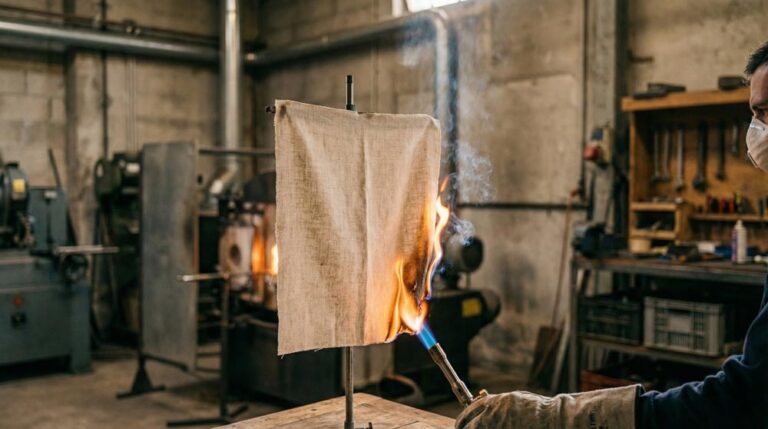
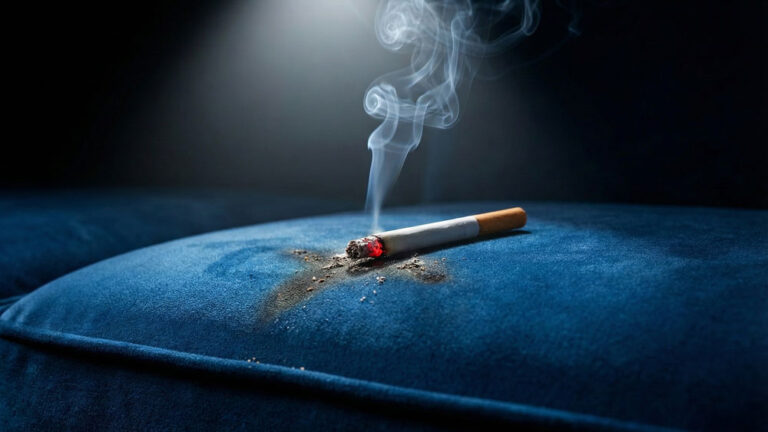
To obtain EN 13773 Class 1 certification, a fabric must sequentially pass the EN 1101 Ignitability Test and the EN 13772 Flame Spread Test, meeting both “Non-ignition” and “No Flame Spread” criteria.
The rating process follows a strict logical sequence; failure at any stage results in a downgraded classification:
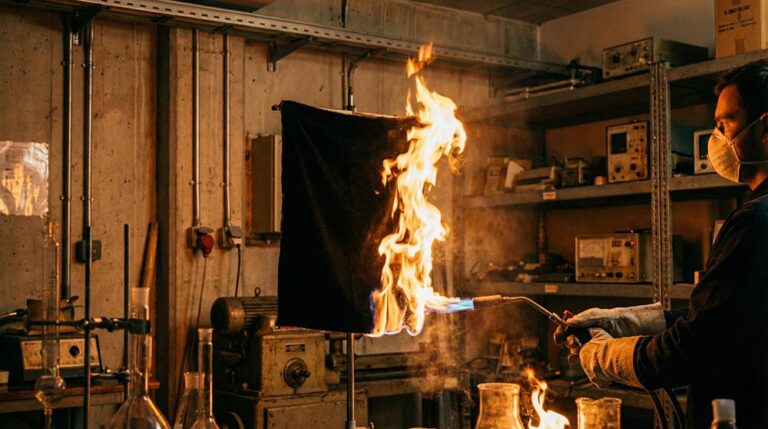
Test Description: This is an advanced test for Class 1 and Class 2 candidates. While the bottom of the fabric is subjected to ignition, the surface is simultaneously exposed to a radiant heat flux from a large radiator, simulating the intense heat of a real fire.
Class 1 Pass Criteria:
While EN 13773 Class 1, French M1, and German B1 all represent “Flame Retardant” safety levels physically, acceptance varies by country due to local regulations.
Although the EU introduced EN 13773 to unify standards, national standards still hold legal or customary authority in practical engineering procurement:
| Standard System | Primary Country | Relation to EN 13773 Class 1 | Procurement Advice |
|---|---|---|---|
| EN 13773 Class 1 | EU General | The Standard Itself | Universally applicable in Poland, the Netherlands, Scandinavia, and countries accepting EU norms. A passport for cross-border projects. |
| NF P 92-503 (M1) | France | Technically Similar | M1 certificates are mandatory for French projects. Although Class 1 performance is physically close to M1, French fire officers typically demand the M1 label. Dual certification is recommended for high-end fabrics. |
| DIN 4102 (B1) | Germany | Safety Level Equivalent | B1 certificates are mandatory for German projects. B1 uses a different test method (Brandschacht), but falls into the same “Flame Retardant” safety tier. |
| BS 5867 Type C | United Kingdom | Different Logic | UK standards prioritize durability after 50 wash cycles. EN 13773 certificates are generally not accepted in the UK; BS 5867 testing is required separately. |
The EN 13773 standard enforces mandatory verification of “Wash Durability.” If a fabric label indicates it is washable or dry-cleanable, the burning test must be repeated after the prescribed cleaning cycles to determine the final classification.
This regulation ensures safety throughout the fabric’s usage lifecycle, preventing the risk of “temporary flame retardancy”:
A: No, “fireproof” is a misleading term. EN 13773 Class 1 means the fabric is Flame Retardant. It is designed to self-extinguish when the ignition source is removed and to limit the spread of fire. However, if exposed to a continuous, large-scale fire source, the fabric will eventually char or melt, but it will not contribute significantly to the fire’s growth.
A: Generally, no. The UK strictly adheres to BS 5867 Part 2. While EN 13773 Class 1 indicates high performance, UK Fire Officers require evidence of compliance with BS 5867, specifically regarding the “Type B” or “Type C” wash durability requirements. You should re-test the fabric to the British Standard.
A: The standard itself does not set a specific expiration date, but best practice dictates renewal every 3-5 years. Additionally, if there is any change in the fabric’s manufacturing process, chemical suppliers, or yarn batch, the certificate becomes invalid and the material must be re-tested. Many auditors will reject certificates that are older than 5 years.
A: You cannot determine this visually. Both classes require the fabric to be non-ignitable (EN 1101). The difference lies in the reaction to radiant heat (EN 13772). Only a professional laboratory test report can confirm if the fabric prevents flame spread under heat flux (Class 1) or simply resists small flame ignition (Class 2).