Get in touch
Thank you for reaching out! Please tell us more about your needs — our expert team will get back to you within 24 hours.
Get in touch
Thank you for reaching out! Please tell us more about your needs — our expert team will get back to you within 24 hours.
In the field of industrial protective clothing, EN ISO 14116 is an often underestimated but crucial standard. Designed specifically for “low-risk environments,” it addresses scenarios involving accidental contact with small igniting flames. For logistics, maintenance personnel, and the “Base Layer” in multi-layer protection systems, correctly understanding EN ISO 14116 not only ensures compliance but also significantly optimizes procurement costs.
This article provides an in-depth analysis of the standard’s core—the critical differences between Index 1, 2, and 3—and offers targeted advice on fabric selection.
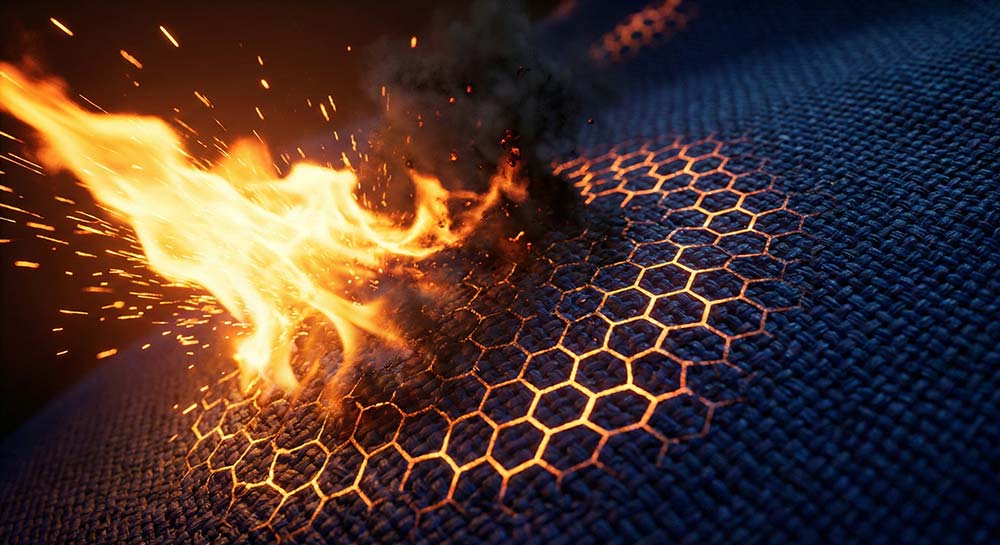
EN ISO 14116 specifies the performance requirements for materials with “Limited Flame Spread” properties. The core purpose of this standard is to protect workers by ensuring that their clothing does not ignite and continue to burn after contact with a heat source (such as sparks or a small flame similar to a lighter).
Products applicable to this standard are typically defined as “Basic Flame Retardant Protection,” adhering to three fundamental safety baselines:
Critical Distinction: EN ISO 14116 does NOT test for heat insulation (such as convective or radiant heat). If your environment involves Flash Fire, Arc Flash, or high heat radiation, you must select EN ISO 11612.
EN ISO 14116 classifies fabrics into three index levels (Index) based on their performance in the ISO 15025 test. Buyers must strictly distinguish between these levels based on whether the garment is worn “next-to-skin” or as an “outer layer.”
Index 1 is the lowest level of the standard. It allows the fabric to form holes during testing, and therefore, it must absolutely NOT be worn directly against the skin.
Index 2 represents a medium level of protection. Its core upgrade lies in the structural integrity of the fabric—no hole formation is allowed.
Index 3 is the highest level of this standard, requiring extremely short afterflame time. Its flame-retardant level is equivalent to Code A1 in EN ISO 11612.
Many companies confuse these two standards, leading to wasted budget or safety hazards. Here are the essential differences:
| Dimension | EN ISO 14116 (Limited Flame Spread) | EN ISO 11612 (Heat & Flame) |
|---|---|---|
| Risk Definition | Low Risk (Accidental contact with sparks) | Med/High Risk (Flash fire, strong heat radiation) |
| Core Function | Prevents clothing ignition | Prevents clothing ignition + Insulates against heat transfer |
| Typical Roles | Logistics, Maintenance, Auxiliary roles, Food processing | Oil & Gas, Welding, Power stations, Firefighting |
| Cost Strategy | Economic Solution | High-Performance Solution |
For different Index levels, we provide a full range of material solutions, covering everything from outer weather protection to inner comfort layers:
When purchasing, be sure to check the code on the label, for example: Index 3/5H/60. This directly determines the lifespan of the garment:
Expert Tip: If the label does not show a washing code, the garment may be disposable or “unwashed,” meaning it could lose flame retardancy after washing.
A: This is a vital “Layering” concept. If a worker wears non-FR underwear (like regular polyester), high heat from an arc flash or flash fire can penetrate the outer jacket and cause the regular underwear to melt and stick to the skin, causing injuries far worse than burns. Wearing EN 14116 (Index 3) FR underwear provides the last line of defense, ensuring that even if heat penetrates, the base layer will not melt.
A: It is not unsafe; it simply has a different purpose. Index 1 is designed to be worn over other FR clothing, such as rain gear. As long as you follow the rule that “Index 1 must be paired with an inner FR layer,” it is compliant and safe.
A: No. Welding operations involve significant molten metal splatter and strong radiant heat. Welders must wear clothing that complies with the EN ISO 11611 (Welding Protection) standard. EN 14116 is only suitable for auxiliary personnel who are indirectly exposed to the welding environment.