Get in touch
Thank you for reaching out! Please tell us more about your needs — our expert team will get back to you within 24 hours.
Get in touch
Thank you for reaching out! Please tell us more about your needs — our expert team will get back to you within 24 hours.
When customers receive fire resistant (FR) fabrics, a common question arises:
“Is there a simple way to check flame-retardant behavior before lab testing?”
While only certified laboratory tests can confirm compliance with standards such as NFPA, EN ISO, or FMVSS, many buyers still need a quick on-site check during incoming inspection or batch comparison.
This article introduces a basic field flame test that provides a preliminary visual indication of FR behavior—and explains its limitations.
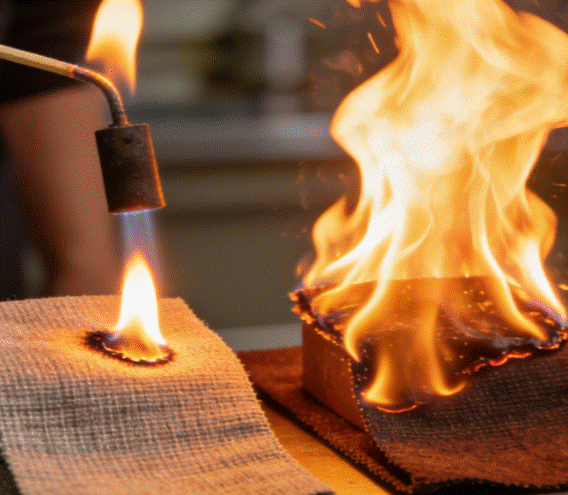
An on-site flame test is meant to be observational, not quantitative. It does not measure burn rate, heat transfer, or flame spread to any formal standard, but serves as a quick screening tool to spot obvious issues such as non-FR materials, material substitution, or inconsistent batch behavior. Vertical flame observation is commonly used because it reflects real-world fabric use and makes it easier to see key behaviors—such as upward flame spread, dripping, and self-extinguishing—once the ignition source is removed. For this reason, experienced FR fabric manufacturers like BEGOODTEX recommend field flame tests only as a preliminary check, always followed by certified laboratory testing for formal validation.
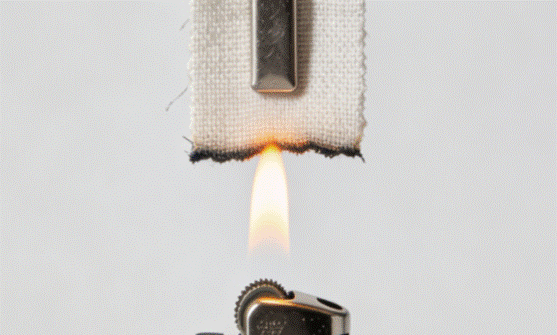
A field flame test should always be carried out with caution and proper safety awareness. The method described below reflects widely accepted industry practice for basic visual checks.
The test does not require specialized equipment, but it does require discipline. Flame exposure should be brief, controlled, and consistent.
In practice, the procedure is straightforward. The fabric sample is held vertically using metal tongs or a clamp. A small flame is applied to the lower edge of the fabric for approximately 2–3 seconds, and then removed. The tester then observes how the fabric reacts.
At this stage, observation matters more than action. The goal is not to burn the fabric aggressively, but to see how it behaves once the ignition source is gone.
Rather than collecting numerical data, on-site flame testing focuses on qualitative behavior. Experienced inspectors pay attention to several visible reactions.
Key aspects typically observed include:
These observations provide an immediate impression of whether the fabric behaves like an FR material.
The table below summarizes the most common behavioral differences observed during simple field flame tests.
| Observed Behavior | Typical Non-FR Fabric | Typical FR Fabric |
| Ignition | Ignites rapidly | Difficult to ignite |
| After flame | Continues burning | Self-extinguishes |
| Flame spread | Fast upward spread | Limited or stopped |
| Melting / dripping | Common (synthetics) | Minimal or none |
| Residue | Ash or molten beads | Stable char layer |
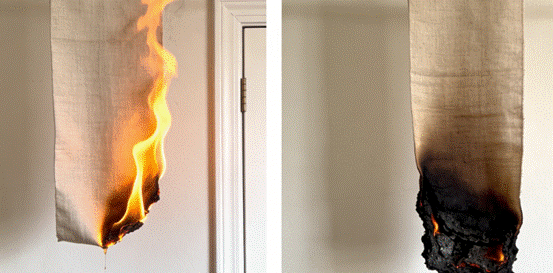
In real-world inspections, inherent flame-retardant fabrics tend to show the most stable and predictable behavior during simple field flame tests.
For example, inherent flame-retardant polyester blackout fabrics—commonly used in curtains and interior applications—typically self-extinguish quickly after flame removal and form a controlled char rather than melting or dripping.
In summary, a flame-retardant fabric does not necessarily refuse to ignite at all, but it should stop burning quickly once the flame is removed and show controlled, predictable behavior.
Because field tests are visual and informal, misinterpretation is possible—especially for buyers new to FR textiles.
One common mistake is assuming that a fabric is flame retardant simply because it melts and stops burning. Many thermoplastic fabrics behave this way without offering real flame resistance. Another issue is applying the flame for too long, which can overwhelm even high-quality FR materials and produce misleading results.
It is also important to avoid testing only coated edges or finished surfaces. The fabric body itself should be exposed to ensure the behavior reflects the material as a whole.
For buyers performing incoming inspections, consistency is just as important as performance. A high-quality FR fabric should show repeatable behavior across different samples and batches when subjected to the same simple field test.
FR fabrics developed by BEGOODTEX, for example, are designed to demonstrate:
This consistency helps buyers confidently distinguish FR materials from non-FR substitutes during on-site checks.
To avoid confusion, it helps to clearly understand where field flame testing fits into the overall quality process.
| Situation | Field Flame Test Value |
| Incoming material inspection | Useful |
| Batch-to-batch comparison | Useful |
| Supplier material verification | Useful |
| Compliance certification | Not suitable |
| Legal or regulatory approval | Not suitable |
In practice, field testing works best as a first checkpoint, followed by laboratory testing for formal confirmation.
Professional buyers and project owners typically use a two-step approach. First, they perform simple on-site flame observations to screen incoming materials. Then, they rely on accredited laboratory reports to confirm compliance with the required standards.
This approach balances speed, cost control, and regulatory confidence, while reducing the risk of material errors entering production.
A: No. Field flame testing only provides a visual indication of flame-retardant behavior. Official compliance must always be verified through accredited laboratory testing.
A: Yes. Many FR fabrics form a stable char layer when exposed to flame. This char helps block oxygen and prevents further flame spread.
A: Differences in fiber type, fabric construction, finishing method, or washing condition can affect visual behavior. High-quality FR fabrics should still show controlled, self-extinguishing reactions.