Get in touch
Thank you for reaching out! Please tell us more about your needs — our expert team will get back to you within 24 hours.
Get in touch
Thank you for reaching out! Please tell us more about your needs — our expert team will get back to you within 24 hours.
Summary: FMVSS 302 is the mandatory safety standard for the flammability of interior materials in the U.S. automotive market. It focuses on the horizontal burn rate of materials within the occupant compartment. As we move through 2026, compliance now requires a balance between strict fire safety, the unique needs of Electric Vehicles (EVs), and a growing demand for sustainable, PFAS-free flame retardant fabrics. This guide covers everything from testing procedures to global comparisons and material selection.
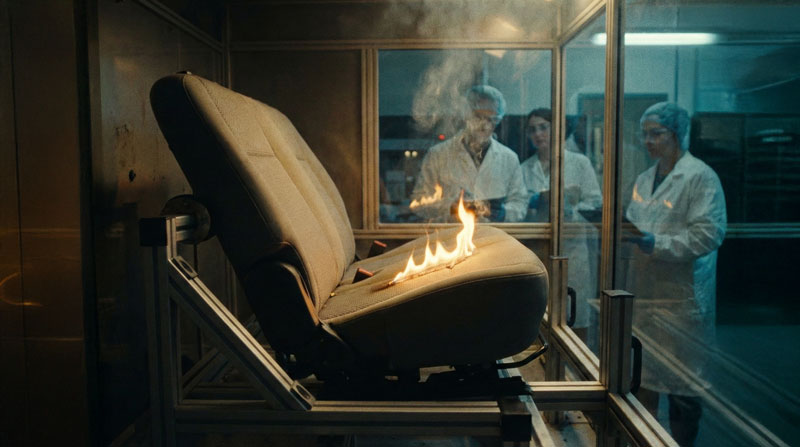
FMVSS 302 (Federal Motor Vehicle Safety Standard No. 302) is a regulation established by the National Highway Traffic Safety Administration (NHTSA). Its primary goal is simple: to reduce deaths and injuries caused by vehicle fires, especially those starting from the inside.
The standard doesn’t require materials to be “fireproof.” Instead, it regulates the burn rate. By slowing down how fast a fire spreads, the standard gives passengers a critical window of time to exit the vehicle safely during an emergency.
In the automotive industry, FMVSS 302 is often referred to as the “Horizontal Burn Test” because of the orientation of the material during the procedure.
The regulation applies to any material that is located within 13 mm (0.5 inches) of the occupant compartment air space. This includes almost everything a passenger can touch or be near while sitting in the car.
Here is a list of common components that must pass FMVSS 302:
Testing for FMVSS 302 is standardized to ensure consistency across different laboratories. The test measures the time it takes for a flame to travel across a specific length of the material.
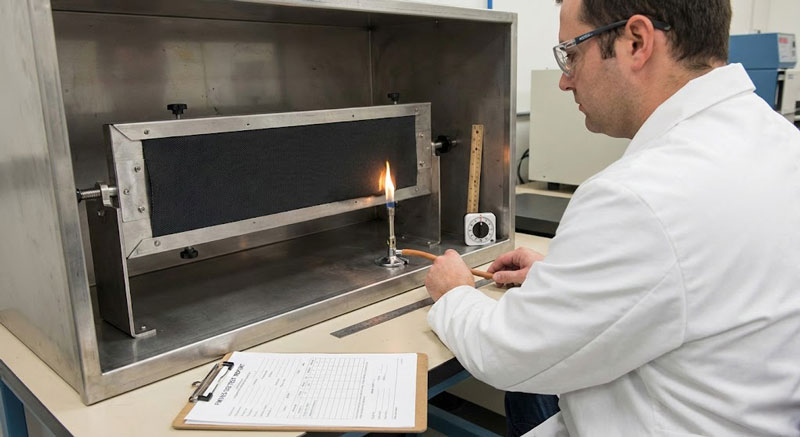
This step-by-step guide outlines the standard procedure for conducting the FMVSS 302 horizontal burn test to measure the flammability of automotive interior materials.
Total Time 1 day and 15 minutes
Cut a flat, rectangular specimen from the material. The standard size is 356 mm long by 102 mm wide.
Place the sample in a controlled environment at 21 degrees C and 50% humidity for at least 24 hours to ensure consistent results.
Secure the specimen horizontally in the U-shaped metal frame to prevent sagging during the burn process.
Apply a 38 mm tall flame to the exposed edge of the sample for exactly 15 seconds, then remove the burner.
Start the timer when the flame reaches the first mark (38 mm from the edge). Record the time it takes to reach the second mark or until it self-extinguishes.
Calculate the burn rate using the formula: distance burned divided by time taken. Ensure the rate is below 102 mm/min to pass.
Estimated Cost: 100 USD
Supply:
Tools:
Materials: Standard test specimen (356 mm x 102 mm) Thickness: 13 mm or less (per standard requirements)
A material passes FMVSS 302 if it meets the specific burn rate limits set by the NHTSA. The most common “pass” occurs when the burn rate is slow enough to meet the 102 mm per minute rule.
However, there are three ways a material can be classified as compliant:
| Criteria | Requirement |
|---|---|
| Maximum Burn Rate | 102 mm/min |
| Self-Extinguish Distance | 51 mm (maximum) |
| Self-Extinguish Time | 60 seconds (maximum) |
If you are selling vehicles globally, you will notice that FMVSS 302 has several international “twins.” While the testing methods are nearly identical, the naming and minor details vary by region.
| Standard | Region/Market | Primary Use |
|---|---|---|
| FMVSS 302 | USA | Federal law for all road vehicles. |
| ISO 3795 | International | Global standard for road vehicles, tractors, and machinery. |
| GB 8410 | China | Mandatory standard for the Chinese automotive market. |
| UN ECE R118 | Europe | Specific to buses and coaches (includes vertical tests). |
In 2026, the rise of Electric Vehicles (EVs) has changed how we look at FMVSS 302. While FMVSS 302 remains the legal baseline, it is a horizontal test designed for traditional fires. EVs face unique risks, such as “thermal runaway” from battery packs.
Many modern manufacturers are now looking for materials that exceed FMVSS 302, often aiming for UL 94 V-0 ratings for components near the battery or high-voltage cables. If you are designing an EV interior, simply passing the 102 mm/min mark may no longer be enough to satisfy consumer safety expectations or insurance requirements.
The industry is moving away from “topical” flame retardants—chemicals sprayed onto fabrics that can wash off or release harmful VOCs. In 2026, the focus is on Intrinsic Flame Retardancy (IFR).
Materials like Jacquard fabric from specialized providers such as BEGOODTEX are becoming popular for this reason. Instead of relying on heavy chemical coatings, these fabrics often use fibers that are naturally resistant to fire. This offers several benefits:
When selecting fabrics, always ask for a test report that confirms compliance after repeated cleaning cycles to ensure long-term safety.
FMVSS 302 is the foundational safety pillar for automotive interiors. It ensures that every material—from your seat cover to your floor mat—burns slowly enough to allow for a safe escape. To stay competitive in today’s market, manufacturers must look beyond the 102 mm/min limit, considering the higher stakes of EV safety and the shift toward eco-friendly, permanent flame-retardant textiles.
The standard technically applies to the first 13 mm of the material facing the occupant compartment. If a component is thicker, usually only the surface layers or the composite assembly are tested.
If a material fails, it cannot be used in a production vehicle for the U.S. market. You must either reformulate the material with flame retardant additives or switch to an inherently resistant fiber.
Yes. It applies to all “motor vehicles,” regardless of whether they are powered by gasoline, electricity, or hydrogen.
FMVSS 302 is a horizontal test. Some materials that pass horizontally might fail a vertical test (like those used in aviation). Always ensure your test lab uses the correct horizontal orientation.
From a safety standpoint, yes. A material that puts itself out (SE) is generally safer than one that continues to burn at 100 mm/min, even if both technically pass the legal requirement.
It can. If the flame retardancy is a surface coating, it may wash off. Fabrics with built-in resistance, like those from BEGOODTEX, are typically preferred for high-wear areas because they stay compliant after washing.