Get in touch
Thank you for reaching out! Please tell us more about your needs — our expert team will get back to you within 24 hours.
Get in touch
Thank you for reaching out! Please tell us more about your needs — our expert team will get back to you within 24 hours.
In procurement contracts for hotels and resorts, fire safety is a non-negotiable bottom line. As a senior industry supplier, we understand that compliance is not just about legal liability—it is about the life safety of every guest.
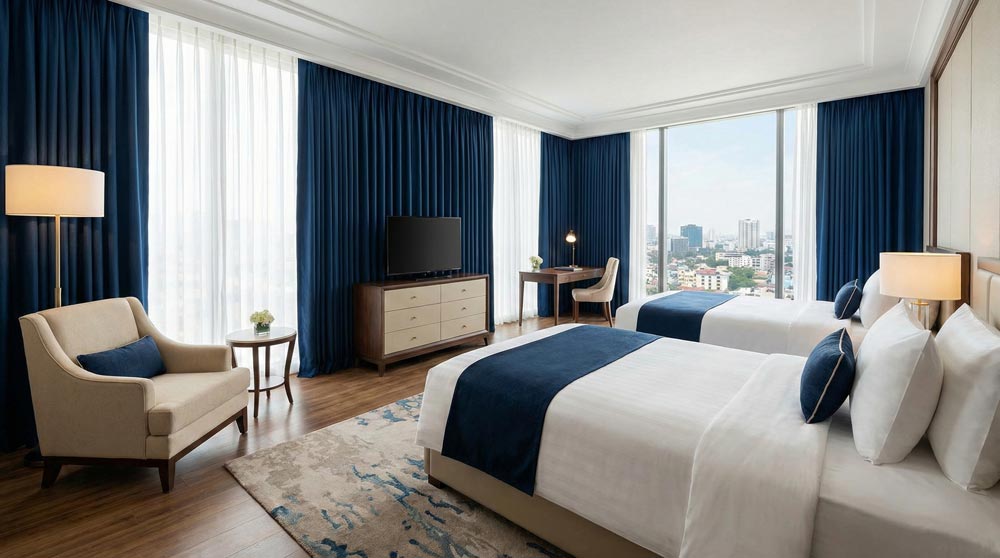
Different markets have different entry requirements for the hotel industry. In the North American market, NFPA 701 (National Fire Protection Association standard) is the gold standard for determining whether hotel fire safety regulated curtains are compliant. It primarily tests the burning rate of the fabric and the occurrence of flaming debris when exposed to flame.
For international projects or Commonwealth countries, BS 5867 Type C is even more stringent, requiring fabrics to maintain superior flame-retardant performance even after multiple high-temperature washes.
| Standard Code | Applicable Region | Core Requirements |
|---|---|---|
| NFPA 701 | USA / North America | Vertical burn test; focuses on flame propagation and falling debris. |
| BS 5867 Type C | UK / International | Strict wash durability tests (usually 50+ industrial washes). |
| GB 8624 B1 | China | Classification standard for flame-retardant building materials. |
Do not rely solely on a supplier’s verbal promises. A valid flame-retardant curtain certification report must possess three key elements:
Fire audits vary by area. When conducting hotel and resort flame-retardant curtain procurement, a categorized management approach is essential:
Verifying the authenticity of certificates is the first step in protecting your brand’s reputation when selecting hospitality fire-retardant textiles. Only materials that have passed rigorous verification can truly reduce a hotel’s operational risk.
In our hotel and resort flame-retardant curtain procurement guide, the core recommendation is to prioritize Inherently Flame Retardant fabrics (IFR). This is not just about safety—it is the key to reducing long-term operational costs.
Unlike traditional methods that spray fire retardants onto the surface of finished cloth, IFR polyester blackout curtains achieve flame retardancy by altering the molecular structure during the fiber production stage.
Treated FR fabrics may have a lower initial procurement cost, but they present clear limitations in hotel applications:
We’ve done the math for hotel owners: While the initial investment for Permanent fire retardant fabrics is approximately 15%-20% higher than treated fabrics, the returns in terms of lifespan and safety far outweigh the price difference.
| Evaluation Metric | Inherently Flame Retardant (IFR) | Chemically Treated (FR) |
|---|---|---|
| Fire Performance Durability | Lifetime effectiveness (Durable washable FR drapes) | Significant decay with wash cycles |
| Maintenance Difficulty | Supports standard industrial washing; no special care | Requires careful washing or periodic re-spraying |
| Replacement Cycle | 5-8+ Years | 2-3 Years (Requires replacement after failure) |
| Safety Compliance | Always meets NFPA 701 and other strict standards | Difficult to pass future fire re-inspections |
Choosing IFR fabrics means you are not just buying window treatments—you are securing permanent safety insurance for your hotel assets. This “one-and-done” procurement strategy significantly reduces administrative costs and operational risks.
In high-end resort design, curtains are more than just decoration; they are critical technical equipment for enhancing the guest experience. To meet the high standards of luxury hospitality, we focus on several core performance areas.
For guests seeking the ultimate sleep experience, 100% Blackout is the baseline requirement. Our IFR polyester blackout curtains use high-density physical shading layers to completely block UV rays and outdoor light interference, helping travelers enter deep sleep regardless of the time of day.
Resorts often feature large floor-to-ceiling windows, so fabrics must have high UV resistance to prevent fading and fiber embrittlement. Simultaneously, to meet public health standards, our fabrics integrate antimicrobial technology and anti-static treatments to inhibit bacterial growth and provide a healthier environment for guests.
For the large glass curtain walls common in modern resorts, we recommend Ultra-wide flame retardant fabric.
In hotel and resort flame-retardant curtain procurement, a “one-size-fits-all” approach often leads to budget waste or functional gaps. We recommend targeted fabric solutions based on the specific environment of each zone.
| Zone | Recommended Combination | Core Function |
|---|---|---|
| Guest Rooms | IFR Blackout + FR Sheers | 100% Light block, Privacy |
| Lobby | IFR Jacquard / Velvet | Luxury aesthetic, Waterproof, Antibacterial |
| Meeting Halls | High-GSM Acoustic Fabric | Sound control, Seamless install |
| Pool Area | Outdoor-specific FR Fabric | UV resistant, Mildew-proof, Quick-dry |
For hotel operations, Durable washable FR drapes are the key to lowering long-term costs. Our curtains are designed for rigorous industrial environments:
Before requesting quotes, establish a detailed Technical Specification Checklist including:
To control budgets and shorten Lead times, choosing Factory-direct hotel curtains is a strategic move. Direct cooperation lowers costs and allows for direct quality monitoring.
| Evaluation Factor | Ideal Standard |
|---|---|
| Quality Control | In-house labs for vertical burn testing. |
| Customization | Ability to produce Ultra-wide flame retardant fabric. |
| Lead Time | Standard orders within 15-30 days. |
| Credentials | Provision of valid third-party test report copies. |
We recommend testing sample drapes in an actual guest room. For instance, a permanent flame-retardant coated fabric sample should undergo mock washes to check for shrinkage or delamination.
| Metric | FR Treated (Temporary) | Inherently Flame Retardant (IFR) |
|---|---|---|
| Initial Unit Cost | Low | Medium to High |
| Post-Wash Performance | Fades; requires re-treatment | Permanently Retained |
| Maintenance Workload | High (Requires periodic testing) | Low (Wash and hang) |
| Overall ROI | Poor (High replacement frequency) | Excellent (Low TCO) |
NFPA 701 is the North American standard that tests the vertical burn rate, flame propagation, and falling debris of fabrics. BS 5867 Type C is a more stringent UK/international standard that specifically requires the fabric to maintain its flame-retardant performance even after 50 or more industrial washes.
IFR fabrics have fire resistance built into their molecular structure during fiber production, ensuring the protection is permanent and lasts the lifetime of the fabric. In contrast, chemically treated fabrics lose their fire-retardant properties over time due to washing or humidity, which can lead to safety risks and higher long-term replacement costs.
A genuine certification must be issued by an accredited third-party laboratory such as SGS, Intertek, or UL. Additionally, you should ensure the report is within its validity period, corresponds to the current production batch, and that the fabric weight and composition match your procurement samples exactly.
Beyond permanent fire safety, these curtains provide 100% blackout for a superior guest sleep experience and offer acoustic insulation to block corridor noise. They also contribute to thermal management by reducing heat loss or gain, and since they lack chemical coatings, they are more eco-friendly and odorless.
Ultra-wide fabrics (300cm+) allow for a seamless aesthetic on large glass walls, which is essential for luxury resort designs. Practically, they also reduce cutting waste during large-scale manufacturing, helping to optimize overall procurement costs.