Get in touch
Thank you for reaching out! Please tell us more about your needs — our expert team will get back to you within 24 hours.
Get in touch
Thank you for reaching out! Please tell us more about your needs — our expert team will get back to you within 24 hours.
For those of you involved in curtain projects for hotels, guesthouses, B&Bs, theaters, and schools, do you often encounter the following questions?
If so, please be sure to read this article carefully. The different processes and standards for curtains will directly impact your project costs—potentially increasing the price by just a few yuan per meter, or by more than ten or even dozens of yuan per meter. Furthermore, selecting a reliable flame-retardant curtain fabric supplier will directly affect your success in winning bids, your project timeline, and the final inspection and acceptance. It also relates to the safety guarantees and maintenance costs during the period of use.
Therefore, we will provide a comprehensive analysis on how to choose flame-retardant curtains, covering multiple dimensions such as flame-retardant standards, fabric processes, project suitability, and manufacturer support.

Many people mistakenly believe that “flame retardant” means “cannot be burned.” This is a misunderstanding.
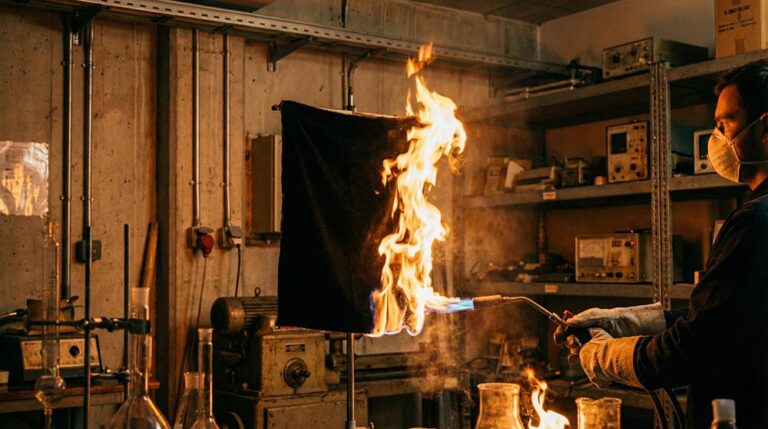
True flame retardancy means that the fabric can quickly self-extinguish after contact with a flame, preventing it from continuing to burn or fueling the fire, thus reducing the risk of fire spreading.
Flame-retardant curtains are not “non-combustible,” but rather they can self-extinguish quickly upon contact with a fire source to prevent the fire from spreading. The real effect of flame retardancy is to reduce the threat to the environment after a fire occurs, not to be completely fireproof. Through special materials and processing techniques, they ensure a reduced risk of fire spreading in the event of a fire and are commonly used in public places such as hotels and hospitals.
Therefore, in public places like hotels, guesthouses, B&Bs, theaters, and schools, it is very necessary to select and use flame-retardant curtains that comply with relevant standards.
Different regions around the world have varying requirements for the flame-retardant performance of curtains (curtain fabrics), primarily reflected in their own promulgated flame-retardant standards and testing methods.
For example, the German DIN 4102 B1 standard, where the B1 level represents “flame-resistant materials,” is widely used for architectural decorative materials like curtain fabrics. The core requirement of the B1 standard is that the material can self-extinguish quickly when burning, limiting the spread of flames and reducing fire risk. This standard uses a vertical burn test method to determine the material’s flame-retardant performance by controlling the burn length and time.
The requirements for passing DIN 4102 B1 are:
For flame-retardant standards for curtains in major global regions for commercial projects, you can refer to the table below, which covers key markets such as Europe, America, the Middle East, and the Asia-Pacific.
Summary Table of Curtain Flame-Retardant Standards in Major Countries and Regions
| Region/Country | Standard Name | Grade Example | Wash Durability Required | Common Venues |
| 🇺🇸 USA | NFPA 701 | Pass/Fail | Yes | Hotels, Theaters, Schools |
| 🇩🇪 Germany | DIN 4102 | B1 / B2 | No (single test) | Exhibition Halls, Office Buildings, Trade Fairs |
| 🇬🇧 UK | BS 5867 Part 2 B/C | Type B / C | Yes | Hospitals, Hotels, Schools |
| 🇫🇷 France | NF P92 M Class | M1 / M2 | No | Public Venues, Government Buildings |
| 🇨🇳 China | GB 8624 / GB/T 5455 | B1 / B2 | No (optional) | Public Buildings, Schools |
| 🇯🇵 Japan | JIS L 1091 | Flameproof Class 1 | Yes | Medical Institutions, Cinemas |
| 🇦🇺 Australia | AS/NZS 1530 | – | Yes | All Commercial/Public Venues |
When choosing flame-retardant curtains, the key lies in the flame-retardant process used. Currently, there are two main methods on the market:
This is achieved by spinning yarn from FR chips that have a flame-retardant agent added. This process incorporates flame-retardant properties during fiber production and has the following characteristics:
Disadvantages:
👉 Suitable for venues with ample budgets and high standards, such as hospitals, Class A office buildings, and public transportation.
A post-treatment FR finish refers to applying a flame-retardant agent to the fabric through a coating or dipping process after it has been woven, followed by high-temperature setting to achieve a flame-retardant effect.
Advantages:
Disadvantages:
👉 Suitable for venues with low washing frequency such as guesthouses, hotels, and B&Bs. It is the mainstream choice for current commercial projects.
When choosing flame-retardant curtains, you should consider a combination of factors such as budget, usage environment, washing frequency, and acceptance standards:
| Project Type | Recommended FR Method | Reason |
| Hotels/Guesthouses/B&Bs | Post-Treatment FR Finish | Controllable costs, flexible patterns, suitable for projects. |
| High-End Office Buildings/Hospitals | Inherent FR Fiber | High standards, requires long-term flame-retardant performance. |
| Venues Requiring Frequent Washing | Inherent FR Fiber | Retains flame-retardant effect after multiple washes. |
In addition to basic flame-retardant properties, curtains in practical applications often need to have multiple additional functions to meet different environmental and usage needs.
Common additional functions include blackout, anti-ultraviolet (anti-UV), anti-bacterial, and anti-static. For example:
When selecting curtains, these functions should be configured based on the specific needs and environment of the project. This not only enhances the comfort and lifespan of the curtains but also adds value to the commercial project.
Many bidding projects have clear requirements for the flame-retardant performance, wash durability, and warranty period of curtain fabrics. In such cases, choosing a manufacturer that offers professional support, complete certifications, and after-sales guarantees is particularly important.
As a factory, we do not participate in bidding, but we provide our distributors with:
Our distributor partners can confidently purchase our products and win customer trust with professional service.
Flame-retardant standards, material selection, cost control, project acceptance… every step determines whether your project can be delivered smoothly. Curtains may seem small, but the details behind them are significant.
Remember: Not all flame-retardant curtains are the same, and the most expensive one is not always the most suitable.
✅ Understand the standards, ✅ master the processes, and ✅ find the right manufacturer to control every detail and help you win commercial project orders with ease.