Get in touch
Thank you for reaching out! Please tell us more about your needs — our expert team will get back to you within 24 hours.
Get in touch
Thank you for reaching out! Please tell us more about your needs — our expert team will get back to you within 24 hours.
On the vast open sea, fire is the ultimate nightmare for crew and passengers alike. This is why the International Maritime Organization (IMO) has established extremely strict fire safety standards under the International Convention for the Safety of Life at Sea (SOLAS). If you aim to become a supplier for cruise lines like Royal Caribbean or Carnival, or provide interiors for luxury superyachts, you must pass the IMO 2010 FTP Code (International Code for Application of Fire Test Procedures, 2010) and obtain the prestigious “Wheelmark”.
This article provides a deep-dive technical analysis of the three core sections relevant to soft furnishing textiles: Part 7 (Curtains), Part 8 (Furniture), and Part 9 (Bedding). We will also compare these with land-based standards to provide you with a comprehensive guide on material selection and compliance.
The IMO 2010 FTP Code (International Code for Application of Fire Test Procedures, 2010) is the definitive regulatory framework established by the International Maritime Organization (IMO). It sets forth mandatory technical requirements and testing procedures to verify that materials used on board international vessels meet strict fire safety standards.
Why is this rule so strict?
On land, if a fire breaks out, people can evacuate to the outdoors. At sea, a ship is a confined space with limited escape routes and no immediate external help. Therefore, the core logic of the IMO is “Passive Fire Protection”—mandating that all materials on board (from curtains to sofas) must possess extremely high flame retardancy to ensure they do not ignite easily or burn very slowly, buying valuable time for evacuation.
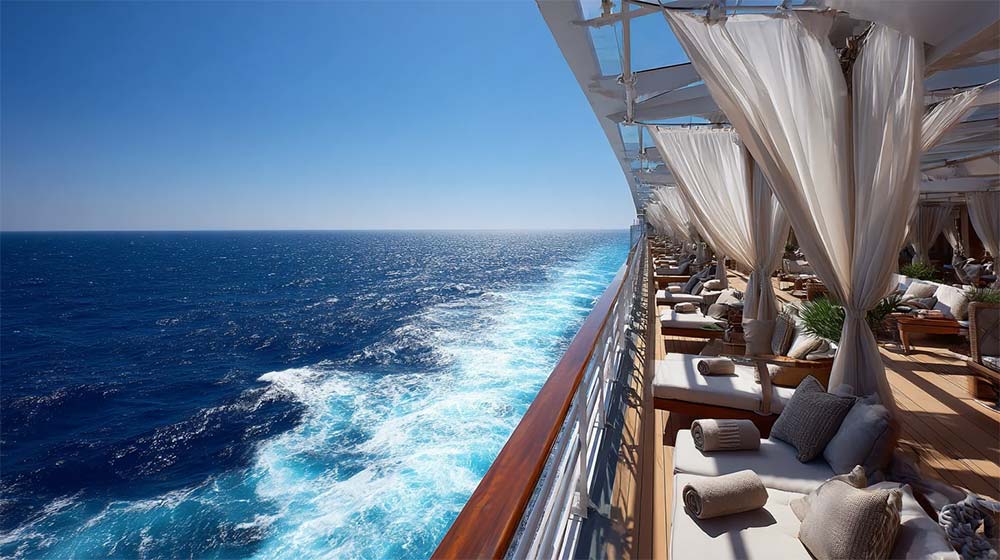
IMO 2010 FTP Code Part 7 (Test for vertically supported textiles and films) is the mandatory standard for all hanging materials. Its core logic simulates a scenario where a curtain is exposed to a small ignition source, focusing on whether the fire will spread rapidly or produce dangerous burning droplets.
The coverage of this part is extensive, including but not limited to:
If you are familiar with land-based architectural standards, you can view IMO Part 7 as the maritime version of EN 13773 (Vertical flame spread for curtains). The testing principles are highly consistent, both focusing on flame spread behavior on vertical fabrics. Some testing logic also references early resolutions like IMO Res. A.471 (XII) and IMO Res. A.563 (14).
Tests are conducted in a standardized combustion chamber with the specimen suspended vertically. The test involves two extremely strict ignition modes:
According to MSC.307(88), the sample must meet all the following hard targets simultaneously:
| Metric | Fail Criteria (What is NOT allowed) |
|---|---|
| After-flame | The flame persists for more than 5 seconds after the ignition source is removed. |
| Burning Droplets | Core Challenge: Any burning debris or droplets must NOT ignite the cotton wool pad placed below the specimen. This is where polyester fabrics fail most often. |
| Edge Spread | The flame must not propagate to any vertical edge or the top edge of the specimen. |
| Char Length | The average char length must not exceed 150mm. |
| Surface Flash | The surface flame propagation must not exceed 100mm. |
The uniqueness of IMO 2010 FTP Code Part 8 (Test for upholstered furniture) lies in the fact that it does not test the fabric alone, but rather the “Fabric + Foam Filling” combination. This means the same fabric may yield completely different results when paired with different types of foam.
This standard applies to all forms of upholstered furniture on board:
The test procedures for IMO Part 8 directly reference EN 1021-1 (Cigarette test) and EN 1021-2 (Match/Butane flame test).
Note: Many clients ask about the British Standard BS 5852 (Crib 5). Although the Crib 5 wood crib source is much hotter and more severe than IMO Part 8, strictly speaking, Classification Societies only recognize IMO Part 8 reports. A Crib 5 report cannot legally substitute an IMO certificate.
Tests must be conducted on a standard test rig with the seat and backrest positioned at a 90° angle. Two independent tests must be passed:
A lit cigarette is placed at the junction between the seat and the backrest (the area most likely to trap heat).
Fail Criteria: The test is failed if:
A burner tube producing a flame equivalent to a match is placed at the junction for 20 seconds.
Fail Criteria: The test is failed if:
IMO 2010 FTP Code Part 9 (Test for bedding components) aims to ensure that bedding in guest cabins does not act as an accelerant for fire.
Unlike furniture, Part 9 targets the removable components of the sleeping system:
The test method is similar to the international standard ISO 12952-1/2 or the European standard EN 597-1/2. These standards all assess the ignitability of bedding items by smouldering sources (cigarettes) and open flames (matches).
The focus is on preventing “smouldering” from transitioning into “open flame,” and preventing bedding from igniting the mattress below. Specific criteria include:
The marine environment imposes extreme demands on textiles: high salt spray corrosion, intense UV radiation, high humidity, and strict fire regulations. Based on BEGOODTEX’s years of experience in marine engineering, we suggest solving compliance issues at the material source:
Compared to cotton, linen, or standard polyester, IFR Polyester is the optimal choice for marine interiors:
Risk of Hygroscopic “Dampness”: In the humid marine environment, fabrics treated with topical FR chemicals (post-treatment) are prone to absorbing moisture. This leads to two serious consequences:
Therefore, marine interiors should insist on using Inherent FR materials.
While Parts 7/8/9 only test for flammability, certain high-end cruise projects additionally require IMO FTP Code Part 2 (Smoke and Toxicity). This is a higher-level environmental requirement. High-quality IFR fabrics do not release toxic gases like hydrogen halides when burned, offering a safer solution aligned with green maritime trends.
A: Yes. This is a mandatory requirement. Whether it is a functional blackout curtain in a guest room, an anti-glare blind on the bridge, or a decorative sheer in the restaurant—if it is a vertically suspended textile, it must comply with IMO Part 7.
A: No. Classification Societies only recognize the IMO FTP Code Part 8. Although the BS 5852 Crib 5 test is technically more severe (larger heat source), the legal basis is different, and they are not interchangeable. You must re-test using the exact same material combination according to IMO Part 8.
A: This is an approval number from the United States Coast Guard. Due to the “Mutual Recognition Agreement (MRA)” between the US and the EU, products that have obtained the EU MED (Wheelmark) certification typically receive a USCG number automatically. This allows the product to be legally installed on US-flagged merchant vessels without re-testing in the US.
A: It requires a cooperative process. We provide the fabric that meets IMO standards along with its test reports. If you are a furniture manufacturer, you need to use our fabric combined with your specific foam to apply for the certificate for your finished furniture. Our fabric certificate serves as the critical “Material Declaration” document in your application process.