Get in touch
Thank you for reaching out! Please tell us more about your needs — our expert team will get back to you within 24 hours.
Get in touch
Thank you for reaching out! Please tell us more about your needs — our expert team will get back to you within 24 hours.
Whether fire retardants are toxic to the human body depends entirely on their chemical composition and how they are integrated into the textile. Traditional halogenated flame retardants, particularly brominated and chlorinated varieties, are indeed associated with health risks due to their bio-accumulative nature and the release of toxic gases during combustion. However, modern Inherent Flame Retardant (IFR) technology solves this problem by embedding fire-suppressing molecules directly into the polymer chain, ensuring they are non-toxic, odorless, and do not migrate to the skin. This article clarifies the distinction between hazardous topical coatings and safe, non-toxic IFR fibers.
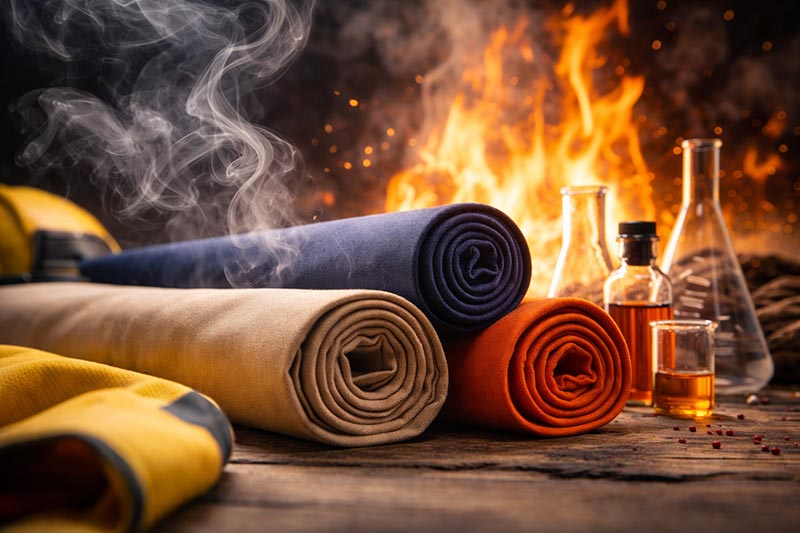
Fire retardants are chemical substances designed to inhibit, suppress, or delay the combustion process of a material. They function through physical or chemical interventions at various stages of the fire cycle: for example, quenching free radicals in the gas phase to stop the flame’s chemical reaction, or promoting the formation of a char layer in the solid phase to create a physical barrier between the heat source and the oxygen. From a technical assessment perspective, the safety of a fire retardant is determined by its molecular stability and the concentration of lethal combustion by-products, such as Hydrogen Cyanide (HCN) and Carbon Monoxide (CO).
Table 1: Technical Comparison of Flame Retardant Systems and Toxicity Profiles
| FR System | Typical Components | Mechanism | Environmental & Health Assessment |
|---|---|---|---|
| Halogenated | PBDEs, Chlorinated Paraffins | Gas-phase radical quenching | High risk. Releases dioxins; associated with neurotoxicity. |
| Phosphorus-based | Ammonium Polyphosphate (APP) | Solid-phase charring | Low risk. Non-volatile; decomposition products are non-toxic salts. |
| Inorganic | Magnesium/Aluminum Hydroxide | Endothermic cooling | Zero toxicity. Environmentally friendly but affects fabric texture. |
The primary determinant of fire retardant toxicity is how the chemical is bonded to the fiber. Topical treatments involve applying additives via dipping or coating on the fabric surface. These additives are not chemically bonded and can easily leach out through sweat or friction. In contrast, Inherent Flame Retardant (IFR) technology, such as Begoodtex’s proprietary fibers, integrates the flame-retardant monomers into the polymer chain during polymerization. Technical evaluations demonstrate that IFR fabrics exhibit zero chemical migration even after 50 industrial wash cycles, which is the gold standard for skin-safe textiles.
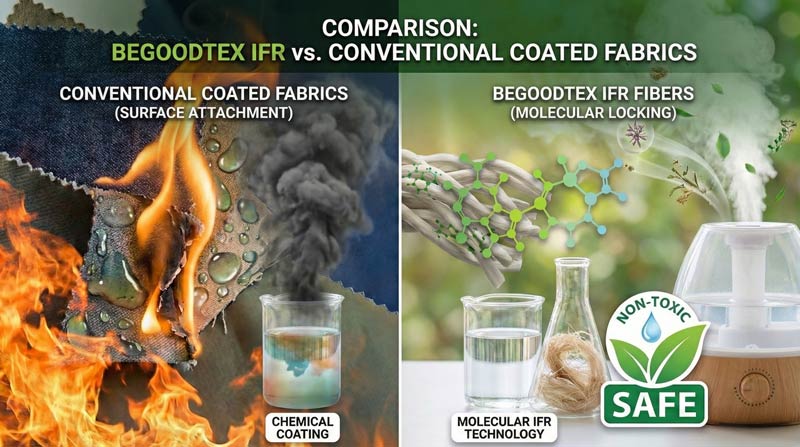
Halogenated flame retardants were once the industry standard due to their efficiency. However, their combustion products are highly corrosive and toxic. When halogenated fabrics smolder, they release high concentrations of hydrogen halide gases, which can cause severe respiratory burns and produce Persistent Organic Pollutants (POPs) that accumulate in human tissue. Global regulations such as REACH (SVHC list) and the RoHS directive now strictly limit the use of brominated agents. Leading manufacturers like Begoodtex have transitioned to halogen-free phosphorus-modified technology to eliminate these high-risk substances from the supply chain.
Non-toxic flame retardant fibers are defined as modified polymers that do not contain halogens or heavy metals and do not rely on volatile additives. Begoodtex IFR polyester, for instance, incorporates phosphorus-containing monomers that catalyze the formation of a char layer when exposed to heat. Laboratory tests confirm that these fibers achieve a Limiting Oxygen Index (LOI) of 32%-35% without emitting harmful volatiles. This makes them the safest choice for hospital cubicle curtains and kindergarten bedding, where long-term skin contact is unavoidable.
Table 2: Begoodtex IFR Technology vs. Conventional FR Processing Parameters
| Technical Parameter | Begoodtex IFR Fiber | Traditional FR Treatment | Safety Threshold |
|---|---|---|---|
| Formaldehyde Content | Not Detected (ND) | 20 – 150 ppm | <75 ppm (Clothing grade) |
| Extractable Heavy Metals | 0% | Trace amounts (Sb/Cr) | Strictly Limited |
| Skin Irritation Test | Non-irritant (Class 1) | Mild to Moderate irritation | Must be non-irritant |
| LOI Stability (Post-Wash) | Stable (50+ washes) | Dropped by 15% – 40% | Should not be <28% |
In traditional flame retardant processes for natural fibers like cotton, formaldehyde is frequently used as a cross-linking agent to fix the FR salts to the fabric. However, formaldehyde is a known human carcinogen. Its continuous release in enclosed spaces like hospital wards or dormitories poses a severe health risk. True non-toxic fabrics must meet the Formaldehyde-free standard. Begoodtex achieves permanent fire resistance without formaldehyde-based resins by utilizing molecular modification, ensuring indoor air quality (IAQ) remains pure and safe for vulnerable populations.
The safety of a flame retardant fabric is verified through biological safety certifications like OEKO-TEX Standard 100. This certification tests for over 100 harmful substances, including pH values, pesticides, and restricted FR agents. Begoodtex products are certified to Class 1 (Baby grade), the most stringent category. This ensures that even under conditions of perspiration and friction, no chemical substances migrate from the fabric to the skin, maintaining the skin’s acidic barrier and preventing immune responses.
Statistics show that nearly 80% of fire-related fatalities are caused by smoke inhalation and gas poisoning rather than thermal burns. A critical metric for non-toxic textiles is Low Smoke (LS) emission. Begoodtex IFR fabrics produce minimal white water vapor and CO2 when exposed to intense heat, significantly reducing the release of Carbon Monoxide and Hydrogen Cyanide. This performance provides a clearer evacuation path and a longer survival window during emergencies, which is why IFR fabrics are mandatory in aviation and rail transport.
Table 3: Combustion Smoke Density and Toxicity Comparison
| Material Type | Specific Optical Density (Ds) | Toxic Gas Profile | Visibility Assessment |
|---|---|---|---|
| Standard Polyester | 450 – 600 | High CO, No HCN | Very Poor (Black smoke) |
| Brominated FR Treated | 500 – 750 | High HBr, Dioxins | Suffocating (Toxic) |
| Begoodtex IFR Fabric | < 150 | Very Low CO, No HCN | Good (Light grey/white) |
The durability of flame retardancy is a physical indicator of whether the retardant will become an environmental hazard. If a retardant is easily washed away, it not only compromises safety but also enters the water system as chemical pollution. Begoodtex IFR fabrics retain over 95% of their fire-resistant efficacy after 50 to 100 industrial wash cycles at 75°C. This molecular-level stability eliminates concerns regarding chemical leaching and ensures long-term protection for the user.
Purchasers must verify dual certifications: fire performance and chemical safety. Performance standards like NFPA 701 (USA) or BS 5867 (UK) measure flame spread and char length. Chemical safety is verified through REACH, RoHS, and OEKO-TEX. Begoodtex integrates these standards and also adheres to the Global Recycled Standard (GRS), ensuring the fabric is non-toxic throughout its lifecycle—from production to recycling.
In facilities such as schools, hospitals, and nursing homes, textile selection must go beyond basic fire codes toward “healthy flame retardancy.” Children and the elderly have more sensitive metabolic systems; therefore, any traces of chemical dust or residual additives can trigger severe allergic reactions. Begoodtex recommends IFR fabrics with integrated antimicrobial and waterproof functions. These materials resolve the technical conflict between “flame retardancy” and “waterproofing” while ensuring absolute biological safety via physical molecular embedding.
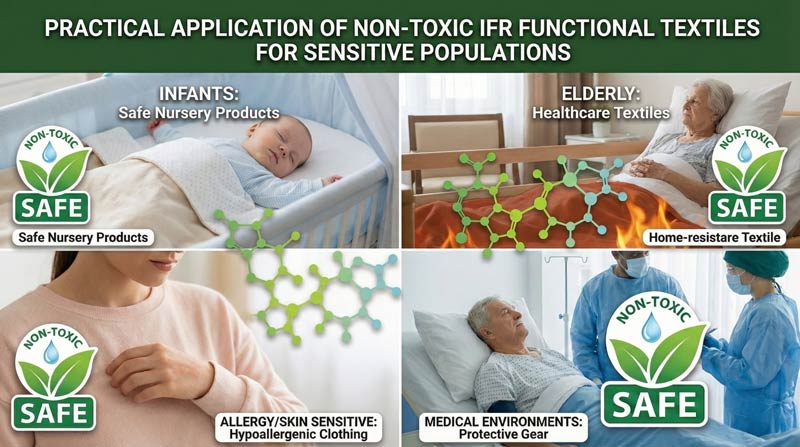
Is fire retardant toxic to the human body? In summary, the toxicity of fire retardants depends on the generation of technology used. While early halogenated and formaldehyde-containing coatings carry significant health risks, modern Inherent Flame Retardant (IFR) technology developed by companies like Begoodtex has achieved a breakthrough in “zero formaldehyde, low smoke, and non-migratory” safety. By verifying OEKO-TEX Class 1 certification and insisting on Inherent fibers, fire retardant fabrics are entirely safe for human use. Choosing IFR textiles not only protects against the physical dangers of fire but also avoids the secondary hazards of chemical contamination.
High-quality Inherent Flame Retardant (IFR) fabrics are odorless because the FR monomers are locked within the molecular chain. A pungent chemical smell usually indicates low-end topical treatments with residual formaldehyde or solvents.
Yes, provided the fabric is OEKO-TEX Class 1 certified. This certification ensures the biochemical indicators are consistent with infant skin contact standards, containing no allergenic dyes or harmful additives.
No. Begoodtex uses a polymerized phosphorus-based system where the phosphorus is chemically bonded. It does not wash out into the water or volatilize at room temperature, making it chemically inert and safe.
IFR molecules catalyze charring in the solid phase, which inhibits incomplete combustion in the gas phase. This reduces the formation of fine carbon particles (black smoke) and converts most fuel into a solid carbon layer.
Yes. Leachable FR chemicals pollute aquatic ecosystems. Furthermore, the loss of fire resistance turns the fabric into a standard flammable product, shortening its lifecycle and increasing environmental waste.