Get in touch
Thank you for reaching out! Please tell us more about your needs — our expert team will get back to you within 24 hours.
Get in touch
Thank you for reaching out! Please tell us more about your needs — our expert team will get back to you within 24 hours.
In the global textile export trade, compliance testing for blackout curtains is a frequent source of order disputes. The most typical technical conflict arises between the Japanese JIS L 1055 and the American AATCC TM203 standards. Many manufacturers fail to understand the fundamental difference in how these two standards define “Light Blocking,” leading to scenarios where products rated as “Grade 1 Blackout (99.99%)” in Japan are rejected in the US market for being “translucent.”
This article provides an authoritative comparative analysis and manufacturing solutions across three dimensions: technical principles, testing methods, and judgment criteria.
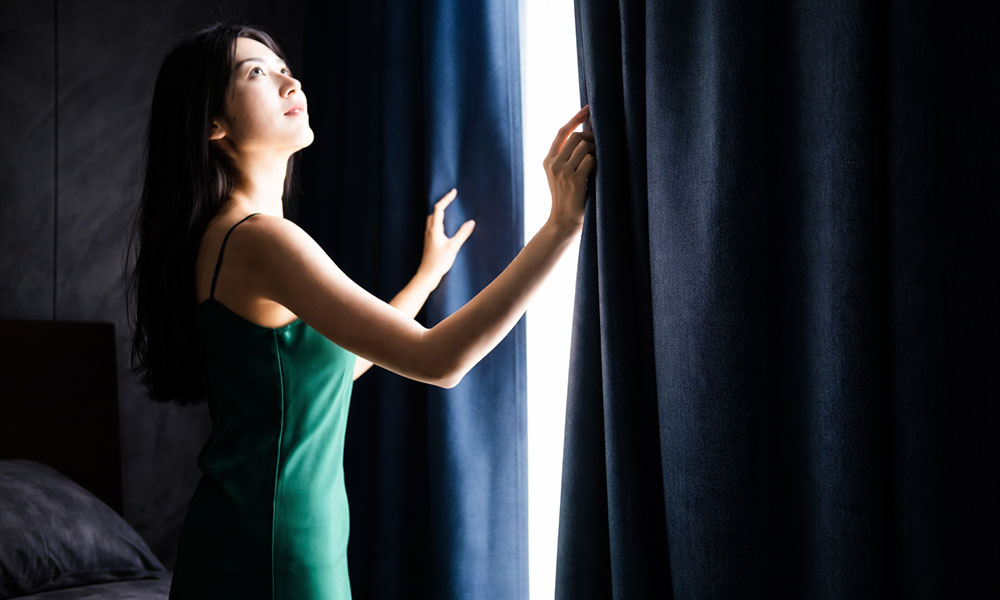
The greatest difference between JIS L 1055 and AATCC TM203 lies in the dimension of their judgment criteria.
Simply put, Japan’s JIS L 1055 standard focuses on “Human Sensory Experience (Illuminance),” measuring the level of brightness perceived by the human eye under strong light conditions. Conversely, the American AATCC TM203 standard focuses on “Absolute Physical Data (Spectral Transmission),” using precision instruments to detect the absolute penetration of light rays. This discrepancy explains why “99.99%” is considered top-tier blackout in Japan, yet often fails to meet the “Blackout” requirement in US commercial standards.
JIS L 1055 (Testing methods for light blocking effect of curtain materials) is the core standard for the Japanese curtain industry, typically employing Method A (Illuminance Method).
The Nippon Interior Fabrics Association (NIF) categorizes light blocking performance into three grades based on JIS L 1055 data. Note: The Japanese standard acknowledges “Relative Light Blocking,” meaning minute light leakage is permissible.
| NIF Grade | Rate Requirement | Visual Experience (NIF Definition) | Recommended Application |
|---|---|---|---|
| Grade 1 | ≥ 99.99% | Almost Full Black. Although faces are unrecognizable, extremely faint light perception may exist (0.01% leakage). | Bedrooms, Home Theaters |
| Grade 2 | 99.80% – 99.99% | Dark. Facial outlines can be vaguely recognized. | Standard Bedrooms |
| Grade 3 | 99.40% – 99.80% | Dim. Facial expressions are visible, but the light is insufficient for office work. | Living Rooms, Studies |
⚠️ Industry Insight: Why is NIF Grade 1 (99.99%) still controversial?
Many buyers mistakenly believe “Grade 1” means “Total Blackness,” but this is a mathematical misconception. The NIF Grade 1 standard allows for <0.01% light leakage.
Under the intense 100,000 Lux test of JIS L 1055, a 0.01% transmission means approximately 10 Lux of light enters the room.
What is 10 Lux? It is equivalent to the brightness of 10 candles or twilight. Therefore, Japan’s “Grade 1” is NOT equal to the American “Blackout.” Addressing this point, since 2018, NIF has encouraged companies to label 100% products separately (e.g., “Complete Blackout”) to distinguish them from standard 99.99% products.
AATCC TM203 (Light Blocking Effect of Textiles: Spectrophotometric Method) is the gold standard for the US market, particularly within the Hospitality Industry.
In US commercial procurement standards, the definition of “Blackout” is absolute. The result from AATCC TM203 determines the product’s classification:
Critical Warning: Many fabrics that test at 99.99% (Grade 1) in Japan often show 0.01% – 0.05% transmission under US AATCC instruments. Under the US system, these are Dimouts. Labeling them as “Blackout” for export risks immediate rejection.
To visualize the differences, here is a detailed comparison of core parameters:
| Comparison Dimension | JIS L 1055 (Japan) | AATCC TM203 (USA) |
|---|---|---|
| Core Instrument | Illuminance Meter (Lux Meter) | Spectrophotometer |
| Primary Focus | Human Perception (Lux) | Instrument Data (Opacity %) |
| Highest Standard | NIF Grade 1 (≥99.99%) | 100% Blackout (0.00%) |
| Tolerance | Tolerance Exists (Allows 0.01% leakage) | Zero Tolerance (Must be 0.00%) |
| Mainstream Fabric | High-Density Woven Dimout | Coated (4-Pass) or Flocked |
As an export manufacturer, a “one-size-fits-all” product strategy is risky. We recommend differentiated textile solutions based on the target testing standard (featuring BEGOODTEX R&D examples):
Recommended Tech: High-Density Dimout
Since the Japanese market prioritizes “hand-feel” and “drape” and permits 0.01% leakage:
Recommended Tech: 4-Pass Silicon/Acrylic Coating
Woven fabrics cannot pass the AATCC 0.00% test due to microscopic gaps between yarns. Chemical covering is mandatory:
A: Almost impossible. Woven dimout fabrics typically achieve 98% – 99.9% light blocking. Under the precision of AATCC 203 instruments, photons penetrate the microscopic gaps (pinholes) between yarns. Without back coating, woven fabrics are defined as “Dimout” in the US.
A: The main issue is “Pinholes.” The 3-Pass process (usually 1 black layer + 2 white layers) may leave microscopic air bubbles or uneven spots during foaming/drying. Under intense light detection, these become light leaks. High-end US products typically require 4-Pass or 5-Pass processes to seal light paths completely.
A: It is equivalent to the brightness of direct noon sunlight in summer. The strictness of the Japanese standard lies in the extreme intensity of the light source, which can shine through thick fabrics. If a fabric achieves 99.99% under this intensity, it provides excellent shading for daily household use (where light is typically below 100,000 Lux).
A: No. The NIF Grade 1 range is 99.99% – 100%. A fabric at the 99.99% edge of Grade 1 will show starry points of light if observed closely or lit by a phone flashlight. Only Grade 1 fabrics that are coated and achieve actual 100% are close to the American definition of “Blackout.”