Get in touch
Thank you for reaching out! Please tell us more about your needs — our expert team will get back to you within 24 hours.
Get in touch
Thank you for reaching out! Please tell us more about your needs — our expert team will get back to you within 24 hours.
NFPA 2112 is the standard on flame-resistant clothing for protection of industrial personnel against short-duration thermal exposures from fire. Primarily targeting the oil, gas, and chemical industries, it is developed by the National Fire Protection Association (NFPA) and is recognized globally as one of the most rigorous certifications for industrial safety workwear. Achieving this certification (especially via third-party bodies like UL) ensures that in the event of a sudden fire, the garment will not melt, drip, or sustain combustion, keeping burn injuries within survivable limits.

A flash fire is a rapidly spreading fire caused by the ignition of flammable gases, dust, or liquid vapors. Its core characteristics are “Extreme Speed” and “High Energy”:
The existence of NFPA 2112 is to ensure that workers have a final “barrier for escape” in these extreme and unpredictable environments.
Unlike the grading system of the European standard EN ISO 11612, NFPA 2112 adopts a strict “Pass/Fail” system. The most famous and brutal test within this standard is the ASTM F1930 Manikin Test.
The test involves dressing a life-sized mannequin, equipped with at least 100 thermal sensors, in a standard-sized coverall. The environment simulates the worst-case industrial accident scenario:
Under this “Pass/Fail” system, computer models calculate the total body area likely to suffer 2nd and 3rd-degree burns based on the sensor data.
The Passing Standard: The total body burn area (excluding hands and feet) must be < 50%.
This means if a garment results in a predicted burn area of more than 50% during the test—no matter how intact the fabric looks afterward—the product is deemed a FAILURE and cannot receive NFPA 2112 certification.
In addition to the mannequin test, NFPA 2112 imposes a series of mandatory requirements on fabric physics and durability to ensure protection lasts throughout the garment’s lifecycle.
This is one of the most challenging thresholds of the US standard. NFPA 2112 requires that fabric samples must undergo 100 industrial washing and drying cycles before being subjected to critical burn tests (like the vertical flame test).
This requirement eliminates “fake” products that rely on cheap chemical coatings which wash out after a few cycles. Only fabrics with molecular-level treatments or inherent flame resistance can pass this test.
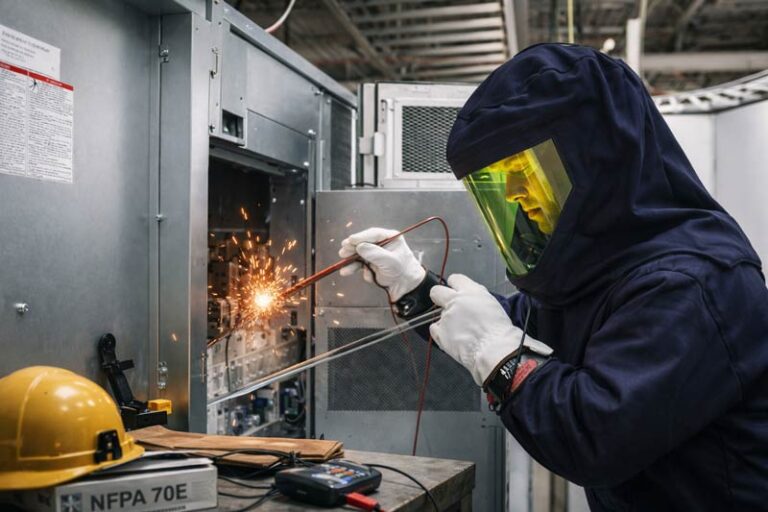
These are the two US standards most often confused by procurement officers. While many high-performance fabrics meet both (Dual Certified), their protection goals and testing logic are completely different. Do not use them interchangeably.
| Feature | NFPA 2112 | NFPA 70E |
|---|---|---|
| Core Protection | Flash Fire | Arc Flash |
| Main Hazard Source | Fuel, gas, or dust explosions | Electrical short circuits, high-voltage blasts |
| Key Metric | Percent Body Burn (<50%) Focus on survival rate | Arc Thermal Performance Value (ATPV / EBT) Focus on insulating energy value (cal/cm²) |
| Target Industry | Oil, Gas, Petrochemical | Electric Utilities, Maintenance, Electricians |
Expert Tip: If your workers operate in complex environments containing both flammable gases and high-voltage equipment (e.g., refineries), you must procure fabrics that are Dual Certified.
Aside from the hazard type, geographical differences dictate standard selection. The US standard (NFPA) favors brutal real-world simulation, while the European standard (EN ISO) favors systematic performance grading.
| Dimension | NFPA 2112 (US Standard) | EN ISO 11612 (EU Standard) |
|---|---|---|
| Test Logic | Result-Oriented (Pass/Fail) Must pass the survival threshold | Performance Grading (A-F) Six indices (A1, B1, C1, etc.) |
| Manikin Test | Mandatory The core assessment | Optional Auxiliary reference only (ISO 13506) |
| Washing Requirement | Extreme (Tested after 100 washes) Lifecycle safety focus | Standard (Usually 5-50 washes) Based on manufacturer declaration |
| Key Markets | North America, Middle East, Multinational Oil Corps | Europe, Russia, Southeast Asia |
To keep burn rates under 50% in the ASTM F1930 test while withstanding 100 washes, there are three mature fabric technology routes currently on the market:
This is the choice for maximum comfort. Using advanced “Ammonia Cure” technology, flame-retardant polymers are polymerized into the core of the cotton fiber. High-quality FR Cotton (such as UL-certified options) can perfectly withstand 100 washes while balancing breathability and safety.
Typically a blend of 88% Cotton and 12% High-Tenacity Nylon 66. The addition of nylon not only boosts the fabric’s Abrasion Resistance but also helps maintain the fabric’s structural integrity during a flash fire. This fabric is ideal for harsh environments like drilling rigs where mechanical wear is high.
Uses synthetic fibers that are naturally flame-resistant (such as meta-aramid). These fabrics offer extreme thermal stability, will never melt at high temperatures, and the flame resistance is permanent—it will never wash out. Their ASTM F1930 burn rates are typically far below the 50% limit.
A: No. No fabric is absolutely “fireproof.” NFPA 2112 defines clothing as “Flame Resistant.” This means that when you move away from the fire source, the clothing will self-extinguish rapidly, rather than continuing to burn or melt like regular clothing. Its purpose is to buy you valuable seconds to escape the fire, not to allow you to linger in it.
A: Because industrial workwear is not just for protection; it must withstand frequent, heavy-duty laundering to remove oil and grease. NFPA 2112 emphasizes lifecycle safety, ensuring that the worker receives the same level of protection on the day the garment is retired as they did on the first day it was worn.
A: Yes. NFPA 2112 only covers Flash Fire. If your work environment involves electrical operations, you also need to look for the ATPV (Arc Thermal Performance Value) to ensure compliance with NFPA 70E. Many high-performance fabrics will display both ratings.