Get in touch
Thank you for reaching out! Please tell us more about your needs — our expert team will get back to you within 24 hours.
Get in touch
Thank you for reaching out! Please tell us more about your needs — our expert team will get back to you within 24 hours.
NFPA 701 (Standard Methods of Fire Tests for Flame Propagation of Textiles and Films) is an industry standard established by the National Fire Protection Association (NFPA) to evaluate the safety of “vertically hung” textiles and films regarding flame propagation. It is the most authoritative fire safety entry standard in North America for curtains, stage draperies, blackout blinds, and temporary shelter materials (such as tents) used in public spaces.
In the United States, whether it is a Broadway theater or a Las Vegas hotel, one of the first things the Fire Marshal checks during inspection is whether the hanging fabrics possess a valid NFPA 701 compliance certificate or label.
NFPA 701 is a set of test methods specifically designed for the flame propagation performance of textiles and films. Unlike fire resistance tests for building materials, NFPA 701 focuses on whether a material will burn rapidly, produce dangerous flaming droplets, and whether the flame will self-extinguish after being ignited by a small ignition source.
Note: NFPA 701 evaluates the “Flammability” of the material, not its “Fire Resistance” (the duration a material can block the passage of fire).
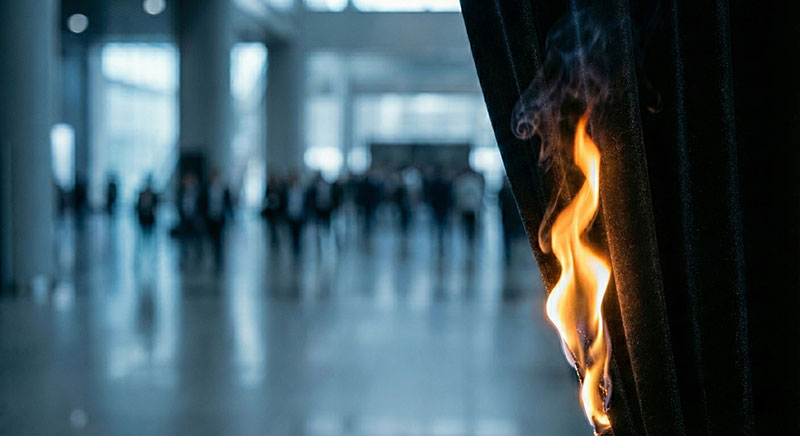
NFPA 701 applies to almost all flexible materials that are vertically hung or used for covering in public spaces. This is typically a mandatory requirement of local fire regulations (such as the IFC, International Fire Code).
Exclusions (Not Applicable):
NFPA 701 contains two distinct Test Methods. The choice of method is not based on client preference, but strictly depends on the density (weight) and composition of the fabric. Choosing the wrong method will render the test results invalid.
Method 1 is specifically designed to evaluate lighter, single-layer structures.
Method 2 applies to heavy fabrics, fabrics with special coatings, and plastic films. This is a more rigorous testing environment.
| Comparison Item | Method 1 | Method 2 |
|---|---|---|
| Primary Target | Light curtains, sheers, standard single-layer fabrics | Heavy draperies, coated blackout fabrics, tents, plastic films |
| Density Threshold | ≤ 700 g/m² (21 oz/yd²) | > 700 g/m² (21 oz/yd²) (or coated materials) |
| Specimen Form | Hung Flat | Usually Hung Folded (or Flat) |
| Ignition Time | 45 Seconds | 70 Seconds (Folded) / 120 Seconds (Flat) |
| Key Pass/Fail Metric | Mass Loss | Char Length |
To obtain an NFPA 701 certificate, the product must meet all the following criteria. Failure in any single aspect results in an overall failure of the test.
While NFPA 701 is the “baseline” across the US, you may encounter other standards when sourcing globally or for projects in specific states (like California).
| Standard | Region/Nature | Comparison Notes |
|---|---|---|
| NFPA 701 | USA (National Standard) | The most common baseline. Focuses on mass loss and dripping. Accepted by most states. |
| CA Title 19 | California, USA (Local Regulation) | Stricter. California often does not recognize certificates that are solely NFPA 701. It has extremely strict limits on char length and must be conducted by a California-registered laboratory. |
| EN 13501-1 | EU (CE Certification) | Completely different system. Europe uses a classification system (e.g., B-s1,d0). NFPA 701 is simply “Pass/Fail”. They are generally not interchangeable. |
| BS 5867 | UK | British curtain standard. Method 2 (Type B) is similar to NFPA 701, but test details differ, and they are not directly mutually recognized. |
Expert Advice: If your product is to be sold throughout the United States, the safest strategy is to pass both NFPA 701 and CA Title 19 tests. This covers the strictest requirements across all 50 states.
A: Absolutely not. This is a serious and dangerous misconception. NFPA 701 is a vertical burn test (for curtains). Sofas and seating use horizontal surfaces and must pass CAL TB 117 (cigarette smoldering test) or NFPA 260. Using NFPA 701 curtain fabric for a sofa will not only fail inspection but also poses a significant safety hazard.
A: Ordinary untreated 100% polyester is very difficult to pass. Standard polyester produces “Flaming Drips” when burning. In the NFPA 701 test, if these drips continue to burn on the floor for more than 2 seconds, it is an automatic failure. To pass, you must use IFR (Inherently Flame Retardant) polyester or fabric that has undergone high-quality FR topical treatment.
A: Not necessarily. NFPA 701 is a published test method standard. Reports from any ISO 17025 accredited third-party laboratory (such as Asian branches of SGS, Intertek, UL) that is qualified to perform NFPA 701 tests are generally accepted by US buyers and Fire Marshals. However, for California (CA Title 19), you must use a laboratory accredited by the Office of the State Fire Marshal (OSFM).
A: It is strongly recommended to choose Method 2. The vast majority of blackout fabrics feature acrylic or vinyl coatings. These coatings have high heat release rates when burning and are prone to producing specific dripping. Even if the weight is below 700g/m², the standard suggests using Method 2 for coated fabrics because the small ignition source of Method 1 may not accurately reflect their combustion risk.