Get in touch
Thank you for reaching out! Please tell us more about your needs — our expert team will get back to you within 24 hours.
Get in touch
Thank you for reaching out! Please tell us more about your needs — our expert team will get back to you within 24 hours.
Buying or manufacturing bedding for international markets can be a logistical nightmare. Between the confusing terminology, differing size standards in the UK and US, and strict fire safety regulations, there is a lot to get right. This guide breaks down everything you need to know about bedding components, quality parameters, and legal compliance to ensure your products meet industry standards. Whether you are a professional buyer or an interior designer, understanding these nuances is the difference between a high-quality sleep environment and a costly procurement mistake.

Before diving into technical specifications, it is essential to understand the basic vocabulary used in the industry. The following terms represent the standard components of a complete bed set. Knowing the difference between a topper and a pad, or a flat sheet and a fitted sheet, is crucial for accurate sourcing and consumer communication.

Modern mattresses are engineered using a layered approach. Each part of the “sandwich” contributes to the final feel and durability of the product. Manufacturers focus on these four main zones:

When evaluating the quality of bedding, manufacturers and buyers rely on specific metrics. These aren’t just marketing terms; they are quantifiable measurements of comfort, warmth, and material density.
Thread Count refers to the number of threads woven into one square inch of fabric. While a higher thread count often indicates a finer, softer fabric, it is important to remember that the quality of the raw yarn and the weave type are equally important for the overall feel and durability.
The Thermal Overall Grade (Tog) is the standard measurement for a duvet’s ability to trap heat. The higher the Tog rating, the warmer the duvet feels. This is a critical metric for markets with varying seasonal climates.
| Tog Rating | Best For | Season / Climate |
|---|---|---|
| 1 – 4.5 | Hot sleepers | Summer or very warm rooms |
| 7 – 10.5 | Average sleepers | Spring and Autumn (or all-year use) |
| 12 – 15 | Cold sleepers | Winter or very cold environments |
For duvets and pillows, insulation is defined by the volume of the filling and its weight. These two metrics help determine if a duvet is “light and fluffy” or “heavy and warm.”
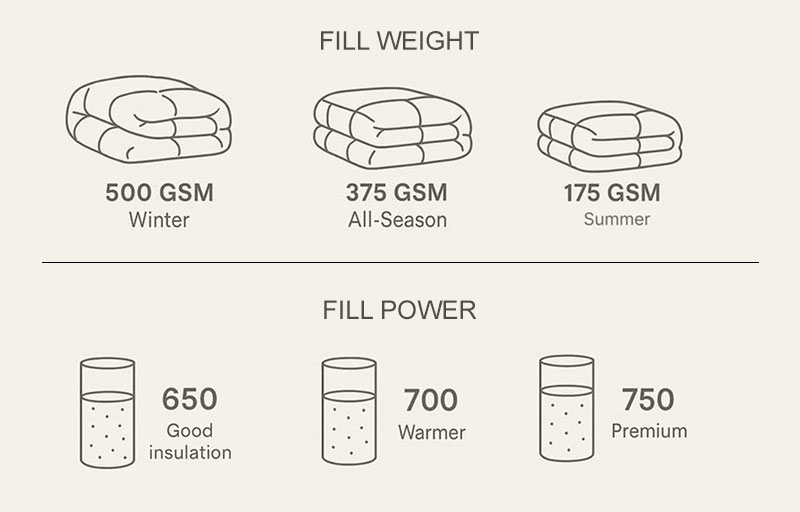
Summer Comfort: 175 GSM
All-Season Balance: 375 GSM
Winter Warmth: 500 GSM
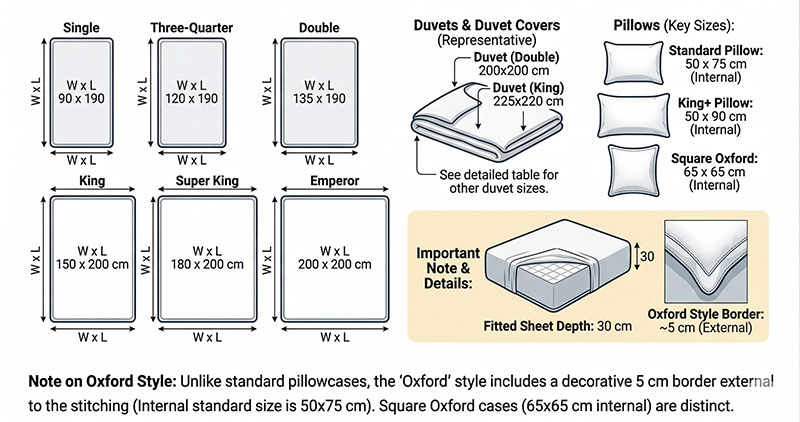
The UK market has standardized its dimensions based on metric measurements. One key detail for buyers is the “Fitted Sheet Depth,” which is standard at 30 cm for most UK linens to accommodate modern mattresses.
| Type | Base Mattress Size (cm) | Fitted Sheet Size (cm) | Duvet Size (cm) | Pillow Size (cm) |
|---|---|---|---|---|
| Single | 90 x 190 | 90 x 190 x 30 | 135 x 200 | 50 x 75 |
| Three-Quarter | 120 x 190 | 120 x 190 x 30 | 200 x 200 | 50 x 75 |
| Double | 135 x 190 | 135 x 190 x 30 | 200 x 200 | 50 x 75 |
| King | 150 x 200 | 150 x 200 x 30 | 225 x 220 | 50 x 90 |
| Super King | 180 x 200 | 180 x 200 x 30 | 260 x 220 | 50 x 90 |
| Emperor | 200 x 200 | 200 x 200 x 30 | 290 x 230 | 50 x 90 |
The Oxford Style: Unlike standard pillowcases, the “Oxford” style includes a decorative 5 cm border beyond the stitching. Standard Oxford cases measure 50 x 75 cm (internal), while Square Oxford cases are 65 x 65 cm.
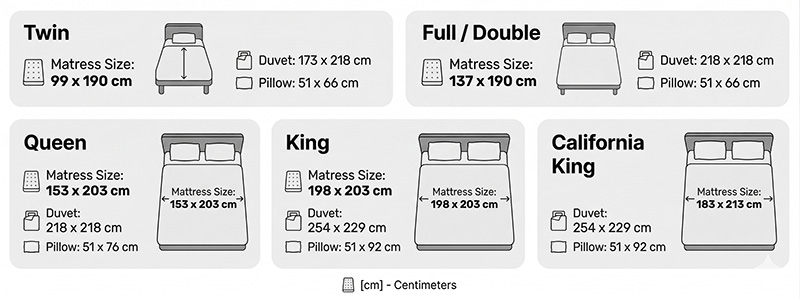
US sizes follow a different logic, often using imperial measurements as their base. They are generally slightly larger and wider than their UK counterparts.
| Type | Base Mattress Size (cm) | Duvet Size (cm) | Pillow Size (cm) |
|---|---|---|---|
| Twin | 99 x 190 | 173 x 218 | 51 x 66 |
| Full / Double | 137 x 190 | 218 x 218 | 51 x 66 |
| Queen | 153 x 203 | 218 x 218 | 51 x 76 |
| King | 198 x 203 | 254 x 229 | 51 x 92 |
| California King | 183 x 213 | 254 x 229 | 51 x 92 |
If you are sourcing across markets, you can use these approximations, but always check dimensions in centimeters to ensure a perfect fit:
The material of a mattress determines its firmness profile and how many years it will remain supportive. This table summarizes the industry averages for standard mattress types.
| Mattress Type | Firmness | Average Lifespan |
|---|---|---|
| Innerspring | Medium to Firm | 5 – 8 Years |
| Memory Foam | Soft to Medium | 8 – 10 Years |
| Latex | Medium | 10 – 12 Years |
| Hybrid | Medium | 8 – 10 Years |
Safety regulations are the most critical aspect of bedding production. Every region has its own testing methods to prevent fire-related accidents. Failure to meet these standards can lead to total product rejection at customs.
The United States has some of the most rigorous fire safety requirements in the world. Compliance is not optional.
Mandatory Limits for 16 CFR 1633: A mattress must not exceed a peak heat release rate of 200 kW within 30 minutes, and the total heat release in the first 10 minutes must be under 15 MJ.
Manufacturers must provide a General Certificate of Conformity (GCC) for adult mattresses and a Children’s Product Certificate (CPC) for crib mattresses, citing these specific regulations.
The UK standard BS 7177 is the primary benchmark for mattresses and bed bases. Testing involves BS EN 597-1 (cigarette) and BS EN 597-2 (match flame).
Other bedding items like sheets and pillows are covered under BS 7175, which uses similar ignition sources to evaluate safety.
While the EU also follows EN 597-1 and 597-2, it is generally considered less strict than the US standards because it focuses on ignition rather than heat release metrics.
| Region | Standard | Relative Strictness |
|---|---|---|
| Europe | EN 597 | 2 Stars |
| United Kingdom | BS 7177 | 4 Stars |
| United States | 16 CFR 1633 | 5 Stars |
Navigating these international standards requires a partner who understands the technical requirements of high-performance textiles. Begoodtex specialized in providing textiles that align with these strict global safety and quality benchmarks. Their product range includes flame-retardant (FR) fabrics and high-durability bedding solutions designed to meet both US 16 CFR and UK BS standards. For buyers looking for reliable, compliant fabrics that don’t sacrifice comfort for safety, Begoodtex offers a professional balance of functionality and premium feel.
Success in the UK and US bedding markets requires attention to detail across three areas: size, quality, and safety. UK sizes focus on depth (standard 30 cm), while US sizes are generally larger. Quality is measured by TC for sheets and Tog for duvets. Most importantly, safety standards in the US (16 CFR 1633) and UK (BS 7177) are among the strictest in the world, requiring specific testing for heat release and ignition resistance. Always ensure your certificates are in order before shipping to avoid compliance hurdles.
A mattress topper is a thick layer designed to change the comfort level, while a pad is a thin layer used for light protection and texture.
Choose 1-4.5 for summer, 7-10.5 for spring/autumn, and 12-15 for cold winter months.
Yes, UK King bedding is the closest match to US Queen, though you should verify the specific centimeter measurements for a perfect fit.
It measures not just if the mattress catches fire, but how much heat it releases, which is critical for fire safety in enclosed spaces.
A high-quality latex mattress typically lasts between 10 and 12 years, making it the most durable option on the market.
The standard internal size is 50 x 75 cm, which is the same as a standard pillowcase, plus the 5 cm decorative border.
Yes, Begoodtex focuses on high-quality textiles that meet various international safety standards, including flame-retardant options for commercial and domestic use.