Get in touch
Thank you for reaching out! Please tell us more about your needs — our expert team will get back to you within 24 hours.
Get in touch
Thank you for reaching out! Please tell us more about your needs — our expert team will get back to you within 24 hours.
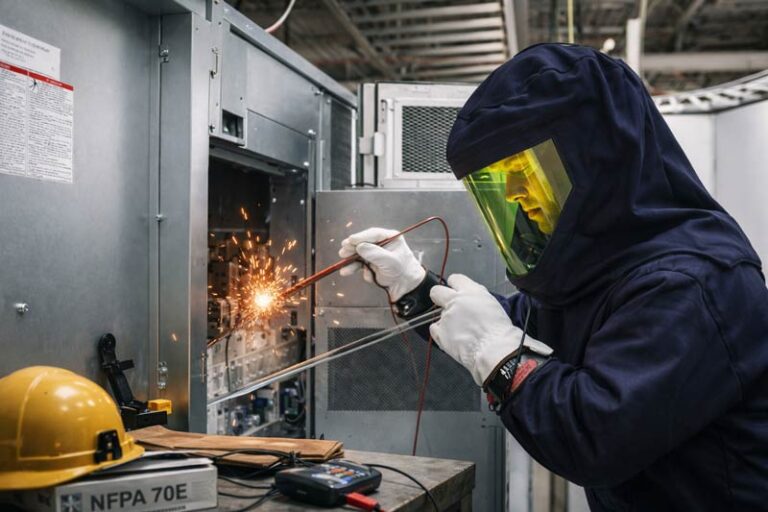
An arc flash is the “invisible killer” of the electrical world. In a split second, an arc flash can reach temperatures of 19,000 degrees C. For workers wearing standard clothing, or even low-quality flame-resistant (FR) gear, the results are catastrophic. The fabric doesn’t just catch fire; it can melt into the skin.
Many people buy workwear labeled “FR” and assume they are safe. However, being flame-resistant is not the same as being arc-rated. This is where ASTM F1506 comes in. It is the gold standard that separates basic safety gear from professional electrical protection.
ASTM F1506 is the performance specification and “rulebook” for protective clothing worn by electrical workers. It tells manufacturers exactly how a fabric must behave when exposed to extreme heat and electricity. It ensures that fabrics won’t ignite or melt during an arc flash by setting strict requirements for vertical flame tests and specific Arc Ratings (cal/cm2). If your gear isn’t ASTM F1506 compliant, it isn’t legally “arc-rated,” and it won’t provide the protection you need.
ASTM F1506 is a performance specification, meaning it defines the “floor” for safety. If a fabric doesn’t meet these metrics, it cannot be sold as arc-rated PPE.
This standard covers almost everything an electrical worker wears daily. This includes FR shirts, pants, coveralls, and even cold-weather jackets or undershirts. If it is part of your protective layer, it needs this certification.
However, it is important to know the boundaries. ASTM F1506 is not for firefighting (which follows NFPA 1971) and it is not designed for molten metal splash in a foundry (which follows ASTM F955). It is specifically built for the unique, intense heat of an electrical arc.
For a piece of clothing to be ASTM F1506 compliant, it must pass several “gatekeeper” tests. If it fails even one, it is out.
The “Arc Rating” is the most important number on your tag. It is measured in calories per square centimeter (cal/cm2). This number tells you how much heat energy the fabric can block before there is a 50 percent chance of a second-degree burn occurring.
You will often see two different types of ratings:
Modern brands like BEGOODTEX use advanced fibers like Aramid or Modacrylic blends. These high-performance materials allow for lightweight, breathable shirts that provide a high Arc Rating without the heavy bulk of traditional fabrics.
People often confuse these two, but they serve different roles. Think of ASTM F1506 as the Tool and NFPA 70E as the Instruction Manual. ASTM F1506 tells the manufacturer how to build the clothes, while NFPA 70E tells the worker which level of protection is needed for a specific job.
| Feature | ASTM F1506 | NFPA 70E |
|---|---|---|
| Primary Focus | Product Performance & Manufacturing. | Workplace Safety & Practices. |
| Who it’s for | Manufacturers and testing labs. | Employers, safety managers, and workers. |
| What it provides | The “Arc Rating” of the garment. | The “PPE Category” required for the task. |
| Testing | Requires strict lab testing (F1959/D6413). | Focuses on Risk Assessment. |
Choosing a fabric is a balance between safety, cost, and comfort. Most professional gear falls into two categories: Inherent and Treated.
| Feature | Inherent FR (e.g., Aramid) | Treated FR (e.g., FR Cotton) |
|---|---|---|
| Protection | Built into the fiber molecules. | Chemical finish applied to fabric. |
| Wash Life | Permanent; never washes out. | Can degrade with improper washing. |
| Comfort | Often lighter and moisture-wicking. | Feels like heavy denim or cotton. |
| Cost | Higher upfront cost. | Lower upfront cost. |
For outdoor utility work, look for high-visibility fabrics with UV resistance. For indoor maintenance, lightweight fabrics with high CFM (breathability) values are better for productivity.
Buying arc-rated gear is an investment. Don’t waste money on these common errors:
ASTM F1506 is the foundation of electrical safety. It guarantees that your workwear won’t ignite, melt, or lose its protection after a few washes. By choosing compliant gear and understanding the cal/cm2 rating, you are not just following the law—you are ensuring that every worker goes home safe. Focus on the label, choose the right fiber for your environment, and never compromise on the rating.
Yes. OSHA 1910.269 requires employers to ensure that employee clothing does not increase the extent of injury during an arc flash. ASTM F1506 is the industry-recognized standard to meet this legal requirement.
Yes, but follow the tag instructions carefully. Use mild detergents, avoid bleach and fabric softeners, and never wash AR gear with highly flammable oily rags.
Inherent fabrics last until the garment is physically worn out (holes or tears). Treated fabrics typically last 25 to 50 washes, but protection can vary if harsh chemicals are used.
ASTM F1506 is for arc flash. While many AR fabrics also pass NFPA 2112 (flash fire), you must check the label for both certifications if you work in an environment with both hazards.
According to NFPA 70E, PPE Category 2 requires a minimum arc rating of 8 cal/cm2. Always check your specific site risk assessment before choosing.