Get in touch
Thank you for reaching out! Please tell us more about your needs — our expert team will get back to you within 24 hours.
Get in touch
Thank you for reaching out! Please tell us more about your needs — our expert team will get back to you within 24 hours.
In the high-stakes world of industrial maintenance, a single spark can escalate into a catastrophic event in milliseconds. NFPA 70E is not just a regulatory document; it is the definitive blueprint for keeping personnel alive when working around energized electrical equipment. This article breaks down the “what” and “why” of NFPA 70E from a real-world engineering and procurement perspective, addressing how it mitigates life-altering risks like arc flashes. Whether you are a facility manager, a safety officer, or a procurement professional, understanding these guidelines is critical for establishing a culture of “safety by design” rather than “safety by luck.”
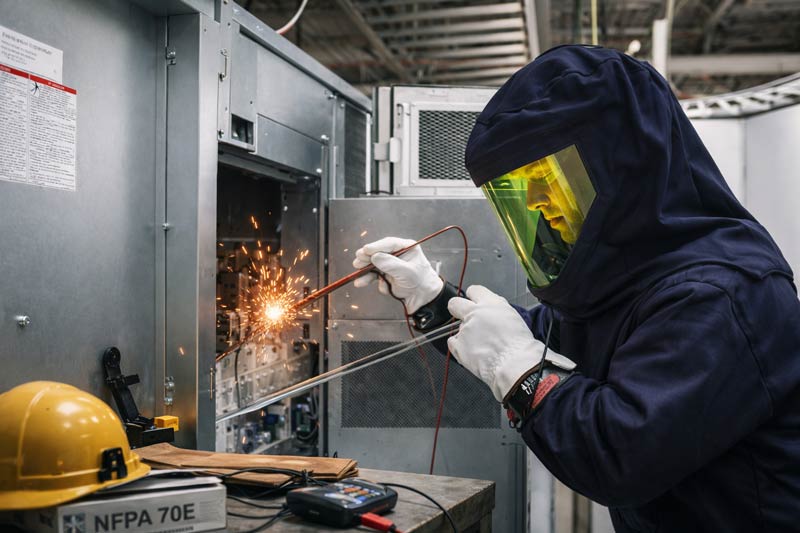
The core objective of NFPA 70E is to bridge the gap between installation safety (covered by the NEC) and the actual human interaction with live electricity. Many professionals mistakenly believe that if a building is “up to code,” the workers inside are safe. However, standard electrical codes focus on the facility, not the person. NFPA 70E addresses the volatile reality of electrical work, specifically focusing on preventing shock and arc flash—an explosive release of energy that can reach temperatures hotter than the surface of the sun.
In our 15 years of fabric R&D, we have seen the aftermath of ignored standards. An arc flash isn’t just a fire; it’s a pressure wave combined with intense thermal radiation. NFPA 70E forces companies to acknowledge this invisible threat by mandating risk assessments before any panel is opened.
Once we recognize that NFPA 70E is the shield between a worker and a potential disaster, the next logical question is: who exactly needs to be reading this manual and following its protocols?
NFPA 70E is not exclusively for licensed electricians; it creates a safety umbrella for anyone whose job brings them into proximity with energized equipment. In a typical factory or commercial setting, this “circle of responsibility” is much wider than most people realize. If your role involves making decisions about maintenance, site safety, or the procurement of protective gear, you are a stakeholder in NFPA 70E compliance.
Identifying who is at risk is the first step in any electrical safety program. We often consult with companies where the HR or Procurement teams were unaware that their decisions on “standard workwear” directly impacted their NFPA 70E compliance status.
| Role | Responsibility under NFPA 70E | Risk Factor |
|---|---|---|
| Electrical Engineers | Performing Arc Flash Hazard Analysis | High: Direct exposure to energized parts. |
| Safety Managers | Developing the Electrical Safety Program (ESP) | Medium: Oversight of LOTO and PPE usage. |
| Procurement/Buyers | Sourcing certified Arc-Rated (AR) clothing | Low: Liability for providing incorrect gear. |
| Facility Maintenance | Troubleshooting HVAC and lighting systems | High: Frequent interaction with control panels. |
Identifying the stakeholders is only half the battle; the real engineering challenge lies in how we prioritize safety measures once the risks are identified.
A common misconception in the textile industry is that Personal Protective Equipment (PPE) is the first line of defense. NFPA 70E explicitly demands a “Hierarchy of Risk Control,” where PPE is actually the final, least-preferred option. From an engineering standpoint, we always advocate for “de-energizing” as the primary goal. If the equipment is dead, the risk of an arc flash is zero.
“PPE is the last line of defense, not the first. The most successful safety programs focus on eliminating the hazard before the worker even puts on an arc-rated suit.”
While we strive to eliminate hazards, reality often dictates that work must be done on or near energized parts, which brings us to the core technical elements of the NFPA 70E standard.
A compliant NFPA 70E program is built on three pillars: Assessment, Documentation, and Training. You cannot simply buy a set of coveralls and call yourself “compliant.” In our experience working with global manufacturers, the most robust programs are those that integrate Incident Energy Calculations directly into their daily work permits. This ensures that every task is matched with the appropriate level of protection.
Each of these elements must work in tandem to create a fail-safe environment for the employee. If one pillar fails, the entire safety structure collapses during an incident.
This is the technical heart of the standard. Engineers calculate the potential “Incident Energy” at a specific working distance. This value, measured in calories per square centimeter (cal/cm2), dictates exactly what fabric weight and PPE category a worker must wear to survive a potential blast.
Except for specific tasks like testing and troubleshooting, NFPA 70E requires a written permit for live work. This document forces the team to justify why the power cannot be turned off and lists every safety precaution taken, including the specific boundaries established to keep non-qualified personnel away.
Understanding the boundaries and permits leads us to the final, most visible aspect of NFPA 70E: the selection of the correct protective clothing.
Choosing the right PPE is where many procurement teams “trip up.” NFPA 70E categorizes electrical hazards into four PPE Categories (CAT 1 to CAT 4). Each category requires a minimum Arc Thermal Performance Value (ATPV). From an R&D perspective, the challenge is balancing this protection with comfort; a CAT 4 suit is heavy and hot, which can lead to worker fatigue and heat stress.
| PPE Category | Min. Arc Rating (cal/cm2) | Typical Clothing Requirements |
|---|---|---|
| Category 1 | 4 cal/cm2 | Single-layer AR shirt and pants. |
| Category 2 | 8 cal/cm2 | AR shirt/pants or AR coverall + face shield. |
| Category 3 | 25 cal/cm2 | AR suit system (flash hood + multi-layer gear). |
| Category 4 | 40 cal/cm2 | Heavy-duty multi-layer AR “Bomb Suit”. |
In the textile industry, we often see buyers confuse “Flame-Resistant” (FR) with “Arc-Rated” (AR). While all AR fabrics are FR, not all FR fabrics are AR. For NFPA 70E, you must use Arc-Rated materials that have been specifically tested for their ability to insulate against the thermal energy of an electrical arc, not just their ability to self-extinguish a flame.
Selecting the gear is vital, but its performance over time depends entirely on how it is maintained and managed throughout its lifecycle.
The protective qualities of AR clothing can be compromised by improper care. At Begoodtex, we specialize in Inherently Flame-Retardant (IFR) fibers because they offer a permanent safety solution. Unlike chemically treated fabrics where the protection can “wash out,” IFR fabrics maintain their NFPA 70E compliance for the life of the garment, provided they are kept free of flammable contaminants.
NFPA 70E is more than a set of rules—it is a comprehensive methodology for managing the inherent risks of a modern, electrified workplace. By understanding the hierarchy of controls, accurately calculating incident energy, and selecting the highest quality inherent arc-rated textiles, organizations can protect their most valuable asset: their people. For the technical decision-maker, compliance is not about ticking a box; it is about ensuring that every worker who starts their shift goes home safely at the end of it.
While NFPA 70E is a voluntary standard, OSHA uses it as the primary yardstick to judge whether a company has met its legal obligation to provide a safe workplace. Non-compliance often leads to heavy fines after an incident.
No. While cotton is better than synthetic meltable fabrics (like polyester), it is not “Arc-Rated.” Under NFPA 70E, if the incident energy exceeds 1.2 cal/cm2, arc-rated PPE is mandatory.
NFPA 70E requires an update every five years or whenever major changes are made to the electrical system that could affect the incident energy levels.
No. While the FR property is permanent, you must still replace the garment if it is torn, heavily soiled with oil/grease, or shows signs of significant mechanical wear