Get in touch
Thank you for reaching out! Please tell us more about your needs — our expert team will get back to you within 24 hours.




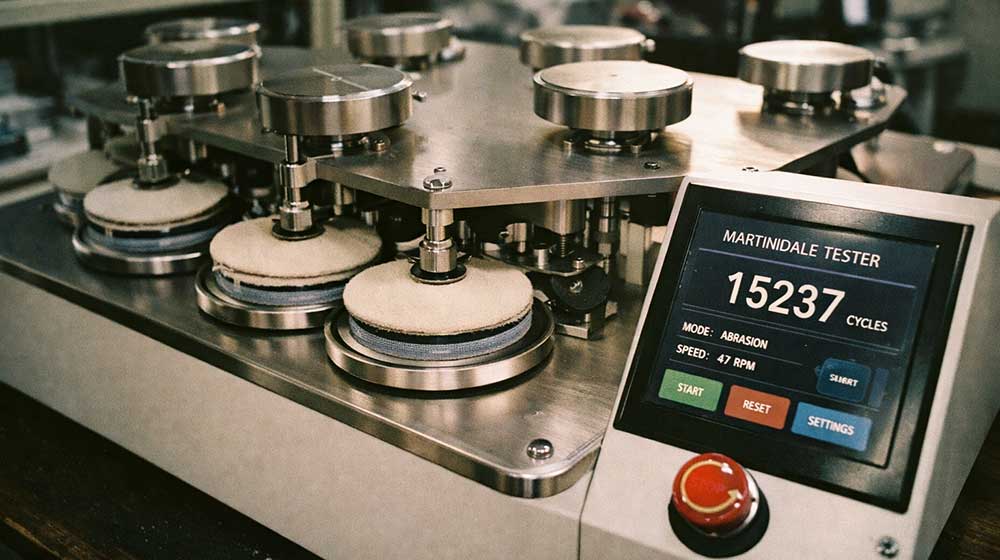
When buyers ask, “How many years will this sofa fabric last?” or “Is this commercial-grade fabric?”, what they really want to see is the abrasion cycle data from ASTM D4966—the Standard Test Method for Abrasion Resistance of Textile Fabrics using the Martindale Abrasion Tester.
Quick answer (ASTM D4966): ASTM D4966 is the US standard test method for measuring a textile fabric’s resistance to surface abrasion with the Martindale tester. The machine rubs the specimen in a complex, multi-directional Lissajous-figure path against a standard worsted wool abradant, and the result is reported as the number of “cycles” (rubs) survived before breakdown. For upholstery the test runs at 12 kPa; 20,000 cycles is the typical entry point for furniture, while 100,000+ cycles signals top-tier commercial durability.
As one of the most widely accepted abrasion test methods worldwide, ASTM D4966 simulates the multi-directional friction a fabric meets in real use. The higher the cycle count, the more “durable” the fabric. For furniture exported to Europe and the US, 20,000 cycles is usually the starting line, while 100,000 cycles marks the top tier.
ASTM D4966 was developed by ASTM International (formerly the American Society for Testing and Materials). Although the US market traditionally leaned on the Wyzenbeek test, ASTM D4966 has taken a dominant position in international trade and the high-end furniture market as global supply chains converged. Its testing principle is regarded as more scientific because it simulates real wear through multi-directional friction rather than a single back-and-forth stroke.
Note: The “-12” after the standard code marks the version year (for example, the 2012 edition). In daily practice the industry simply says “ASTM D4966,” which is the current mainstream version.
The heart of ASTM D4966 is its distinctive friction trajectory. The method is named after Dr. Martindale, who designed the instrument in the 1940s to mimic the uneven, rotating pressure a seated body places on upholstery. Unlike simple linear “back-and-forth” rubbing, the Martindale tester drives the specimen along a complex path across the abradant known as the Lissajous figure.
This path resembles ever-shifting circles and ellipses. Its real value is that it mimics the irregular, multi-angle friction a body produces when sitting on a sofa—widely seen as a more realistic and scientific method than linear abrasion, ensuring the yarns are stressed evenly from every direction.
💡 Related reading: For a hands-on look at how the machine operates and how results are read, see our guide to textile abrasion and FR testing.
The standard spans nearly every textile category, with subtle differences by field:
For a broader look at the flame-retardant fabric families that routinely carry Martindale ratings, our catalog maps each construction to its typical cycle range and fire code.
Exception: Carpets usually fall under dedicated standards such as ASTM D5252 and are outside this method.
ASTM D4966 itself only prescribes the method—it does not set a pass/fail line. Acceptance levels are normally defined by industry bodies (such as ACT, the Association for Contract Textiles) or by individual buyers. The following are common furniture-industry reference points:
| Durability Level | Typical Cycles (Rubs) | Applicable Scenarios |
| Delicate / Decorative | < 10,000 | Throw pillows, curtains, items rarely touched |
| Light Domestic | 10,000 – 15,000 | Occasional-use furniture, delicate silk or viscose blends |
| General Domestic | 15,000 – 25,000 | Daily-use family sofas (mainstream) |
| Heavy Duty | 25,000 – 40,000 | High-frequency homes with kids or pets, home offices |
| Commercial | ≥ 40,000 | Hotel lobbies, restaurants, office chairs |
ACT’s performance guidelines are published openly for specifiers who need to translate “cycles” into a procurement requirement—see the Association for Contract Textiles.
To keep data authoritative, labs follow a fixed procedure and stop when a defined condition is met.
Parameter setting
Operation and inspectionStart the machine; the specimen rubs the abradant along the Lissajous path. The operator must pause for inspection at set intervals (commonly every 5,000 cycles).
End-point determinationRecord the cycle count as the final result when any of these occur:
Many buyers confuse these two because they are mechanically near-identical. The differences are systemic, not procedural:
| Comparison Item | ASTM D4966 | ISO 12947-2 |
| Organization | ASTM International (USA) | ISO (International) |
| Core principle | Martindale (Lissajous) | Martindale (Lissajous) |
| Parameters | 9 kPa / 12 kPa | 9 kPa / 12 kPa |
| Main difference | Belongs to the US standard system; cited when US buyers accept Martindale data | Belongs to the international/European system; source of EU and GB standards |
| Data compatibility | Extremely high—results are usually interchangeable | Extremely high |
For the full picture across regions, our overview of global FR testing standards compares ASTM, ISO, EN, and GB approaches side by side.
This is the classic US-market pain point. Many traditional American buyers recognize only Wyzenbeek.
Expert tip: There is no official conversion formula between the two. The rule of thumb “1 Wyzenbeek ≈ 1.5 Martindale” is highly unreliable. If you only hold Martindale data, run a dedicated ASTM D4157 test for the US market.
To push Martindale numbers higher, fabric R&D should focus on three levers:
Our polyester flame-retardant fabrics are a practical example—high-tenacity yarn plus tight construction lifts both abrasion life and fire safety at once.
At BEGOODTEX we treat ASTM D4966 as a product-development compass, not just a number. Through material science we target different needs:
High-traffic commercial scenariosFor hotel lobbies, KTVs, and restaurants we use high-tenacity modified synthetics (specialized polyester or nylon) with high-density weaves. This physically raises wear resistance—engineered constructions hold Martindale data above 50,000 cycles even at 12 kPa heavy pressure, meeting strict commercial specs.
Functional protection + abrasion synergyAppropriate finishing can assist physical performance. Layering Easy-Clean technology onto an abrasion-resistant base not only blocks stains; at the microscopic level the coating also acts as “lubricating protection,” cutting inter-fiber friction loss and extending service life in real use.
If you are specifying fire-retardant upholstery fabric for a project, pair the Martindale rating with the relevant fire code (for example, NFPA 260 / BS 5852 / EN 1021) so one fabric clears both durability and safety.
Misconception: higher cycles mean better fabric.Not necessarily. Abrasion resistance is one physical metric. A polyester at 100,000 cycles can feel like sandpaper and look dull. A truly good fabric balances high abrasion, soft hand, fire safety, and design.
Misconception: pilling equals poor abrasion resistance.False. These are separate tests. ASTM D4966 measures breakdown (holes/breakage); pilling is typically covered by ASTM D3512. Many high-tenacity abrasion fabrics (high-twist polyester) actually pill more. A fabric can break without pilling, or pill without breaking.
Caution: the “pressure” trap.When reading reports, check the “Test Pressure” column. For upholstery it must be 12 kPa. A high score at 9 kPa looks great but is invalid for furniture because it fails to mimic the real load of a seated body.
Roughly 3–5 years of normal household use, but it depends heavily on intensity—active children, pets, and sofa construction all shift the number.
For delicate pile fabrics the goal may be to observe “pile matting” or “appearance change” rather than grind to a hole. Some specs pass once no significant change shows by a set count (for example, 20,000), without destroying the sample.
Yes—huge. 12 kPa applies more pressure and causes more severe wear. For upholstery you must confirm the lab used 12 kPa.
No. ASTM D4966 measures abrasion only. Fire performance is covered by separate standards (NFPA 701, BS 5852, EN 1021, and others). When specifying contract upholstery, request both the Martindale rating and the applicable FR test so the fabric clears durability and safety in one shot.
No official formula exists. The “1 Wyzenbeek ≈ 1.5 Martindale” rule of thumb is unreliable. If a US buyer requires Wyzenbeek, run a dedicated ASTM D4157 test rather than converting.
ASTM D4966 (Martindale) remains the clearest common language for fabric durability in international and high-end furniture trade. Three takeaways for buyers and specifiers:
For project-specific Martindale targets and FR pairings, reach out through our contact page—our technical team maps the right construction to your cycle and code requirements.