Get in touch
Thank you for reaching out! Please tell us more about your needs — our expert team will get back to you within 24 hours.




In international textile trade, when buyers from Europe, Australia, or Asia ask, “How many abrasion cycles does this fabric have?” they are almost strictly referring to the test results of ISO 12947-2.
As the core part of the ISO 12947 series, it defines the number of friction cycles a fabric withstands using the Martindale instrument until “Specimen Breakdown” occurs. For furniture fabric exporters, this is an essential “health check.” Generally, residential fabrics need to reach 15,000 – 25,000 cycles, while commercial contract fabrics need to challenge 30,000 or even 50,000+ cycles.
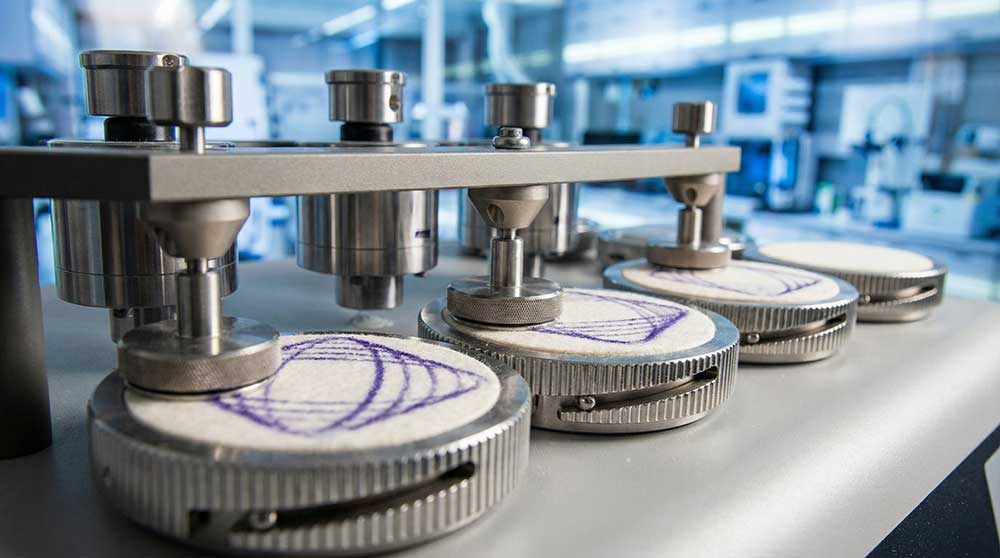
ISO 12947 was developed by the International Organization for Standardization (ISO) to unify global textile abrasion test methods. The series actually contains four parts, and understanding them helps you read complete test reports:
ISO 12947-2 also utilizes the Lissajous Figure trajectory for multi-directional friction. The principle involves clamping a circular specimen onto a holder and rubbing it against a standard wool abradant mounted on a table under specified pressure.
The trajectory shifts from a circle to a gradually widening ellipse, then back to a straight line, repeating the cycle. This ensures that both warp and weft yarns receive uniform wear, avoiding the bias of unidirectional friction.
💡 Related Reading: For a deeper analysis of the Martindale test principle, please click: Martindale Abrasion Test Explained: Principle, Applications & Global Standards.
This standard is a true “all-rounder,” applicable to almost all types of textile fabrics:
Note: For pile fabrics, if the pile is worn off but the base fabric is not broken, it is usually also considered the test end point.
ISO 12947-2 provides only test data (cycles) and does not prescribe a “pass” line. Specific grading is usually based on application standards like BS 2543 or EN 14465 (EU Furniture Standard):
| Performance Level | Recommended Cycles (ISO 12947-2) | Typical Application Scenarios |
|---|---|---|
| Decorative | < 10,000 Cycles | Throw pillows, display chairs only. |
| Light Use | 10,000 – 15,000 Cycles | Bedroom furniture, occasional use chairs. |
| General Domestic | 15,000 – 25,000 Cycles | Living room sofas (Daily use). |
| Severe Domestic | 25,000 – 30,000 Cycles | High-frequency home environments with children and pets. |
| Contract | 30,000 – 40,000 Cycles | Offices, hotel guest rooms. |
| Severe Contract | ≥ 50,000 Cycles | Airports, hospitals, lobbies, transport seating. |
The testing process of ISO 12947-2 is known for its rigor. Testers need to strictly execute the following steps and accurately capture the moment of fabric “breakdown.”
Abradant: Use Standard Wool Abradant to ensure global consistency.
Pressure Selection (Crucial):
9 kPa (595g): Used for apparel fabrics and home textiles.
12 kPa (795g): Dedicated to Upholstery Fabrics. Sofa fabric testing must use 12 kPa, otherwise, the data is artificially high and invalid.
After the machine starts, the frequency of stoppage for inspection is dynamically adjusted as cycles increase. For example, every 1,000 cycles before 6,000; every 5,000 cycles after 50,000. This is to precisely capture the moment of breakage.
The test is terminated when the fabric shows “breakdown” matching the following definitions, and the cycles are recorded:
Although both use the Martindale instrument, their identities differ in global trade:
| Feature | ISO 12947-2 | ASTM D4966 |
|---|---|---|
| Identity | International Standard. The universal global language. | American Standard. The version under the US ASTM system. |
| Associated Standards | Equivalent to China’s GB/T 21196.2; linked with EU EN 14465. | Independent of the US system, often used as a supplement to Wyzenbeek. |
| Test Differences | Minimal. Almost identical in equipment, principle, and pressure parameters. | Minimal. |
| Selection Advice | If the client is in Europe, Australia, Asia, or the Middle East, provide an ISO report first. | If the client is in the US and explicitly requests “Martindale” data, provide an ASTM report. |
💡 Understand the US Version: If your clients are primarily in the US, we recommend you also learn about the American standard version: ASTM D4966 Standard Guide.
Clients often ask, “What does ISO 12947-2 equal in Wyzenbeek?” There is no standard answer.
Expert Tip: Some fabrics run 20,000 Martindale cycles but 100,000 Wyzenbeek double rubs (like Chenille); others run 50,000 Martindale but only 15,000 Wyzenbeek (like certain coated fabrics). It is recommended to test separately for target markets and not attempt conversion.
To get a high score in ISO 12947-2, fabrics need to possess:
High Abrasion Resistant Fibers
Polyamide (Nylon) > Polyester > Cotton > Viscose. If the budget allows, adding Nylon is the most direct way to improve abrasion resistance.
Yarn Structure
Plied yarns are more durable than single yarns; High twist yarns are more durable than low twist yarns.
Weave Structure
The more interlacing points, the more durable (Plain > Twill > Satin). Tightly woven fabrics can better resist external friction.
For High Traffic Areas, BEGOODTEX has developed targeted material solutions based on the ISO 12947-2 standard to solve specific durability pain points:
For extreme environments like airport seating and 24-hour call centers, we use high-tenacity modified nylon or specialized polyester blends. Test data shows that these fabrics can exceed 100,000 cycles under the ISO 12947-2 (12 kPa) standard. Our goal is to ensure the fabric’s physical life far exceeds the furniture’s refurbishment cycle through material selection.
Traditional velvet is often not durable and prone to pile matting or shedding. We use a unique “W-type” pile weaving technology to greatly enhance the pile’s grip, with test data > 50,000 cycles. This effectively solves the problem of “bald spots” in traditional velvet while maintaining a luxurious hand feel and achieving engineering-grade durability.
While test data is objective, interpreting it can lead to biases. Here are common pitfalls to avoid when sourcing fabrics:
Correction: False. Abrasion testing measures “Physical Breakdown” (Will it tear?), while Pilling testing measures “Surface Pilling” (Will it fuzz?). For pilling, please refer to ISO 12945-2. Ironically, polyester filaments used to pursue extreme abrasion resistance are often more prone to pilling.
Crucial Tip: This is the most hidden trap. When viewing an ISO report, be sure to check the “Test Pressure” column. If you are buying furniture fabric, it must say 12 kPa. If a high score is achieved at 9 kPa, it is invalid in the furniture industry because it underestimates human sitting pressure.
A: Many labs stop testing once the fabric reaches the client’s required threshold (e.g., 50,000 cycles) if it hasn’t broken yet, and issue a report saying “> 50,000”. This is usually done to save testing costs and time. This already represents excellent quality.
A: Completely identical. China’s GB/T 21196.2 is “Identical (IDT)” to ISO 12947-2. Reports from certified Chinese labs using the GB standard are often recognized internationally because the technical parameters are consistent.
A: For certain thick coated fabrics (like PU leather), ISO 12947-2 is applicable. However, special attention should be paid to coating peeling. If the coating wears off first, it is usually considered the test end point.