Get in touch
Thank you for reaching out! Please tell us more about your needs — our expert team will get back to you within 24 hours.
Get in touch
Thank you for reaching out! Please tell us more about your needs — our expert team will get back to you within 24 hours.
In the field of industrial safety, EN ISO 11612 is the gold standard for evaluating the performance of heat and flame-resistant protective clothing. For procurement professionals in Oil & Gas, Metallurgy, Utilities, and Manufacturing, understanding the A-F performance codes of this standard is critical to ensuring compliance and safeguarding worker lives.
This guide provides a comprehensive breakdown of the EN ISO 11612 test methods, the meaning of the six performance modules (A-F), and the core differences between this standard, the welding standard EN ISO 11611, and the American standard NFPA 2112.
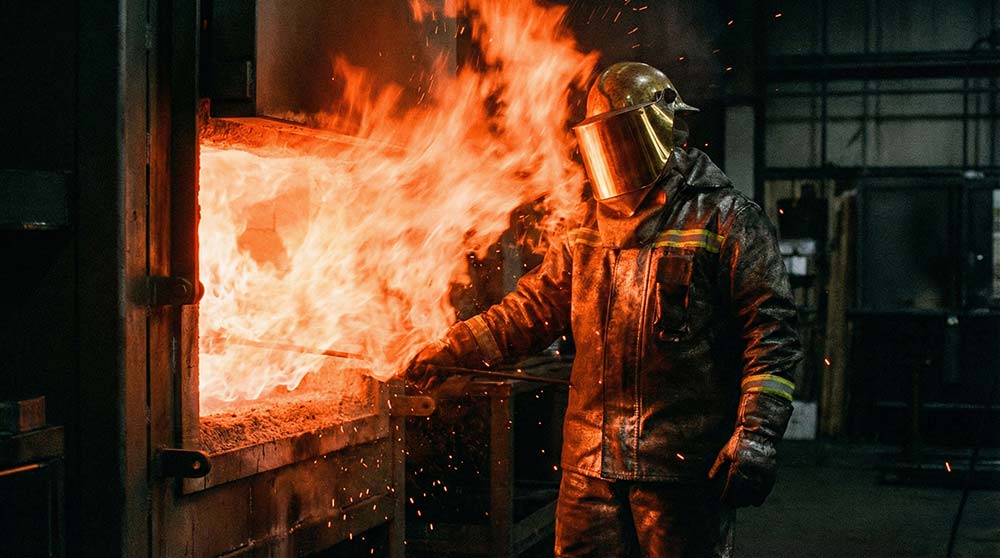
EN ISO 11612:2015 (Protective clothing — Clothing to protect against heat and flame) is an international standard specifying performance requirements for protective clothing made from flexible materials. Its core purpose is to protect workers from second-degree burns during short-term exposure to flame, radiant heat, or molten metal splashes.
Key Facts:
EN ISO 11612 is a versatile industrial heat protection standard. Its “modular” nature makes it applicable to various industries with thermal hazards. If your work environment involves the following risks, this certification is typically mandatory:
To achieve EN ISO 11612 certification, protective clothing or fabrics must undergo a rigorous series of physical tests. Each performance code (A-F) corresponds to a specific ISO test standard. Below is the technical mapping table:
| Performance Code | Test Name | ISO Standard | Test Purpose |
|---|---|---|---|
| Code A | Limited Flame Spread | ISO 15025 | Evaluates self-extinguishing properties after contact with a naked flame. |
| Code B | Convective Heat | ISO 9151 | Tests thermal insulation when surrounded by flame. |
| Code C | Radiant Heat | ISO 6942 | Tests time to burn when facing a strong radiant heat source. |
| Code D | Molten Aluminum Splash | ISO 9185 | Tests resistance to adhesion and burn-through by molten aluminum. |
| Code E | Molten Iron Splash | ISO 9185 | Tests resistance to adhesion and burn-through by molten iron. |
| Code F | Contact Heat | ISO 12127 | Tests protection time when contacting objects at 250°C. |
The numbers following the codes on a certificate (1-3 or 1-4) indicate the level of protection. Higher numbers represent stronger protection. Here are the specific definitions:
This is the entry threshold. During the test, the fabric must not drip, shrink, or develop a hole.
Procurement Tip: Most high-spec tenders require fabrics to pass both A1 + A2.
This measures the time required for heat to penetrate the fabric and raise the temperature of a calorimeter (simulating skin) by 24°C (HTI 24).
| Level | HTI 24 (Seconds) | Protection Level |
|---|---|---|
| B1 | 4.0 – < 10.0 | Basic Protection |
| B2 | 10.0 – < 20.0 | Medium Protection |
| B3 | ≥ 20.0 | High Protection |
Simulates heat radiation from high-temperature sources. The test measures the time to reach a second-degree burn threshold (RHTI 24) under specific heat flux density.
| Level | RHTI 24 (Seconds) | Typical Application |
|---|---|---|
| C1 | 7.0 – < 20.0 | General Industrial |
| C2 | 20.0 – < 50.0 | Proximity to Heat Sources |
| C3 | 50.0 – < 95.0 | High Radiant Environments |
| C4 | ≥ 95.0 | Extreme Environments (Aluminized fabric usually required) |
Evaluates if molten metal adheres to the fabric or damages the skin simulation behind it.
Grading is based on the minimum weight (grams) of molten metal required to damage the artificial skin. Higher levels withstand larger splashes.
Simulates accidental contact with hot objects at 250°C.
This is the most common question in global procurement. While both are FR standards, their focus and testing logic differ significantly:
| Comparison Dimension | EN ISO 11612 (EU/International) | NFPA 2112 (USA/North America) |
|---|---|---|
| Core Logic | Modular Grading (A-F), rates specific thermal hazards individually. | Pass/Fail System, focuses on overall Flash Fire protection. |
| Mannequin Test | Optional (ISO 13506). Not mandatory for certification. | Mandatory (ASTM F1930). Requires <50% body burn after a 3-second flash fire. |
| Washing Test | Typically tested after 5 or 50 wash cycles. | Mandatory testing after 100 Industrial Wash cycles. |
| Target Market | Europe, Asia, Middle East, General Industry. | USA, North America, Offshore Oil Rigs. |
Many clients confuse these two standards. Simply put, EN ISO 11612 is the “General Heat & Flame” standard, while EN ISO 11611 is the “Welding & Allied Processes” standard. EN ISO 11611 is ‘specialized professional gear’ for welders, while EN ISO 11612 is ‘general-purpose fire-resistant clothing’ for industrial heat hazards. Here is the detailed comparison:
| Comparison Dimension | EN ISO 11612 (General Heat) | EN ISO 11611 (Welding Specific) |
|---|---|---|
| Primary Use | Protection against radiant, convective, contact heat, and large molten splashes. | Protection against welding Spatter, radiant heat, and accidental electrical shock. |
| Electrical Insulation | No Requirement. | Mandatory. Resistance must be > 10^5 Ω at 100V DC to prevent electric shock. |
| Metal Splash Test | Large Splash (D/E): Tests massive amounts (grams) of molten metal poured onto fabric. | Small Spatter (Impact): Tests the number of small drops required to raise temperature. |
| Grading System | A-F Performance Codes. | Class 1 (Light Welding) and Class 2 (Heavy/Confined Welding). |
Conclusion: If workers are engaged in professional welding, EN ISO 11612 alone is insufficient. They must also be certified to EN ISO 11611 to ensure electrical insulation and protection against small spatters.
Passing the fabric test alone does not make a garment EN ISO 11612 compliant. The finished garment must adhere to strict design specifications to prevent heat entrapment or molten metal retention:
Choosing the right fabric material depends entirely on your specific working conditions:
A: No. While EN ISO 11612 covers heat and flame resistance, Arc Flash is a distinct hazard. If you require arc flash protection, you must verify that the product also meets the IEC 61482-2 standard and check its ATPV or EBT rating.
A: This depends on the test selection. A1 tests surface ignition, while A2 tests edge ignition. Some fabrics or specific end-uses may only require A1. However, for global versatility, we recommend procuring fabrics that pass both A1 + A2.
A: EN ISO 14116 (formerly EN 533) is a lower-level standard solely for “Limited Flame Spread.” It does not include tests for Convective Heat (B), Radiant Heat (C), etc. If the risk is minimal (occasional exposure only), 14116 may suffice; but for regular industrial hazards, 11612 is mandatory.