Get in touch

Thank you for reaching out! Please tell us more about your needs — our expert team will get back to you within 24 hours.

弹窗表单

Aramid Fabric Explained: A Comprehensive Guide from Molecular Structure to Ultimate Fire Protection

In high-risk fields such as firefighting, aerospace, military, and industrial manufacturing, the requirements for protective materials go far beyond “usable”—they must be “absolutely reliable” under extreme conditions. Traditional textiles are vulnerable to high temperatures and flames, and many primary flame-retardant materials suffer from performance degradation or toxic release. The emergence of Aramid has fundamentally changed this situation.

Aramid is not a single material but a family of high-performance fibers. With its “inherent flame resistance” derived from its chemical structure, it has set an unparalleled benchmark in the field of safety protection.

This page is your authoritative aggregate guide. We will explore the “Why” and “How” of aramid in a rigorous, logical order. Starting from its chemical essence, we will analyze its fire-protection mechanism, authoritative standards, family classifications, product forms, key applications, environmental safety, and finally, compare it with traditional materials. Whether you are an engineer, purchasing manager, or safety standards setter, this is the core knowledge you need.

Aramid Fabric
Aramid Fabric

I. What is Aramid fabric? Definition and Classification of High-Performance Fibers

Aramid, short for “Aromatic Polyamide,” is a class of high-performance synthetic fibers developed in the 1960s. It is hailed as a “super fiber” and is recognized alongside carbon fiber and ultra-high-molecular-weight polyethylene (UHMWPE) as one of the world’s three major high-performance fibers.

The name “Aramid” reveals its chemical essence: “Aromatic” refers to the high content of rigid benzene ring structures in its molecular backbone; “Polyamide” indicates that it is connected by strong amide bonds. Although Nylon is also a polyamide, it is an “aliphatic” polyamide, with a flexible and flammable molecular chain. Aramid’s “aromatic” structure, however, creates a qualitative leap in chemical stability, thermal stability, and mechanical strength, elevating it into the “high-performance” category.

1. Aramid’s Core Chemical Structure

Aramid’s superior performance is rooted in its highly ordered molecular structure with extremely high bond energy. The rigid benzene rings make the molecular chains difficult to move, deform, or degrade at high temperatures; meanwhile, the numerous amide bonds form a powerful hydrogen bond network between the chains, making them extremely difficult to pull apart. It is this “rigid backbone + strong hydrogen bonds” combination that endows aramid with its unparalleled comprehensive properties:

  • Extreme thermal stability: Does not burn or melt.
  • Exceptional mechanical strength: High strength and high modulus (resistance to deformation).
  • Excellent chemical inertness: Resistant to corrosion and solvents.

2. The Two Major Aramid Fabric Families: Meta and Para

The aramid family is primarily divided into two main classes, which have distinct properties and applications. We will compare them in-depth in the article on the differences between Aramid 1313 and 1414:

  • Meta-Aramid (Aramid 1313): Its molecular chain has a flexible “zigzag” structure. Its core advantages are exceptional heat resistance, flame retardancy, and electrical insulation. It can be used long-term at 250°C without significant aging or degradation, making it ideal for firefighting suits, arc flash protection, high-temperature filtration materials, and electrical insulation paper.
  • Para-Aramid (Aramid 1414): Its molecular chain has a rigid, linear “rod-like” structure. Its core advantage is unimaginable mechanical strength (5-6 times that of steel by equal weight) and cut resistance. It is primarily used for body armor, stab-resistant vests, cut-resistant gloves, and structural reinforcement composites.
Fireproof Aramid Fabric

3. From Fiber to End-Product

Aramid is not just a fiber; it is the starting point of an entire industrial chain. These two core fibers are processed into a series of standardized aramid product forms to meet various processing needs, for example:

  • Aramid Fibers: As industrial raw materials (e.g., short-cut fibers, solution-dyed fibers).
  • Aramid Yarns: As textile intermediaries (e.g., blended yarns, flame-retardant sewing threads).
  • Aramid Fabrics: As end-products (e.g., aramid textiles, aramid webbing).
  • Aramid Paper & Pulp: As specialty industrial materials (e.g., electrical insulation, friction materials).

Now that we understand the definition and classification of aramid, we will next delve into its most critical feature: why it doesn’t burn.

II. Core Decryption: Why Is Aramid Fireproof?

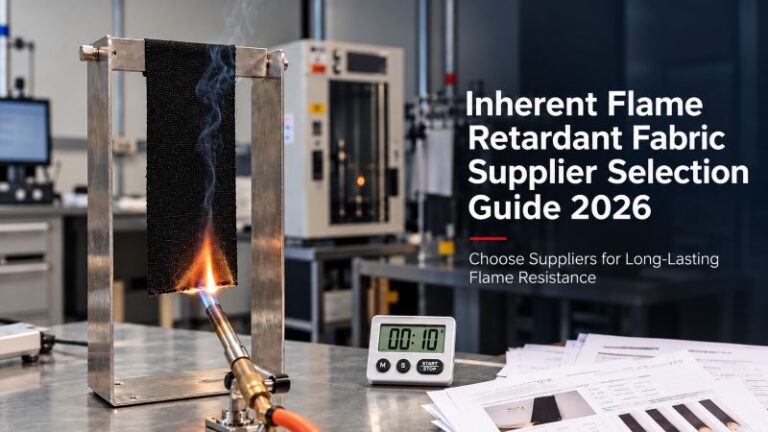
Aramid’s fire-protection performance does not come from a chemical coating but from its “inherent flame resistance.” Its protective mechanism in a fire is multifaceted and synergistic. To understand the complete chemical details of this process, you can read this in-depth analysis of aramid’s flame-resistant mechanism.

  1. High Decomposition Temperature: The aromatic ring structure has extremely high bond energy, giving it a decomposition temperature far exceeding that of ordinary fibers (ranging from 370°C to over 500°C).
  2. No Melt, No Drip: Aramid has no melting point. It does not melt or drip when exposed to fire. This is crucial as it eliminates “secondary ignition” and severe skin burns caused by molten droplets.
  3. Carbonization Layer Protection: When exposed to flames, the fiber surface rapidly dehydrates and cross-links, forming a dense black char layer. This layer effectively insulates against heat and blocks oxygen, thereby suppressing combustion and achieving “self-extinguishing” properties.
  4. Inert Decomposition Products: It primarily releases inert gases such as water vapor, carbon dioxide, and nitrogen during combustion, which produce little smoke and do not support the flame.

III. Authoritative Certification: Which International Flame Retardant Standards Does Aramid Pass?

A material’s safety must be verified by authoritative standards. Aramid fabric is designed to pass the world’s most stringent international flame-retardant standard tests. Different applications correspond to different standards:

  • Industrial Flash Fire Protection (PPE): Must pass NFPA 2112, which uses a thermal manikin test to require minimal predicted total body burn area after a 3-second flash fire.
  • Firefighting & High-Heat Protection: Must pass EN 11612 (European standard), which grades material performance against flame spread (A), convective heat (B), radiant heat (C), and more.
  • Public Spaces & Architecture: For curtains and drapes, materials must pass NFPA 701 (US standard) or DIN 4102-B1 (German standard) to prove they are flame-resistant and limit flame propagation.

Aramid’s non-drip, low-smoke properties allow it to perform exceptionally well in these rigorous tests.

IV. Types of Aramid: Performance Differences Between 1313 and 1414

The aramid family is primarily divided into two main classes: meta-aramid (1313) and para-aramid (1414). Their chemical structural differences lead to vastly different properties and uses:

  • Aramid 1313 (Meta-Aramid): Its molecular chain has a flexible “zigzag” structure. Its core advantages are exceptional heat resistance and flame retardancy, allowing long-term use at 250°C. Therefore, it is mainly used for firefighting suits, arc flash apparel, high-temperature filtration, and electrical insulation.
  • Aramid 1414 (Para-Aramid): Its molecular chain has a rigid, linear “rod-like” structure. Its core advantage is unimaginable mechanical strength (5-6 times that of steel by equal weight) and cut resistance. Therefore, it is mainly used for body armor, stab-resistant vests, cut-resistant gloves, and structural reinforcement.

In short: 1313 is the expert in “fire and heat protection,” while 1414 is the expert in “ballistic and cut protection.”

V. Aramid Product Classification

Based on these two core fibers, aramid is processed into a series of standardized industrial products and textiles to meet various process requirements:

  • Aramid Fibers: Industrial raw materials, such as dyeable staple fibers, high-tenacity staple fibers, and solution-dyed fibers.
  • Aramid Yarns: Textile intermediaries, such as 100% meta-aramid yarns, meta/para-blended yarns, and flame-retardant sewing threads.
  • Aramid End-Products: Directly used finished goods, such as aramid fabric (for apparel) and aramid webbing (for harnesses).
  • Deep-Processed Products: To meet specific industrial needs, such as aramid pulp, short-cut fibers (for friction materials), and aramid insulation paper (for transformers).

VI. Typical Application Scenarios for Aramid

Thanks to its superior performance and diverse product forms, aramid is widely used in various high-risk and high-performance application scenarios:

  • Personal Protective Equipment (PPE): Firefighting turnout gear, arc flash protection suits, steel mill apparel, and military combat uniforms.
  • Transportation: Seat covers, interior panels, and fire-blocking curtains in aircraft and high-speed rail (utilizing its FR, lightweight, and low-smoke properties).
  • Industrial & Construction: High-temperature filter bags for dust collection, fire curtains, stage drapes, and electrical insulation paper.
  • Military & Reinforcement: Body armor and stab-resistant vests (using para-aramid’s high strength), and optical cable reinforcement.

VII. Is Aramid Eco-Friendly and Non-Toxic?

While performance is critical, safety is paramount for protective materials. Aramid performs exceptionally well in terms of environmental safety and non-toxicity:

  • Halogen-Free, Low Toxicity: Aramid is a “halogen-free” material. Its combustion byproducts are mainly inert gases and water, and it does not release the highly toxic dioxins or corrosive gases produced by traditional flame retardants.
  • Skin Safety: Aramid fiber is chemically stable, and finished products can pass OEKO-TEX® Standard 100 certification, proving they are free of harmful substances and safe for skin contact.
  • Durability (Eco-Friendly): Aramid’s environmental contribution mainly lies in its extreme durability. Its service life is several times that of ordinary materials, significantly reducing waste generation and replacement frequency, thus lowering its lifecycle cost.

VIII. Aramid vs. FR-Treated Cotton: The Difference

In the industrial protective apparel sector, aramid’s main competitor is FR-treated cotton. The two differ vastly in protection level, durability, and cost:

Comparison DimensionAramidFR-Treated Cotton
Flame-Resistant MechanismInherent FRTreated FR
Protection DurabilityPermanent (Does not degrade with washing)Limited (Degrades with washing, requires proper care)
Reaction to FireCarbonizes, No DripCarbonizes, No Drip
Thermal ProtectionVery High (Stable char layer, no break-open)Good (Brittle char layer, prone to break-open)
ComfortFair (Stiffer, low moisture absorption)High (Soft, breathable, moisture-wicking)
Initial CostHighLow

Conclusion: Aramid provides permanent, reliable, and uncompromising high-level safety protection, suitable for high-risk environments like firefighting and arc flash. FR-treated cotton is an economical and practical solution that balances comfort and cost, suitable for lower-risk, budget-conscious applications.


About Aramid Fabric Flame Retardancy Topics

To help you quickly locate the information you need, we have summarized all knowledge about aramid into the following seven topics. You can browse the “Key Points” for a quick summary or click the title to read the full in-depth guide.

CategoryTopic GuideKey Points
MechanismWhy Is Aramid Flame Resistant?Core Principle: Aramid relies on high-bond-energy aromatic ring structures to resist heat. It forms a protective char layer when burning, blocking oxygen and heat, and does not melt or drip, achieving self-extinguishing.
StructureWhat Is the Difference Between Aramid 1313 and 1414?Core Difference: 1313 (Meta-Aramid) has a flexible structure, excelling in heat resistance and flame retardancy (e.g., firefighting suits). 1414 (Para-Aramid) has a rigid structure, renowned for ultra-high strength (e.g., body armor).
ComparisonWhat Are the Differences Between Aramid and FR Cotton Fabric?Core Difference: Aramid is inherently flame-resistant (permanent, no-drip), while FR cotton is chemically treated (performance degrades with washing). Aramid’s protection in extreme heat is far superior.
StandardsWhich International Flame Retardant Standards Does Aramid Pass?Authoritative Certification: Aramid fabric can pass the world’s strictest FR tests, such as NFPA 2112 for apparel, EN 11612 (Europe), and NFPA 701 / DIN 4102-B1 for public spaces.
ApplicationsWhat Are the Typical Applications for Aramid Fabric?Application Fields: Due to its high performance, aramid is widely used in firefighting suits, aerospace interiors, electric arc protection, industrial heat insulation, and fire curtains.
Eco-SafetyIs Aramid Eco-Friendly and Non-Toxic?Safety & Eco-Friendliness: Aramid is a halogen-free material with low smoke toxicity and no dioxin release. It can be OEKO-TEX® Standard 100 certified, proving it is safe for human skin.
ProductsWhat Are the Aramid Product Classifications?Product System: Aramid products are categorized into four main types: Aramid Fibers (raw material), Aramid Yarns (intermediary), Aramid Fabrics (end-product), and Deep-Processed Products (e.g., aramid paper, pulp).

Aramid Frequently Asked Questions (FAQ)

Q1: Will aramid’s flame-resistant properties fade with washing?

A: No. Aramid’s flame resistance is an “inherent” property of its molecular structure, not from a chemical coating. Therefore, its FR performance is permanent and will not degrade or disappear with repeated washing, friction, or long-term use.

Q2: Why does aramid need to be protected from sunlight?

A: Aramid (especially para-aramid 1414) has poor resistance to ultraviolet (UV) light. Prolonged exposure to sunlight will cause the molecular chains to degrade, leading to yellowing and a loss of mechanical strength. Therefore, aramid products should be stored away from direct sunlight or protected with a UV-resistant coating.

Q3: Does aramid release toxic gases when it burns?

A: Aramid has extremely low toxicity. It is a halogen-free material that produces little smoke when burned. Its main decomposition products are inert gases and water. It does not release the highly toxic dioxins or corrosive gases associated with halogenated flame retardants, making it far safer than many other FR materials.

Get Professional Support and Samples

Are you looking for high-performance aramid flame-retardant fabric solutions for your project?

Want to get physical samples, TDS (Technical Data Sheets), or international standard test reports for aramid FR fabric? Contact the Begoodtex® engineering team today for a one-on-one professional consultation.

Contact the Begoodtex® Engineering Team Now