Enter your details and we will send the requested document to your inbox.





Thanks to its exceptional inherent flame resistance, non-drip, high-temperature resistance, and high-strength properties, Aramid (Aramid) fireproof fabric is widely used in critical fields with extreme safety requirements. Its most typical application scenarios include: Personal Protective Equipment (PPE) (e.g., firefighting suits, arc flash suits); Transportation (e.g., aerospace interiors, high-speed rail seats); Architecture and Public Spaces (e.g., fire curtains, stage drapes); and Industrial & Military (e.g., high-temperature filtration, ballistic/blast protection).
In these applications, aramid is not just one of the “options”; it is a “necessary configuration” to ensure the safety of life and property. To fully understand why aramid is suited for these demanding tasks, you should first understand aramid’s principles, products, standards, and uses: Aramid Fabric Explained: A Comprehensive Guide from Molecular Structure to Ultimate Fire Protection.
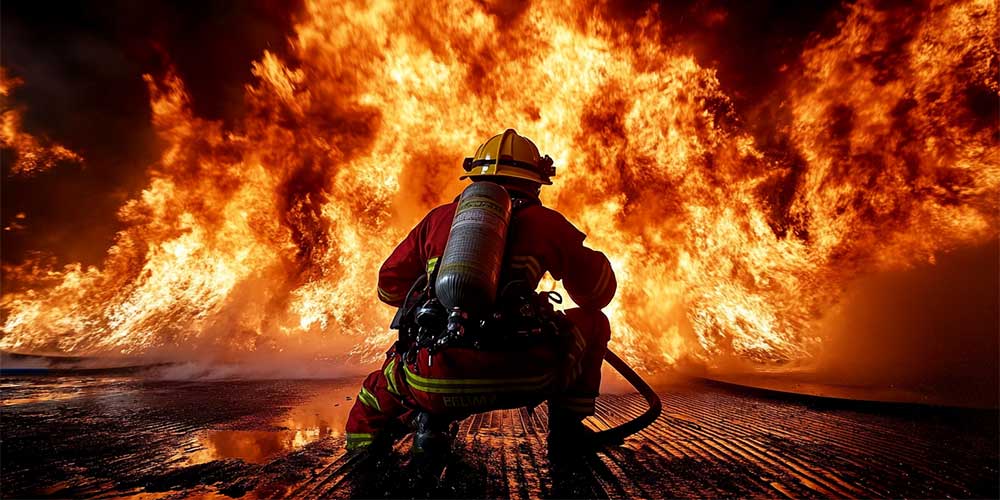
This is aramid’s most core and widely known application area. The protective performance of aramid is directly related to the safety of personnel in high-risk jobs.
The outer shell and thermal liner of firefighter turnout gear heavily use meta-aramid (1313) and its blends. Meta-aramid provides the first line of defense against flames and high-temperature heatwaves; its non-drip and carbonizing properties prevent burns. At the same time, it is often blended with para-aramid (1414) to significantly increase the outer shell’s tear resistance, preventing it from being ripped by sharp objects in complex rescue environments. This performance combination of meta- and para-aramid is a classic solution.
In the electrical industry, an arc flash can instantly release immense heat (up to 19,000°C). Aramid is one of the few materials that can withstand this extreme temperature. Arc flash protective clothing (HRC 2 to HRC 4) must use aramid or its blended fabrics. Its stable char layer effectively insulates thermal energy, preventing severe arc burns to the body.
In industries like metal smelting and glass manufacturing, workwear must resist molten metal splash and high radiant heat. Aramid (especially with special finishing) can effectively prevent molten metal droplets from penetrating, a performance far superior to that of FR-treated cotton.
Military equipment requires composite performance. Combat uniforms use meta-aramid (1313) for flame and heat resistance, while body armor and blast blankets rely on the ultra-high strength of para-aramid (1414) to resist shrapnel and shockwaves.
In enclosed public transport vehicles like airplanes, high-speed rail, and ships, fire safety and lightweighting are top design priorities.
Commercial aircraft interiors—such as seat covers, carpets, cabin wall acoustic insulation, and fire-blocking curtains—are almost entirely made of meta-aramid or its blends (e.g., aramid/wool blends). This is because aramid meets strict FAA (Federal Aviation Administration) fire standards (like FAR 25.853) while offering two key advantages:
Similar to aerospace, high-speed rail and subway cars have mandatory requirements for flame retardancy, low smoke, and non-toxicity (LSZH), such as the EN 45545 standard. Aramid fabrics are used for seats, sleepers, and curtains to prevent the rapid spread of fire within the cabin.
In crowded public venues, preventing small fire sources from becoming major disasters is the core of fire-safe design.
In theaters, concert halls, large exhibition centers, school auditoriums, and stadiums, fire curtains (Proscenium Curtains) and divider curtains are critical fire-blocking partitions. Aramid fabrics (or fiberglass/aramid composites) are the material of choice for these permanent fire curtains, as they must meet the strictest building fire codes (like NFPA 701 or DIN 4102-B1).
If high-end hotels, hospitals, and government buildings use aramid fabrics for curtains, bedspreads, and upholstered walls, they can achieve permanent, inherent flame resistance without worrying about the performance loss from washing, as is the case with treated materials. This greatly enhances public safety.
These applications often require specific product forms of aramid, such as aramid paper or filter bags.
In industries like cement, steel, chemicals, and waste incineration, dust must be filtered from high-temperature flue gases (often over 200°C). Meta-aramid needle-punched felt filter bags have become the mainstream material for high-temperature filtration due to their excellent heat resistance and chemical stability.
The application scenarios for aramid fireproof fabric almost all share the common traits of “high risk,” “high value,” and “high regulation.” It is indispensable because it can simultaneously meet the most stringent demands in three dimensions:
From protecting the life of a firefighter to ensuring the safety of an aircraft, Aramid has become the cornerstone of the modern social safety protection system.
To help you quickly locate the information you need, we have summarized all knowledge about aramid into the following seven topics. You can browse the “Key Points” for a quick summary or click the title to read the full in-depth guide.
| Category | Topic Guide | Key Points |
|---|---|---|
| Outline | Aramid Fabric Explained | A Comprehensive Guide to Aramid Fabrics: From Molecular Structure to Ultimate Fireproof Performance |
| Mechanism | Why Is Aramid Flame Resistant? | Core Principle: Aramid relies on high-bond-energy aromatic ring structures to resist heat. It forms a protective char layer when burning, blocking oxygen and heat, and does not melt or drip, achieving self-extinguishing. |
| Structure | What Is the Difference Between Aramid 1313 and 1414? | Core Difference: 1313 (Meta-Aramid) has a flexible structure, excelling in heat resistance and flame retardancy (e.g., firefighting suits). 1414 (Para-Aramid) has a rigid structure, renowned for ultra-high strength (e.g., body armor). |
| Comparison | What Are the Differences Between Aramid and FR Cotton Fabric? | Core Difference: Aramid is inherently flame-resistant (permanent, no-drip), while FR cotton is chemically treated (performance degrades with washing). Aramid’s protection in extreme heat is far superior. |
| Standards | Which International Flame Retardant Standards Does Aramid Pass? | Authoritative Certification: Aramid fabric can pass the world’s strictest FR tests, such as NFPA 2112 for apparel, EN 11612 (Europe), and NFPA 701 / DIN 4102-B1 for public spaces. |
| Applications | What Are the Typical Applications for Aramid Fabric? | Application Fields: Due to its high performance, aramid is widely used in firefighting suits, aerospace interiors, electric arc protection, industrial heat insulation, and fire curtains. |
| Eco-Safety | Is Aramid Eco-Friendly and Non-Toxic? | Safety & Eco-Friendliness: Aramid is a halogen-free material with low smoke toxicity and no dioxin release. It can be OEKO-TEX® Standard 100 certified, proving it is safe for human skin. |
| Products | What Are the Aramid Product Classifications? | Product System: Aramid products are categorized into four main types: Aramid Fibers (raw material), Aramid Yarns (intermediary), Aramid Fabrics (end-product), and Deep-Processed Products (e.g., aramid paper, pulp). |
Aramid’s main applications are in high-risk environments. This includes Personal Protective Equipment (PPE) like firefighter turnout gear and arc flash suits, aerospace interiors, public fire curtains, and industrial high-temperature filtration.
Aramid is used in aircraft interiors (seats, carpets) because it meets strict FAA fire standards. It is inherently flame-resistant, lightweight, and (most importantly) has Low Smoke, Zero Halogen (LSZH) properties, which is critical for passenger evacuation.
Aramid is the gold standard for high-performance PPE. This includes firefighter turnout gear (meta-aramid), blast-proof suits and body armor (para-aramid), arc flash protective clothing, and industrial workwear for molten metal protection.