Get in touch
Thank you for reaching out! Please tell us more about your needs — our expert team will get back to you within 24 hours.
Get in touch
Thank you for reaching out! Please tell us more about your needs — our expert team will get back to you within 24 hours.
Fiberglass Fabric is the cornerstone material in the fields of industrial high-temperature resistance and fire protection. As an internationally recognized A1 rated non-combustible material, its thermal insulation performance and fire resistance limits far exceed those of ordinary textiles. This guide provides an in-depth analysis of the scientific principles behind its “physical non-combustibility,” its temperature ratings, and a guide to avoiding pitfalls during purchase.
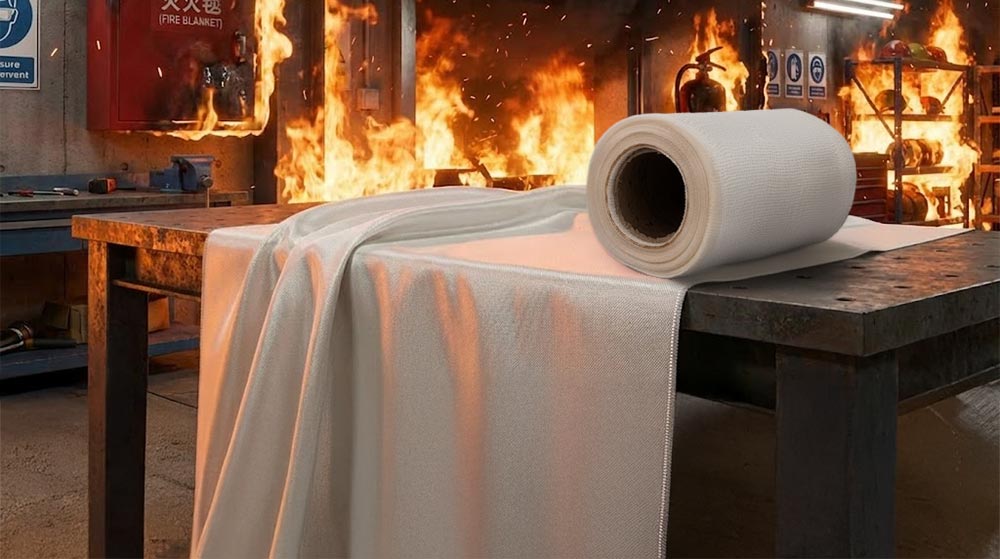
Simply put, Fiberglass Fabric is created by transforming “hard glass” into “soft cloth” through high-tech processes.
It is a high-performance inorganic fireproof fabric made from inorganic glass (primarily silicon dioxide, SiO₂). Its production process is similar to steelmaking: glass raw materials are melted into a liquid state at high temperatures of 1200–1600℃, then drawn into filaments, plied, and finally woven into a fabric structure.
This unique “inorganic body” grants it a dual nature: it retains the flexibility and bendability of a fabric while inheriting the hardcore genes of glass—inherently non-combustible, corrosion-resistant, and heat-resistant.
The answer is unequivocal: It is a “Fireproof / Non-combustible” fabric, a level far superior to “Flame-Retardant.”
Fiberglass Fabric is inherently an A1 Class Non-combustible Material. Its fire resistance stems from its microscopic physical and chemical structure, rather than simple surface chemical treatments.
The Limiting Oxygen Index (LOI) of fiberglass fabric is theoretically infinite, meaning it simply cannot be ignited under normal atmospheric oxygen concentrations.
Under extreme direct flame testing, it exhibits perfect inertness: it will not burn, will not produce flames, will not spread fire, will not drip, and will not release toxic smoke. Only when temperatures breach its physical limits (typically above 750–850℃) will it undergo physical softening, melting back into a glass state rather than charring or burning.
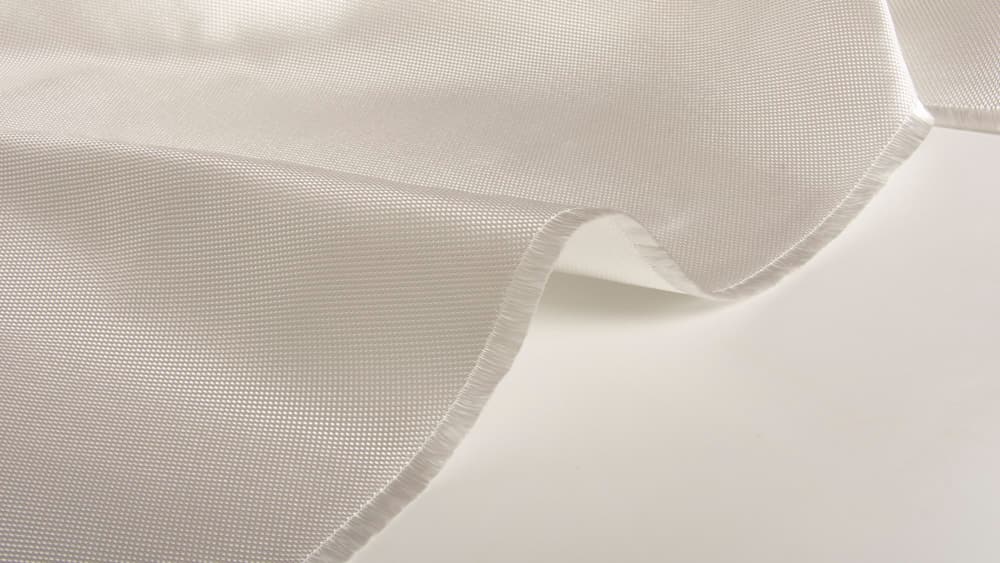
Thanks to its unique physical structure, Fiberglass Fabric combines excellent High-Temperature Resistance with Thermal Insulation capabilities.
As an industrial-grade fireproof material, fiberglass fabric has irreplaceable advantages in specific scenarios, but it also has physical limitations. Understanding these “pitfalls” is key to buying the right material.
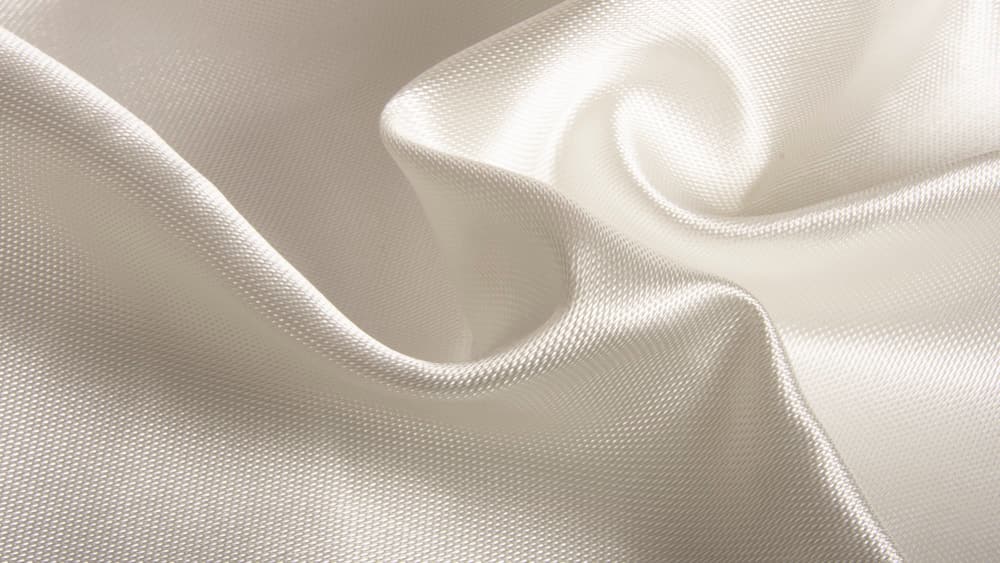
The following is a lateral performance comparison between fiberglass fabric and mainstream market alternatives to help you quickly identify the right application.
| Comparison Item | Fiberglass Fabric | FR Viscose |
|---|---|---|
| Fire Rating | A1 Fully Non-Combustible | Flame Retardant (LOI 28–32) |
| Temp Limit | 550–1000℃+ | Chars around 200℃ |
| Tactile Feel | Hard, Itchy | Silky, Skin-friendly |
| Application | Equipment Protection, Construction | Underwear, Protective Workwear |
| Comparison Item | Fiberglass Fabric | Aramid |
|---|---|---|
| Core Feature | Extreme Heat Res. (Static) | High Strength (Dynamic) |
| Cost Estimation | Low ($1–$8/sqm approx.) | High ($30–$100+/sqm approx.) |
| Application | Industrial Insulation, Fire Curtains | Firefighter Suits, Body Armor |
Based on its dual “Non-Combustible + Thermal Insulation” properties, Fiberglass Fabric is widely used in the following professional sectors:
Want to understand the differences in flammability, flame-resistant ratings, and LOI (Limiting Oxygen Index) among various fibers? We have compiled a list of related professional articles to help you quickly determine if a material is safe and suitable for use as a flame-resistant fabric, click the link below to view quickly:
A: Standard textile-grade fiberglass (diameter ≥ 9μm) is not classified as respirable fiber and does not carry asbestos-like risks; it is considered safe and non-toxic. However, due to its physical structure, broken fiber debris can mechanically irritate the skin. It is recommended to wear gloves during handling or choose coated products to reduce loose fibers.
A: The main difference lies in the temperature rating. Standard E-glass has a continuous resistance of 550℃, suitable for general industrial insulation. High Silica fabric is acid-leached to achieve a SiO₂ content of over 96%, allowing it to withstand continuous heat of 1000℃ and instantaneous shocks of 1400℃, making it the top choice for extreme environments like steel smelting.
A: 1. Burn Test: Apply a direct flame for 30 seconds; it should remain non-combustible, with no black smoke and no dripping.
2. Check Labeling: Legitimate products must clearly mark the temperature rating (e.g., 550℃ or 1000℃).
3. Verify Certificates: Request an A1 Non-Combustible certificate (GB 8624 or EN 13501-1).