Enter your details and we will send the requested document to your inbox.





If you’ve ever found yourself wondering “is spandex flammable,” you’re in good company—and the short answer is yes, very. Spandex (you’ll also see it called elastane, or, when it’s the branded version, Lycra) is a polyurethane fiber engineered for stretch, not for fire. Put an open flame anywhere near it and the fiber curls, melts, and burns faster than most people expect. But here’s the part that actually matters for buyers, product designers, and specifiers: the fiber can be modified to resist fire, and that’s where flame retardant spandex earns its keep in protective wear, public furnishings, and transportation interiors.
The confusion is understandable. Spandex is usually a small percentage of any fabric, so its flammability rarely shows up in daily life. But in an industrial coverall, a blackout curtain in a hotel, or a car seat, that same fiber can be the weak link in an otherwise safe product. This article walks through the real combustion behavior of spandex, the chemistry that makes it burn, its LOI rating, the three ways manufacturers make it flame retardant, the test standards that prove it works, and where it’s actually safe to use.
Yes, spandex is highly flammable. Its limiting oxygen index is only 18–20%—far below the 21% oxygen in air—so it ignites easily, melts, and drips with toxic fumes. Pure spandex should never be used where fire safety matters; flame retardant spandex is required instead.

Yes. The question “is spandex flammable” isn’t really up for debate—the fiber is a high-elasticity synthetic that ignites easily and keeps burning once it starts. Chemically, spandex is a polyurethane, and its molecular structure is packed with carbon–hydrogen bonds. Heat those bonds and the fiber decomposes, releasing flammable gases that feed the flame from the inside out.
When spandex meets an open flame, it moves through four stages in quick succession: it curls back on itself, it melts into a sticky bead, it catches, and it throws off black smoke plus molten drips. Those drips are the part experienced safety engineers worry about most. They cling to skin and can cause severe secondary burns, and they can land on neighboring materials—a nearby towel, a rug, a coworker’s sleeve—and start a second fire. Burning polyurethane also breaks down into toxic gases, isocyanates among them, with a sharp, acrid smell you don’t forget.
If you’re sourcing materials for any environment where fire is a genuine risk, it helps to see how spandex fits inside a compliant multi-fiber construction. Our flame retardant fabric hub is a good place to start that comparison.
To really get spandex flammability, you have to look at what the fiber is made of. Spandex is a segmented polyurethane: long “soft” segments of polyether or polyester give it that famous 5–8× stretch, while “hard” segments of urethane and urea linkages hold the whole thing together. The soft segments are where the trouble starts, because they’re rich in hydrocarbons—and hydrocarbons burn.
Polyurethane forms when a diisocyanate reacts with a polyol. The resulting urethane linkages are heat-sensitive by nature, and the soft segments begin to break down at a surprisingly low temperature, around 230–260°C. That’s well below what a garment might see next to a welding spark, a stovetop, or an industrial heat source. Once those segments decompose, they release flammable volatiles, and the flame sustains itself without outside help.
So spandex walks into a fire with two structural weaknesses working against it:
Put those two together and you get a fiber that’s comfortable, stretchy, and genuinely hazardous near heat. It’s worth saying plainly: the same chemistry that gives spandex its magic stretch is what makes it a fire liability in pure form.
Here’s how the fiber behaves once a flame reaches it:
The Limiting Oxygen Index (LOI) is the minimum percentage of oxygen a material needs in the surrounding air to keep burning. Spandex sits at roughly 18–20%. Normal air is about 21% oxygen, so any material with an LOI below 21% will happily self-sustain a flame in ordinary air. Spandex falls squarely in the “highly flammable” zone, right alongside untreated cotton.
For context, here’s how spandex lines up against other common fibers:
| Fiber | LOI |
| Cotton | 18% |
| Acrylic | 18.5% |
| Spandex (elastane) | 18–20% |
| Polyester | 20–22% |
| Nylon | 20–22% |
| FR polyester | ≥28% |
| Modacrylic | 28–32% |
| Aramid | 28–30% |
| Fiberglass | >100% |
Notice the jump the moment you move into engineered FR fibers. Our inherently FR polyester, for example, pushes well past the 28% mark—the kind of number you want when a garment has to survive a flash fire. Spandex on its own never reaches that range, but as you’ll see next, it can be modified to get there.
Making a fiber fire-resistant isn’t a single trick—there are three routes, and they differ sharply in durability, cost, and where they make sense.
This is the gold standard. FR monomers—often DOPO derivatives or phosphate polyols—are built directly into the polymer chain during manufacture. The fire resistance becomes part of the molecule itself, not a coating that can wash or wear away. Expect an LOI of 28–30%, performance that lasts past 50 wash cycles, and a higher price tag. For protective wear that gets laundered repeatedly, this is the route that pays for itself. For a commercial look at the approach, our Inherently FR Spandex fabric shows the construction in a finished product.
Here, flame retardant powders or liquids are mixed into the spinning solution before the fiber is formed. It’s simpler and cheaper than co-polymerization, and it lifts LOI to about 24–27%. The catch is that the additive can migrate and leach out, so wash durability is poor—often under 10 washes. Fine for a short-life or disposable item, risky for anything that has to stay certified.
This is a post-treatment. Phosphorus–nitrogen (P–N) finishes such as Pyrovatex or Proban, or silicone coatings, are applied to the finished fiber or fabric. The big advantage is minimal impact on elasticity. The downside is the weakest wash performance of the three—typically 20–30 washes before the effect fades.
Here’s the comparison at a glance:
| Route | How it works | LOI | Wash durability | Cost | Best for |
| Co-polymerization (inherently FR) | FR monomers built into the molecular chain | 28–30% | >50 washes | Higher | Protective wear, repeated laundering |
| Additive blending | FR powders or liquids mixed into spinning dope | 24–27% | <10 washes | Lower | Short-life or disposable items |
| Surface finishing | P–N or silicone coating on finished goods | 24–27% | 20–30 washes | Low–mid | Stretch fabrics where elasticity must stay intact |
If your product needs both stretch and certified fire performance, a flame retardant stretch fabric built on the inherently FR route is the safest place to start.
Specifying FR spandex means specifying to a test, not a feeling. Four standards come up constantly in real procurement:
For furnishings that need to clear the US curtain standard, our NFPA 701 compliant upholstery gives you a verified starting point instead of a guess.
Spandex’s whole reason for existing is stretch—typically 5–8× its length—and it’s almost never used on its own. It’s blended at 2–25% with cotton, polyester, or nylon to add recovery and comfort. That small percentage is exactly why the question “is spandex flammable” matters less in a t-shirt and a lot more in a blackout curtain.
For window treatments, flame retardant blackout curtains keep both the stretch and the compliance in one fabric. For seating, a flame retardant upholstery fabric is the practical choice where comfort and code both matter.
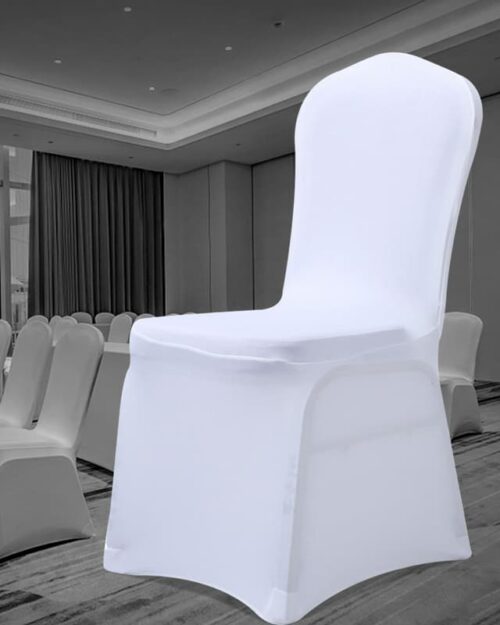 Flame Retardant Chair Cover Stretch Polyester-Spandex Fabric for Contract Event Table Linen Production | 17.3 × 21.7 × 36.6 in
 Inherent Flame Retardant Spandex Stretch Tension Rectangle Table Covers for Event Decor | 72 × 30W" × 30H" in | EN 13773 Class 1
 Flame Retardant Spandex Table Cover for Contract Hospitality Table Decor with Wholesale Supply Options | 23.6 × 43.3 in | EN 13773 Class 1
The honest answer: pure spandex is flammable, but in everyday clothing it rarely meets an open flame, and the low blend percentage keeps the real-world risk down.
A typical activewear knit might contain only 5–20% spandex, blended with polyester or nylon that carry slightly higher LOI values. You’re not holding a torch to your shirt during a run, so daily wear stays low-risk. The danger shows up in occupational settings—welding bays, foundries, utility work—where sparks and heat are simply part of the job. That’s the line between “stretchy and fine” and “stretchy and a hazard.”
Here’s a spec we see often from a client making coveralls for arc-flash and flash-fire environments: 97% inherent FR cotton, 3% inherent FR spandex, finished to EN ISO 11612, with an after-flame under 2 seconds and no melting drips after 50 industrial washes. The 3% spandex is what lets the garment move with the worker instead of fighting them—and because both fibers are inherently FR, the protection doesn’t wash out. That blend is the difference between a compliant garment a worker will actually wear and a stiff, rejected one hanging in a locker.
When you’re sourcing, run through this before you ask for a quote:
Ask suppliers for the actual LOI number and the test report, not just a loose claim of “FR.” Request wash-durability data tied to the specific standard you’re buying against. And remember the blend: FR spandex alone rarely carries a garment; it’s the combination with FR cotton or aramid that delivers certified safety plus the comfort people will tolerate for a full shift.
Spandex is flammable—its LOI of 18–20% says so plainly—but flame retardant spandex changes the equation. For protective wear, choose inherently FR spandex paired with FR cotton or aramid. For home furnishings, a durable FR coating that passes NFPA 701 is the right call. And if you need curtains that look good and still meet code, our inherently FR jacquard curtain fabric is a ready example of spandex-grade stretch working inside a certified construction.
The takeaway for any buyer is simple: don’t stop at asking “is spandex flammable”—ask which FR route, which standard, and how many washes. Answer those three and you’ll spec a product that’s safe, compliant, and worn willingly.
Because the spandex content is low—usually 5–20%—and it’s blended with polyester or nylon, which have slightly higher LOI values. On top of that, everyday sportswear isn’t worn near open flame, so the flammability of pure spandex rarely becomes a real-world problem in normal use.
High-quality treatments, especially the inherently FR route, have minimal impact on stretch. Modern phosphorus–nitrogen finishing retains more than 90% of the original elasticity even after 50 washes. Cheap additive blends can stiffen over time, which is exactly why the route you choose matters as much as the rating on the label.
It means FR monomers are chemically bonded into the molecular chain during polymerization, not added later as a coating. The result is permanent fire resistance—lasting past 50 wash cycles—with an LOI of 28–30%. It’s the most stable and durable of the three technical routes described above.
Yes. The classic high-performance solution for protective wear is 97% FR cotton plus 3% FR spandex, which meets EN ISO 11612 while staying comfortable and flexible. The spandex adds the stretch workers need; the FR cotton carries the certified protection that keeps them safe.