Get in touch
Thank you for reaching out! Please tell us more about your needs — our expert team will get back to you within 24 hours.
Get in touch
Thank you for reaching out! Please tell us more about your needs — our expert team will get back to you within 24 hours.
Is Linen Flammable? Yes, linen is classified as a flammable textile. It is a natural plant fiber, and like other plant-derived fibers (such as cotton), it has a relatively low ignition point. Once linen comes into contact with a flame or a sufficiently high heat source, it will ignite quickly and burn rapidly.
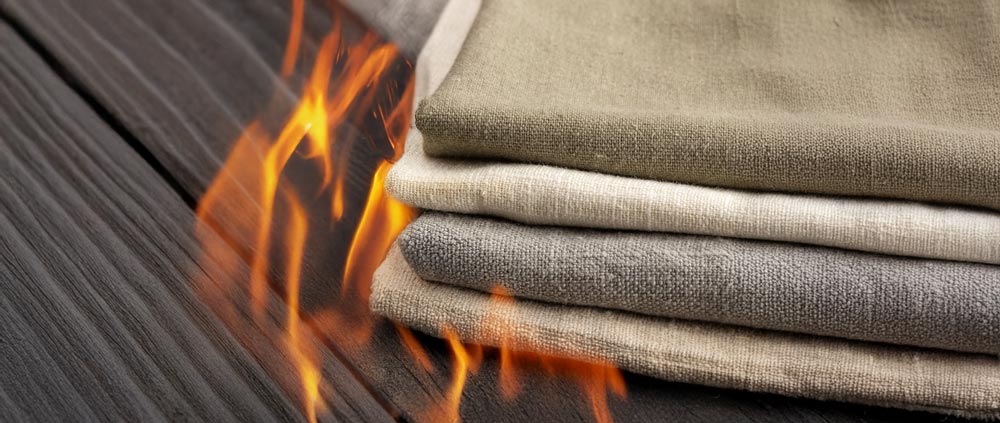
The fundamental reason for linen’s flammability lies in its chemical composition. Linen fibers are primarily composed of Cellulose, which is the same combustible component found in wood and paper. Cellulose is a flammable organic polymer that decomposes quickly when heated, producing flammable gases that allow flames to spread rapidly.
A typical characteristic of burning linen is a smell similar to burning paper, leaving behind a small amount of light, brittle ash, which is consistent with the burning properties of plant fibers.
The burn rate of linen is influenced by several physical factors, the most critical being the fabric’s weight, weave density, and surface finish.
Among common textiles, linen and cotton belong to the most flammable category of natural fibers. In contrast, wool has excellent natural flame-retardant properties. Synthetic fibers (like polyester) are difficult to ignite, but they melt and drip when exposed to high heat, posing an entirely different type of safety hazard.
The table below compares the burning characteristics of several common fabrics to help you visually understand linen’s risk profile:
| Fabric Type | Ease of Ignition | Burn Rate | Burning Characteristics | Primary Hazard |
|---|---|---|---|---|
| Linen | Low (Easy to ignite) | Very Fast | Spreads rapidly, like paper; leaves light ash | Rapid flame spread, can engulf fabric quickly |
| Cotton | Low (Easy to ignite) | Fast | Similar to linen, burns steadily; leaves ash | Similar risk to linen, ignites easily |
| Wool | High (Difficult to ignite) | Slow (Often self-extinguishes) | Curls away from flame; chars; smells like burnt hair | One of the safest natural fibers |
| Silk | Medium | Medium | Curls from flame; burns slower than cotton; smells like burnt feathers | Safer than cotton/linen, but still combustible |
| Synthetic (e.g., Polyester) | Medium (Hard to ignite) | Slow (Melts) | Melts, drips, and pulls away from flame; can self-extinguish | Melting Drip Hazard: Molten drips can cause severe skin burns |
This comparison clearly shows that linen and cotton share a very similar flammability risk profile, both being materials that require high vigilance. Wool, due to its high nitrogen and moisture content, is naturally flame-retardant and one of the safest choices. The primary danger from synthetic materials like polyester is not “burning” but “melting,” as their molten drips can cause severe secondary skin burns.
The main fire risk from linen fabric stems from its “rapid flame spread” characteristic. In real life, this means a small ignition source (like a candle flame or a stove burner) can cause a linen garment or curtain to become fully engulfed in flames in just a few seconds.
High-risk environments are any places where linen products might come into close contact with open flames or high-heat sources. Be vigilant in the following scenarios:
Certain forms of linen products pose a greater safety hazard than others, primarily those that are lightweight, loose-fitting, or used in sleep environments.
The core principle of using linen safely is “prevention.” The most effective measure is to always maintain a safe distance between linen products and fire sources. In specific scenarios, choosing professionally treated fabrics or alternatives is necessary.
Cultivating good fire safety habits in daily life is the most important line ofD” defense against linen fires.
For environments with higher safety requirements (such as public commercial spaces, hotels, transportation, or children’s rooms), priority should be given to linen fabrics that have been professionally treated to be flame-retardant (FR), or to other naturally flame-retardant alternatives.
Want to understand the differences in flammability, flame-resistant ratings, and LOI (Limiting Oxygen Index) among various fibers? We have compiled a list of related professional articles to help you quickly determine if a material is safe and suitable for use as a flame-resistant fabric, click the link below to view quickly:
A: The flammability of linen and cotton is very similar. Both are composed primarily of cellulose and are considered highly flammable fabrics that ignite easily and burn quickly. In terms of practical fire safety, they should be treated as having the same high-risk level.
A: Modern professional flame-retardant (FR) treatments can largely preserve linen’s natural texture, breathability, and comfort. However, there might be a slight change in the “hand” or feel (it may be slightly stiffer), and the cost is generally higher. You should choose reputable, certified manufacturers to ensure a balance between safety and comfort.
A: It is true that damp linen is harder to ignite because the flame must first expend extra energy to evaporate the moisture. However, this is by no means a reliable or lasting safety measure. As soon as the moisture evaporates (e.g., by being near a heat source), the linen will quickly regain its highly flammable properties. Therefore, you cannot rely on “dampness” to prevent fire risk.