Get in touch
Thank you for reaching out! Please tell us more about your needs — our expert team will get back to you within 24 hours.
Get in touch
Thank you for reaching out! Please tell us more about your needs — our expert team will get back to you within 24 hours.
Polyester is one of the most widely used synthetic fibers in the world, known for its durability, versatility, and affordability. It is the foundational material for a vast range of products, found in everything from clothing (like shirts and activewear) and home furnishings (such as curtains and bedding) to industrial applications like ropes and tarps. However, when it comes to fire safety, not all polyester is created equal.
Because of its wide use, it’s critical to understand its fire performance. We must first clarify a core premise: are we talking about “Regular Polyester (Non-FR Polyester)” or “flame-retardant polyester (FR-PET)”? These two materials are completely different in their fire safety ratings; the former is flammable, the latter is flame-retardant.
Regular polyester (PET) itself is flammable and is a “melt-combustible” material. In contrast, flame-retardant polyester achieves its self-extinguishing property through technical modification. This article will use scientific metrics to detail the essential differences between these two types of polyester.
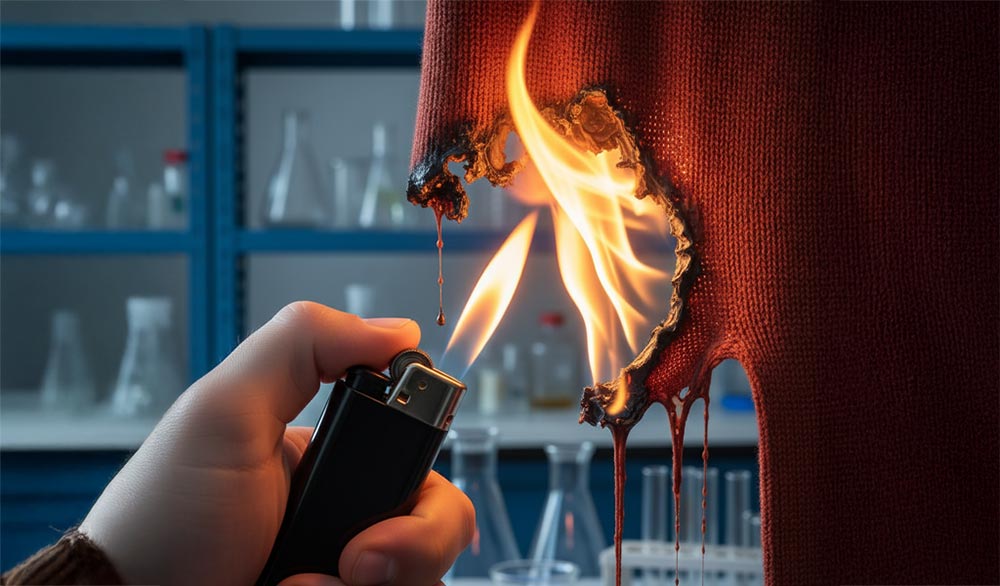
Non-FR polyester (PET) is a thermoplastic synthetic fiber formed by the polycondensation of terephthalic acid (TPA) and ethylene glycol (EG). It does not have natural flame retardancy and is classified as a combustible fiber. Its ignition point is approximately 485–560°C, and its auto-ignition point is around 630°C.
The burning characteristic of non-FR polyester is “melt-combustion.” When exposed to fire, it will first soften, melt, shrink, and drip. These hot, molten drips can cause secondary ignition if they fall onto other flammable materials, or cause severe burns. After the flame source is removed, it will typically continue to burn for a short time before extinguishing; it is not self-extinguishing.
The Limiting Oxygen Index (LOI) is one of the most common and intuitive scientific metrics for judging a material’s fire performance. Think of it as a “fire safety score”—the higher the score, the safer the material.
The role of LOI is very simple: it tells us how “dependent” a material is on oxygen to burn.
We all know that fire requires oxygen. The air we breathe contains about 21% oxygen. This 21% is the “passing grade.”
The LOI number (or “score”) represents: “The minimum percentage of oxygen a material needs to ignite and keep burning.”
Comparing this score to 21% (the oxygen in the air) makes its meaning crystal clear:
Based on this standard, non-FR polyester (PET) has an LOI of about 20% to 21%.
This number clearly classifies it as a flammable fiber. Because the amount of oxygen it needs to sustain combustion is equal to (or even lower than) the oxygen content in the air, it can burn continuously in air.
When non-FR polyester burns, it exhibits the following typical characteristics, which are completely different from natural fibers like cotton, regarding whether cotton fabric is flammable, you can read: Is Cotton Fireproof? Unveiling the Truth About Cotton’s Flame Retardancy.
| Property | Behavior |
|---|---|
| Burning State | Melts and drips, accompanied by black smoke |
| Flame Color | Yellow with a blue edge |
| Odor | Aromatic scent (similar to burnt plastic) |
| Residue | Black, hard, bead-like lumps (carbonized drips) |
| Self-Extinguishing Property | Not self-extinguishing (continues to burn briefly after flame is removed) |
Comparing non-FR polyester with flame-retardant polyester and other common fibers clearly shows its flammable classification:
| Material | LOI % | Flammability Rating | Burning Behavior |
|---|---|---|---|
| Cotton | 17–18 | Flammable | Burns quickly, no melting/dripping, grayish-white smoke |
| Non-FR Polyester (PET) | 20–21 | Flammable | Melts and drips, black smoke |
| Acrylic (non-modified) | 18-20 | Very Flammable | Bright flame, burns rapidly |
| FR Viscose | 26–30 | Flame Retardant | Self-extinguishes when flame is removed |
| Aramid | ≥ 28–30 | Flame Retardant | Does not melt or drip, self-extinguishes |
| FR Polyester (FR-PET) | ≥ 28–35+ | Flame Retardant / Self-Extinguishing | No molten drips, extinguishes when flame is removed |
To transform flammable non-FR polyester (LOI 20-21%) into flame-retardant polyester (LOI > 28%), specific technical treatments are required. There are two main methods:
This is a technique where flame retardants (such as phosphorus- or halogen-based) are “added” to the surface of the finished fabric through dipping, coating, or resin bonding.
Also known as solution-dyeing or co-polymerization modification. This involves introducing flame-retardant monomers (like phosphorus- or nitrogen-based compounds, e.g., DOPO, CP) into the polyester’s molecular chain during the polymerization (pre-spinning) stage.
Based on the analysis above, the conclusion regarding polyester’s fire performance is clear:
Want to understand the differences in flammability, flame-resistant ratings, and LOI (Limiting Oxygen Index) among various fibers? We have compiled a list of related professional articles to help you quickly determine if a material is safe and suitable for use as a flame-resistant fabric, click the link below to view quickly:
A: The chemical structure of non-FR polyester (PET) is formed from the polymerization of TPA and EG, and its molecular chain contains many ester bonds. This structure requires a relatively low amount of heat and oxygen to decompose and burn. Its LOI of 20-21% means the oxygen required to sustain its combustion is equal to or lower than the 21% oxygen content in the air. Therefore, it is classified as a flammable fiber (capable of burning in air).
A: There are two main dangers: 1. Causing secondary fires: Hot, molten drips falling onto other flammable items like carpets, paper, or sofas can quickly ignite them, causing the fire to spread. 2. Causing severe burns: If polyester clothing catches fire, the molten fiber will stick to the skin, causing deep, severe burns that are difficult to remove.
A: “Inherent FR” or “Permanent FR” (IFR) polyester refers to fiber where the flame-retardant “gene” (like a phosphorus-based monomer) is integrated into the polymer’s molecular chain via chemical co-polymerization during the production (polymerization) stage. This makes the flame-retardant property part of the fiber’s molecular structure, not a topical coating. Therefore, its FR performance is permanent and will not diminish or fail, no matter how many times it is washed.