Get in touch
Thank you for reaching out! Please tell us more about your needs — our expert team will get back to you within 24 hours.
Get in touch
Thank you for reaching out! Please tell us more about your needs — our expert team will get back to you within 24 hours.
Abstract: This article provides an in-depth analysis of the physical properties, combustion characteristics, and flame retardant solutions of Viscose fiber. It clearly distinguishes the essential differences between standard flammable Viscose and Flame Retardant (FR) Viscose, detailing the manufacturing principles, carbonization mechanisms, and a comprehensive performance comparison with other mainstream FR fabrics such as Aramid and Modacrylic.
- Flammability Difference: Standard Viscose is highly flammable (LOI 18-20), whereas FR Viscose is permanently flame retardant (LOI 28-32).
- FR Mechanism: It self-extinguishes by forming a protective char layer with no melt-drip risk (unlike FR Polyester).
- Core Value: It bridges the gap between “Comfort” and “Safety,” offering cotton-like breathability with industrial protection.
- Best Partner: Frequently blended with Modacrylic in PPE to achieve the perfect balance of protection and wearer comfort.

Viscose Fabric, also known as Viscose Rayon, is a semi-synthetic fiber made from “Regenerated Cellulose.” It uses natural raw materials such as wood pulp, bamboo pulp, or cotton linters, which are reconstituted through chemical dissolution and a wet spinning process. Viscose combines the breathability and moisture absorption of natural fibers with the uniformity of man-made fibers, renowned for its silk-like elegant drape and skin-friendly touch.
The answer depends on the specific type of Viscose: Standard Viscose is highly flammable, while FR Viscose is flame retardant.
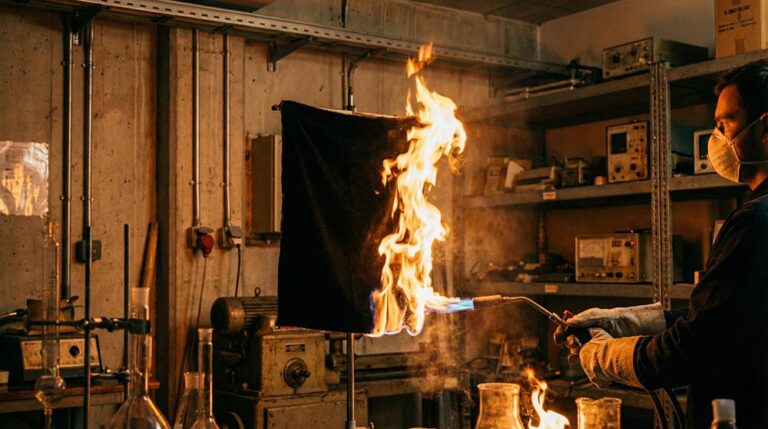
The vast majority of fashion Viscose fabrics on the market fall into this category. Their Limiting Oxygen Index (LOI) is typically only 18–20, far below textile flame retardant standards. Since its chemical composition is high-purity cellulose, it ignites rapidly upon contact with fire, burns with a bright flame and fast spread speed, continues to burn after removal from the fire source, and finally turns into light gray ash.
To address the flammability issue, the industry developed FR Viscose. The LOI value of this fiber is raised to 28–32, classifying it as a flame-resistant material. When it contacts a flame, it exhibits self-extinguishing properties upon removal of the fire source and does not continue to spread like standard Viscose. Therefore, if the application involves fire safety (e.g., workwear, hotel curtains), FR Viscose must be explicitly specified.
FR Viscose (Flame Retardant Viscose) refers to regenerated cellulose fibers that are endowed with permanent flame retardant properties through internal modification techniques during the manufacturing process. Unlike simple surface coating treatments, its flame retardancy originates from within the fiber’s molecular structure.
The production of FR Viscose typically employs “Dope Injection” or “Co-spinning” technology. During the stage where cellulose is dissolved into a viscous spinning solution (Dope), manufacturers add specific Phosphorus-based Flame Retardants. Subsequently, the mixture is extruded through spinnerets and solidified in an acid bath.
This process ensures that the flame retardant is evenly distributed within the matrix of every fiber. Therefore, its flame retardant performance is Inherent/Permanent and will not fail due to washing, friction, or long-term use.
The core protective mechanism of FR Viscose is “Promoting Carbonization.” When the fabric encounters high heat or flames, the following chemical reactions occur:
Function of the Char Layer: This acts like putting a “thermal armor” on the fiber. It blocks external oxygen from entering the interior and prevents heat transfer, thereby cutting off the combustion cycle, achieving self-extinguishing properties with no melt-drip.
In the field of Personal Protective Equipment (PPE) and industrial textiles, there is no “absolutely perfect” fabric, only the “most suitable choice for the scenario.” We compare FR Viscose with other mainstream FR products to help you clarify the core value of each material.
Ultimate Comfort vs. Ultimate Durability & Cost-Efficiency
FR Polyester is the most widely used flame-retardant synthetic fiber on the market; its advantage lies in its superior mechanical physical properties.
| Comparison Item | FR Viscose | FR Polyester |
|---|---|---|
| Core Advantage | Skin-friendly, No Melt-Drip | High Strength, Durable, Cost-Effective |
| Physical Strength | Medium (Lower wet strength) | Very High (Tear/Tensile resistant) |
| Wash Durability | Medium (Requires gentle care) | Excellent (Low shrinkage, shape retention) |
| Color Fastness (Hi-Vis) | Good | Excellent (Ideal for High-Vis workwear) |
| Safety Difference | No melt-drip, protective char | Melt-drip risk (Often used for outer layers) |
Buying Advice: If you need to produce High-Visibility vests, outdoor durable workwear, or seek ultimate cost-efficiency, FR Polyester is the top choice; if you prioritize next-to-skin safety (e.g., underwear, bedding) or need to prevent melt-drip burns, please select FR Viscose.
Moisture Wicking vs. Chemical Resistance & Comprehensive Protection
Modacrylic is the “all-rounder” of high-end workwear fabrics. Although its hand feel is not as cool as Viscose, it performs excellently in complex chemical and arc flash environments.
| Comparison Item | FR Viscose | Modacrylic |
|---|---|---|
| Core Advantage | Absorbency, Breathability | Chemical Resistance, High LOI |
| Chemical Resistance | Average | Excellent (Acid/Alkali resistant) |
| Arc Flash Performance | Supportive Role | Primary Role (Core for Arc Rated fabrics) |
| Texture/Feel | Silky, Cool feel | Warm, Cotton or Wool-like feel |
Buying Advice: Modacrylic is the core material for Petrochemical and Electrical Arc Flash workwear, offering excellent chemical resistance; FR Viscose often serves as its best partner (blend component), responsible for improving the overall breathability and wearing comfort of the garment.
Inherent FR vs. Heavy Duty Protection & Welding Choice
FR Cotton (such as Proban or CP treated cotton) is the most trusted choice in traditional heavy industry, especially in scenarios requiring heavy-duty protection.
| Comparison Item | FR Viscose (Inherent) | FR Cotton (Treated) |
|---|---|---|
| Core Advantage | Permanent FR, Lightweight Comfort | Metal Splash Shield, Anti-static, Heavy |
| FR Type | Inherent FR | Treated FR (Chemical Finish) |
| Molten Metal Splash | Average | Excellent (Esp. heavy weight, for welding) |
| Cost Advantage | Medium | High Value (Lower initial cost) |
Buying Advice: For heavy industries like welding and casting with risks of molten metal splash, heavy FR Cotton is the industry standard; for scenarios requiring frequent washing where FR performance must never degrade, FR Viscose offers better long-term advantages.
Civilian Comfort Protection vs. Extreme Environment Hardcore Protection
Aramid is the pinnacle of high-performance fibers, representing the limits of heat resistance and strength.
| Comparison Item | FR Viscose | Aramid |
|---|---|---|
| Core Advantage | Cost-effective, Daily Comfort | Extreme Heat Res., High Strength |
| Thermal Stability | Medium (Decomposes ~200°C) | Very High (Stable structure at 400–500°C) |
| Mechanical Strength | Medium | Very High (Tear resistant, ballistic grade) |
| Lifespan | Medium | Very Long (Extremely durable against wear/wash) |
Buying Advice: In extreme environments like wildland firefighting, military combat, or racing suits, Aramid is an irreplaceable lifeline; for general industrial protection and interior FR textiles where comfort is prioritized and budgets are sensitive, FR Viscose is the superior commercial choice.
Through the above comparative analysis, we can clearly see the unique ecological niche of FR Viscose in the flame retardant family:
It does not aim to “replace” high-strength Polyester or high-heat-resistant Aramid, but rather exists to solve the pain point of “wearing comfort.” In practical industrial applications, FR Viscose most often plays the role of the “Best Teammate”—it is frequently blended with Modacrylic or Aramid to significantly improve worker comfort and reduce heat stress and skin irritation, all while ensuring safety compliance.
Viscose is widely used in two distinct market sectors depending on whether it possesses flame-retardant capabilities.
Want to understand the differences in flammability, flame-resistant ratings, and LOI (Limiting Oxygen Index) among various fibers? We have compiled a list of related professional articles to help you quickly determine if a material is safe and suitable for use as a flame-resistant fabric, click the link below to view quickly:
A: No. True FR Viscose (Inherent type) has the flame retardant integrated into the fiber molecules. It is permanently flame retardant; even after 50+ washes, its LOI value and carbonization performance remain stable.
A: This is a “Golden Combination.” Modacrylic provides extremely high flame retardancy and chemical resistance, while Viscose provides moisture absorption and a soft hand feel. The combination (usually in a 60/40 or 50/50 ratio) passes strict FR standards while ensuring comfort for workers wearing the gear for long shifts.
A: Due to its high flammability, standard Viscose is strictly prohibited for use in children’s sleepwear that does not meet relevant flame retardant regulations (such as CPSC 16 CFR 1615/1616). Treated FR Viscose or tight-fitting polyester materials must be used instead.