Get in touch
Thank you for reaching out! Please tell us more about your needs — our expert team will get back to you within 24 hours.
Get in touch
Thank you for reaching out! Please tell us more about your needs — our expert team will get back to you within 24 hours.
Summary: Choosing the right flame retardant fabric is no longer just about heat resistance. In 2025, industrial safety demands a balance of tensile strength, weight-to-performance ratios, and chemical stability. While carbon fiber offers unmatched heat tolerance (up to 3000 degrees C in inert environments), aramid (Kevlar/Nomex) remains the king of wearable protection, and glass fiber serves as the most cost-effective industrial insulator. This guide breaks down these high-performance fibers to help you make an informed procurement decision.
In the world of functional textiles, the raw material is the most critical factor. At Begoodtex, we have seen that most procurement failures happen not because a fabric is low quality, but because the fiber type does not match the specific environmental hazard. Whether you are designing PPE for firefighters or heat shields for aerospace, understanding the molecular strengths of carbon fiber, aramid, and glass fiber is the first step to ensuring safety and compliance.
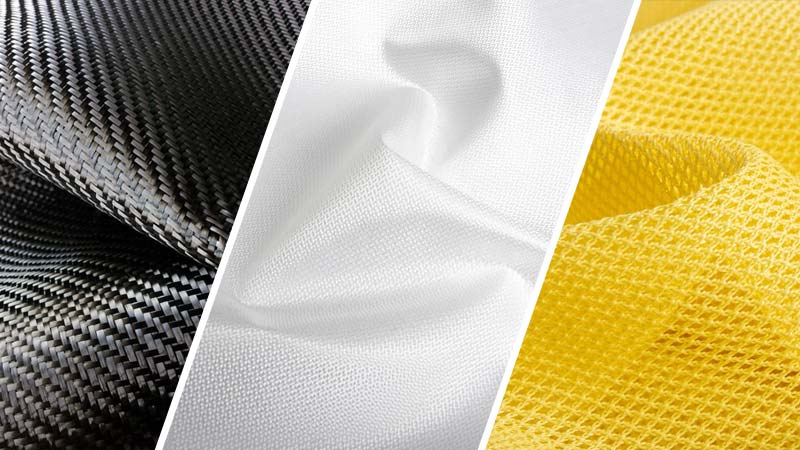
Carbon fiber is composed of at least 90 percent carbon. It is produced through the high-temperature carbonization of precursor fibers like polyacrylonitrile (PAN). In the flame retardant industry, we consider it the gold standard for environments where temperatures exceed 1000 degrees C.
Heat Resistance: Carbon fiber remains structurally stable at temperatures exceeding 1000 degrees C and can withstand up to 3000 degrees C in inert environments.
We often recommend carbon fiber blends for customers who need “zero-shrinkage” performance. Unlike synthetic polymers that may curl or melt, carbon fiber remains dimensionally stable. However, we always remind our clients that pure carbon fiber is brittle. It doesn’t stretch. If your application involves high impact or constant movement, we suggest our carbon-aramid hybrid fabrics to give you the best of both worlds.
Aramid fibers (aromatic polyamides) are famous under brand names like Kevlar and Nomex. These are the workhorses of the safety industry. They do not have a melting point and only begin to degrade or carbonize at temperatures above 400 degrees C.
Heat Resistance: Aramid fibers have no melting point and begin to carbonize or degrade only when exposed to temperatures above 400 degrees C.
It is important to distinguish between the two types we use at Begoodtex:
Glass fiber is made from silica-based compounds. It is the most widely used reinforcement and insulation material due to its low cost and high melting point (around 1100 degrees C).
Heat Resistance: Glass fiber handles continuous service temperatures up to 550 degrees C and possesses a high melting point of approximately 1100 degrees C.
If you need to wrap a high-temperature steam pipe or create a fire curtain for a warehouse, glass fiber is the most logical choice. It is an excellent electrical insulator and does not support combustion. However, at Begoodtex, we do not recommend glass fiber for wearable clothing. The fibers are prone to breaking under repeated bending, which can cause skin irritation (the “itchy” factor) and a loss of protection over time.
Ultra-High Molecular Weight Polyethylene (UHMWPE) is often discussed alongside these fibers. It has incredible strength and is used in bulletproof vests and cut-resistant gloves. However, it has a major weakness: heat. UHMWPE melts at around 145 degrees C. While we use it for mechanical protection, it should never be used as a primary flame retardant layer in high-heat scenarios.
To help you compare these materials quickly, we have compiled this data based on 2024 industrial standards. Note that these values can vary based on the specific resin matrix or weaving style used.
| Property | Carbon Fiber | Aramid (Para) | Glass Fiber (E-Glass) |
|---|---|---|---|
| Heat Resistance (Temp) | 1000C (Service) / 3000C (Inert) | 250C (Service) / 400C (Carbonize) | 550C (Service) / 1100C (Melt) |
| Tensile Strength | 3500-4500 MPa | 2800-3600 MPa | 2000-3000 MPa |
| Density | 1.75 g/cm3 | 1.44 g/cm3 | 2.55 g/cm3 |
| Young’s Modulus | 230 GPa (Very Stiff) | 120 GPa | 72 GPa |
| Flammability | Non-combustible | Charring > 400C | Non-combustible |
| Conductivity | High (Conductive) | Insulative | Insulative |
| UV Resistance | Excellent | Poor (Needs coating) | Excellent |
| Abrasion Resistance | Moderate | Excellent | Low |
| Chemical Resistance | Excellent | Sensitive to Acids | Good |
| Fatigue Resistance | Low (Brittle) | High (Tough) | Moderate |
| Moisture Absorption | Very Low | Moderate (up to 7%) | Negligible |
| Weight Ratio | Excellent | Best in Class | Heaviest |
When you are in a flash fire situation, the fabric should not melt onto the skin. This is why we focus on aramid and carbon fiber. Glass fiber has a high melting point, but it becomes soft and loses its shape. Carbon fiber, on the other hand, does not melt; it undergoes sublimation (turning directly into gas) only at extreme temperatures. At Begoodtex, we use this “no-melt” property to design layers that provide a critical buffer between the heat source and the wearer.
Industrial environments often involve corrosive substances. Carbon fiber is almost entirely chemically inert. Aramid fiber is tough but sensitive to strong acids and bleach (sodium hypochlorite). If you are using aramid fabrics, we recommend using oxygen-based bleaches for cleaning to avoid fiber degradation.
The performance of the fabric is not just about the fiber, but how we weave it. Here are the three most common styles we produce at Begoodtex:
In 2025, we are seeing a massive shift toward “Green FR” (Flame Retardant) solutions. We are increasingly working with recycled carbon fiber to reduce the carbon footprint of industrial safety gear. Additionally, the move away from PFAS-based chemical coatings toward inherently flame-retardant fibers (like aramid) is a trend we fully support at Begoodtex. Buying inherently FR fabrics means the protection never washes out, which is better for the environment and for your long-term budget.
To simplify your selection process, follow this logic used by our technical team:
We don’t just sell fabric; we engineer safety. At Begoodtex, we specialize in custom fiber blends. We know that sometimes the answer isn’t “Carbon vs. Aramid,” but rather a specialized blend of both. Our manufacturing process ensures that every meter of fabric meets international standards like NFPA 2112 and EN ISO 11612. When you work with us, you are getting decades of expertise in high-performance textile engineering.
Understanding the fundamental differences between carbon, aramid, and glass fiber is vital for any safety professional. Carbon fiber leads in heat and stiffness, aramid excels in toughness and wearable safety, and glass fiber remains the practical choice for static insulation. By selecting the right material and weave, you ensure not just compliance, but the highest level of life-saving protection.
No. Chlorine bleach will break down the molecular bonds in aramid fibers, significantly reducing their strength and FR properties. Use oxygen-based cleaners instead.
While not toxic, pure carbon fiber is stiff and can be abrasive. We recommend using carbon-fiber blends or using it as a secondary layer in garments.
Aramid fibers undergo UV degradation which turns the fabric darker and weakens the fibers. Always store aramid gear in dark places or choose fabrics with UV-resistant coatings.
No. Glass fiber is inherently non-combustible. However, its mechanical strength decreases if it is frequently moved or vibrated, which could lead to physical gaps in protection.
Meta-aramid (Nomex) is generally preferred for arc flash because it provides excellent thermal insulation and does not conduct electricity, unlike carbon fiber.