Get in touch
Thank you for reaching out! Please tell us more about your needs — our expert team will get back to you within 24 hours.
Get in touch
Thank you for reaching out! Please tell us more about your needs — our expert team will get back to you within 24 hours.
Chiffon is the go-to fabric for elegance. It is lightweight, sheer, and drapes beautifully, making it a favorite for evening gowns and luxury decor. Most chiffon fabrics in their natural state are highly flammable. Because the material is so thin and airy, it can catch fire easily and burn with extreme speed once ignited.
However, modern textile innovation has changed the safety profile of this delicate material. While traditional versions pose a fire risk, Inherent Flame Retardant (IFR) Polyester Chiffon has been developed to provide a crucial safety barrier. This specialized fabric offers the same aesthetic appeal as standard chiffon but is engineered to resist ignition and slow down the spread of fire, making it the superior choice for professional and commercial applications.

Chiffon is a plain-woven, lightweight fabric known for its distinct translucency. The name originates from the French word “chiffe,” meaning “cloth.” Today, it is synonymous with high-end fashion and sophisticated interior design.
It can be produced from natural fibers like silk and cotton or synthetic fibers like polyester and nylon. Its defining characteristic is its “sheer” look—it is transparent enough to see through, yet it holds enough structure to add volume and movement to a garment or drapery.
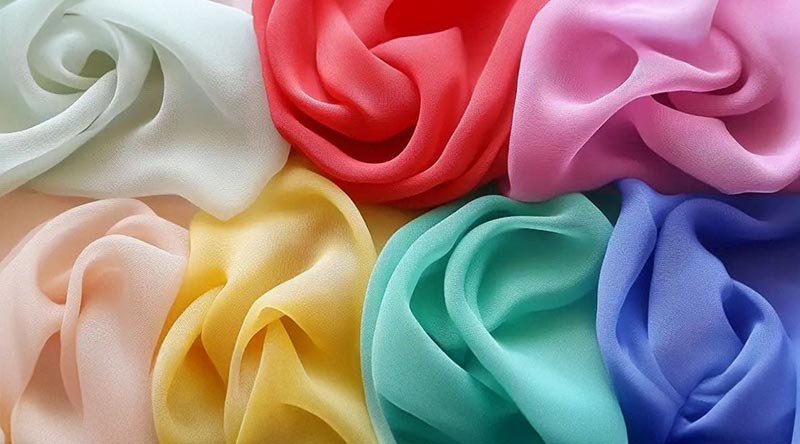
Chiffon is prized for its unique physical properties that distinguish it from other sheer fabrics like organza or georgette:
The secret to chiffon’s bounce and unique texture lies in the high-twist yarns used during weaving. It is constructed using alternating S-twist and Z-twist yarns in a simple plain-weave pattern.
These yarns are twisted much tighter than standard threads. When the fabric is finished, these twists cause the material to pucker slightly in both directions. This creates the “crepe” effect and gives the fabric a slight mechanical stretch, allowing it to drape elegantly without being heavy.
This is the luxury version. It has a natural, soft shimmer and a very smooth handle. While beautiful, it is also the most fragile and expensive type of chiffon.
Polyester is the industry standard for durability and cost-effectiveness. It is much easier to care for than silk. Crucially, polyester is the primary base material used to create high-performance Inherent Flame Retardant (IFR) chiffon.
Rayon mimics the feel of silk but at a lower price point. Nylon is known for its strength. However, both are naturally highly flammable unless they undergo intensive safety modifications.
Standard chiffon is inherently flammable, whereas Inherent Flame Retardant (IFR) Chiffon is specifically engineered for safety. This risk in standard chiffon is caused by its physical structure; because the fabric is so thin and porous, oxygen can easily penetrate the fibers from both sides, fueling the fire instantly. This creates a “chimney effect” where flames race up a hanging curtain or gown in seconds.
In contrast, Inherent Flame Retardant Chiffon addresses this structural vulnerability at the molecular level. Even though it retains the same light and airy structure as standard chiffon, the fibers themselves are modified to resist heat. When exposed to a flame, the IFR fibers work to suppress combustion, providing a critical window of safety that standard chiffon simply cannot offer.
| Material Type | Flammability Level | Reaction to Fire |
|---|---|---|
| Cotton Chiffon | Very High | Burns rapidly; leaves fine ash and continues to glow. |
| Silk Chiffon | Medium-High | Smells like burning hair; thin layers burn very easily. |
| Standard Polyester | High | Melts and drips quickly, posing a high risk of skin burns. |
| Inherent FR Chiffon | Flame Retardant | Resists ignition; slows flame spread with significantly reduced melting. |
Safety Note: For any commercial project, using standard untreated chiffon is often a violation of fire codes. Always specify Inherent Flame Retardant (IFR) versions to ensure permanent compliance and safety.
For professional purchasers, understanding Inherent Flame Retardant (IFR) Polyester is vital. This is the highest level of safety available in the textile industry today.
Unlike traditional methods, the flame-retardant properties are built directly into the molecular structure of the polyester fiber itself before the weaving process begins. This leads to several key advantages:
While chiffon is famous for fashion, its use in professional decor is where the flame-retardant function becomes most important:
Sustainability is becoming a priority in the textile industry. Many manufacturers now offer Recycled Polyester Chiffon (rPET) made from post-consumer plastic bottles. When combined with inherent flame retardancy, this creates a product that is both safe for humans and better for the planet.
To preserve the beauty and the flame-retardant integrity of chiffon, follow these steps:
Chiffon is an essential fabric for anyone seeking an elegant, airy aesthetic. While standard chiffon is naturally flammable due to its thin weave, Inherent Flame Retardant (IFR) Chiffon provides a safe and professional alternative. By choosing fabrics with inherent FR properties, you can enjoy the translucent beauty of chiffon without compromising on safety standards like NFPA 701 or 16 CFR 1610. IFR chiffon ensures that the protection is permanent, lasting for the entire life of the fabric.
No. Although silk has some self-extinguishing properties, silk chiffon is so lightweight that it will still catch fire and burn quickly. It is not fireproof.
Standard polyester will melt and drip dangerously when it burns. Inherent FR polyester is engineered to resist catching fire and significantly reduces melting, providing a much higher safety margin.
No. Because the flame retardancy is built into the fiber itself, Inherent FR chiffon is permanent. It will remain flame retardant regardless of how many times it is washed.
Only if it is certified Flame Retardant. Most commercial buildings require fabrics to pass the NFPA 701 or equivalent local fire safety tests. IFR Chiffon is the standard choice for these settings.
Always look for a certificate of compliance from the manufacturer. Reliable FR fabrics will have documented test results for specific fire safety standards like NFPA 701.