Get in touch
Thank you for reaching out! Please tell us more about your needs — our expert team will get back to you within 24 hours.
Get in touch
Thank you for reaching out! Please tell us more about your needs — our expert team will get back to you within 24 hours.
Safety in high-risk industrial environments isn’t just about wearing “fireproof” clothes. It is about knowing exactly how much protection those clothes provide when a disaster happens. In the world of flame-resistant (FR) fabrics, the ASTM F1930 test method is the gold standard. It is often called the “Manikin Test,” and it is the closest we can get to testing a garment in a real-life fire without putting a human in danger.
Many procurement officers and safety managers often confuse ASTM F1930 with NFPA 2112. While they are related, understanding the difference between a “test method” and a “performance standard” is vital for workplace safety. This guide will explain the ASTM F1930 test method in detail, clarify its importance to your team, and show you how to use test results to select the best protective equipment for flash fire hazards.
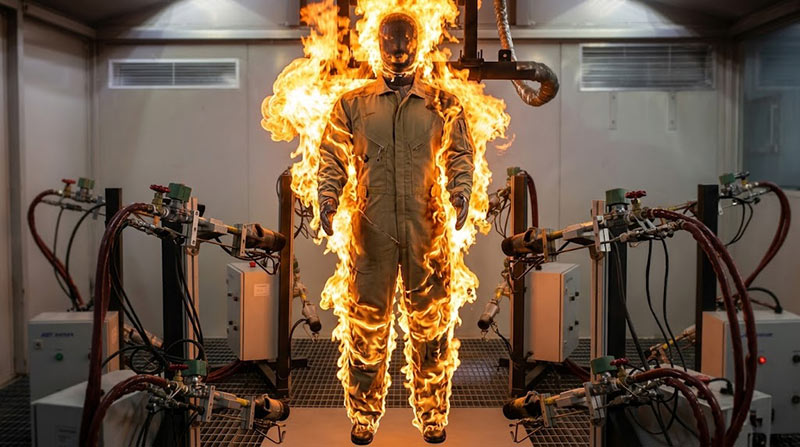
ASTM F1930 is an internationally recognized standard test method rather than a performance standard. This is a critical distinction: it describes the specific technical procedures for testing a full garment—such as a coverall or a lab coat—on a life-sized manikin equipped with sophisticated sensors. The official title is the “Standard Test Method for Evaluation of Flame Resistant Clothing for Fire Simulations Using an Instrumented Manikin.”
While many other tests only look at a small, flat piece of fabric (like vertical flame tests), ASTM F1930 looks at the entire clothing system. This is crucial because a great fabric can be ruined by a bad garment design, such as loose cuffs, exposed metal zippers, or cheap sewing threads that fail under heat. The manikin test tells us how the whole outfit performs when it is engulfed in flames for a specific duration.
The primary goal of this test method is to predict human skin burn injury. It measures the heat that passes through the clothing and calculates whether a person wearing that outfit would suffer second-degree or third-degree burns during a simulated flash fire. By using this data, manufacturers can refine fabric blends and garment designs to offer maximum protection.
ASTM F1930 is not a universal test for every type of clothing. It is specifically designed for protective gear used in environments where flash fire is a risk. Understanding which products should undergo this test helps in making better procurement decisions.
Several high-risk sectors rely on ASTM F1930 data to validate their safety protocols. These include:
In industries like oil and gas, chemical processing, or electrical utilities, a “flash fire” is a constant, unpredictable risk. These fires happen when fuel and air mix and ignite, causing a sudden, intense burst of heat. Usually, these fires last only three seconds or less, but the temperature can reach 1000 degrees C or more in an instant.
ASTM F1930 is essential because it provides real-world simulation that fabric-only tests simply cannot match. Here is why it stands out in a safety program:
At Begoodtex, we believe that the best FR fabrics should do more than just meet a standard; they should provide a measurable margin of safety that gives workers those extra few seconds needed to escape and survive.
The core idea of ASTM F1930 is to recreate a flash fire in a highly controlled, repeatable laboratory environment. The “instrumented manikin” is a sophisticated piece of equipment, usually made from heat-resistant materials like epoxy or ceramic. It is roughly the size and shape of an average adult male to ensure the garment fits as it would on a worker.
The manikin is covered with at least 100 small heat sensors (thermocouples) distributed all over its body, head, and limbs. These sensors act like “digital skin.” When the fire starts, these sensors measure how much heat energy (heat flux) is hitting the manikin every millisecond. This data is then sent to a computer system for real-time analysis.
The test uses a mathematical model based on human tissue physiology, often referred to as the “Stoll Curve” or similar skin burn models. It calculates how much energy it takes to cause a second-degree burn (where the skin blisters) and a third-degree burn (where the damage goes deep into the tissue). By comparing the heat data from the sensors to this model, the computer can draw a precise map of exactly where the person would have been burned.
Testing according to ASTM F1930 is a rigorous process. Labs don’t just throw a shirt on a dummy; they follow a very specific, documented sequence to ensure the results are valid and can be compared to other tests:
The garment must be prepared correctly. Usually, this means it has been washed several times (often 100 times for certain certifications) to ensure the flame resistance is inherent or durable and doesn’t simply wash out. The size must match the manikin’s dimensions perfectly—a garment that is too small or too large will provide inaccurate data regarding the protective air gap.
The manikin is dressed in the test garment. If the garment is a coverall, it is zipped up according to the manufacturer’s instructions. If it is a layering system, such as an FR base layer under a heavy outer shell, both are put on. Standardized cotton undergarments are often used underneath to simulate common work conditions.
The manikin is placed in a chamber with a series of industrial burners (usually 8 to 12 burners). These burners are calibrated to produce a specific amount of heat—usually 84 kilowatts per square meter. The fire is turned on for a set amount of time, typically 3 seconds or 4 seconds, to simulate a standard flash fire scenario.
After the fire stops, the manikin remains in the chamber. The sensors continue to record data for about 60 to 120 seconds. This is critical because the garment might hold heat or “after-burn,” which can continue to transfer energy to the skin even after the external fire is extinguished. This “heat soak” period is often where the most dangerous injuries occur. Many advanced fabrics, like those produced by Begoodtex, are designed specifically to minimize this heat soak effect.
The result of an ASTM F1930 test is primarily expressed as a Total Body Burn (TBB) percentage. This is the sum of all areas on the manikin that reached the threshold for second-degree or third-degree burns, excluding the hands and feet which are usually not instrumented or covered.
When you look at a professional lab report, you will see a few key numbers:
The Importance of the Burn Map: Most reports include a visual diagram. If the map shows a lot of burns on the chest or back, it might mean the fabric weight is insufficient for that heat level. If the burns are concentrated around the neck or wrists, it might mean the garment design needs better closures or overlap. This detail allows designers to optimize the final product for better field performance.
This is a common point of confusion in the safety industry. Are they the same thing? No. They work together, but they serve different purposes:
To be certified under NFPA 2112, a garment must be tested using the ASTM F1930 method. The requirement is that the garment must show a total predicted body burn of 50 percent or less after a 3-second exposure. If the burn is 51 percent, the garment fails NFPA 2112 certification, even if the fabric itself passed every other flame test.
| Comparison Feature | ASTM F1930 | NFPA 2112 |
|---|---|---|
| Category | Technical Test Method | Regulatory Performance Standard |
| Main Purpose | To measure burn injury prediction | To certify a garment as “Safe” |
| Pass/Fail Criteria | None (it only provides data) | Must be under 50 percent total burn |
| Scope | Full garment simulation | Fabric and garment requirements |
Many factors can change the outcome of an ASTM F1930 test. Understanding these variables helps you choose the right product for your specific risk level.
Generally, heavier fabrics provide more thermal insulation, leading to a lower burn percentage. However, weight isn’t everything. The fiber blend—whether it is FR Cotton, Modacrylic, or Aramid—plays a huge role. Some fabrics char and stay strong (like Begoodtex premium FR cotton blends), while others might shrink significantly. Shrinkage is dangerous because it eliminates the air gap and brings the hot fabric directly against the skin.
If a garment is too loose, it can create a “chimney effect” where flames are sucked up through the bottom of the jacket. If it is too tight, there is no insulation. The ASTM F1930 test helps designers find the “sweet spot” in garment sizing that offers the best balance of comfort and safety.
Small details often lead to failure. Metal zippers can get extremely hot and cause localized third-degree burns even if the fabric is perfect. Non-FR thread can melt, causing the garment to fall apart during the fire. Using high-quality, flame-resistant components ensures the entire garment system performs at its peak.
If you are in any of the following roles, understanding ASTM F1930 is essential for professional risk management:
When you receive a technical report, look past the summary page. Check these details to ensure the data is accurate and relevant:
ASTM F1930 has transformed the flame-resistant clothing industry. It moved the conversation away from marketing claims and toward hard, scientific evidence. By using a sophisticated manikin, we can see exactly how a flash fire impacts the human body and how our clothing can prevent life-changing injuries.
As a specialized manufacturer, Begoodtex is committed to producing fabrics that don’t just “pass” the test, but set new benchmarks for safety. We focus on the consistency of our flame-retardant treatments and the thermal stability of our blends, ensuring that when the sensors on that manikin start recording, the results reflect the highest possible level of worker protection.
ASTM F1930 is the internationally recognized standard test method used to predict human burn injuries in a simulated flash fire. It is a technical protocol, not a performance standard, and it evaluates the entire garment system on an instrumented manikin. A lower “Total Body Burn” (TBB) percentage indicates superior protection. Most certification standards, like NFPA 2112, use this test method and require a TBB of less than 50 percent to grant certification. When evaluating PPE, always demand the full ASTM F1930 report to understand the real-world safety margin of your clothing.
No. It is a test method. It provides the “how-to” for the test. Standards like NFPA 2112 or ISO 13506 are the ones that provide the “pass/fail” rules based on the results of the ASTM F1930 test.
Three seconds is the estimated duration of a typical industrial flash fire. It represents the time a worker has to realize a fire has occurred and begin to move away from the source.
Absolutely. It is one of the best ways to test if an outer shell and an inner lining work together to trap air and provide better insulation, or if the inner layer melts and causes more harm.
While very rare for a 3-second exposure in a standard coverall, some high-performance multi-layer systems can achieve near-zero burn results. Most high-quality single-layer FR garments aim for the lowest possible TBB while maintaining comfort.
Shrinkage usually causes the burn percentage to increase because it removes the protective air gap between the fabric and the manikin’s sensors. High-quality FR fabrics are engineered to be thermally stable to prevent this.
Look for labs that are ISO 17025 accredited. This ensures that their ASTM F1930 equipment is calibrated correctly and their technicians follow the standard test method strictly.