Get in touch
Thank you for reaching out! Please tell us more about your needs — our expert team will get back to you within 24 hours.




Many buyers are surprised when they first deal with rail transit fabric projects.
For normal commercial interiors, buyers may focus mainly on flame retardancy, color, hand feel, and durability. But subway and light rail projects are different.
Rail cars are narrow. Passengers are close together. Exit space is limited. If a fire happens in a tunnel or enclosed section, smoke is much harder to remove.
That is why NFPA 130 does not only look at whether a fabric is “hard to ignite.” The bigger concern is what happens after ignition.
In a real emergency, even a few extra minutes can make a big difference.

In sourcing conversations, we often hear this question:
“Can this fabric pass NFPA 130?”
The question is understandable, but not completely accurate.
NFPA 130 is not one single fabric test. It is a fire safety standard for fixed guideway transit and passenger rail systems, including subway, light rail, stations, tunnels, ventilation, evacuation, and train materials.
So when we talk about fabric compliance, the lab usually does not run a test called “NFPA 130.”
Instead, the material is tested according to specific methods referenced in the project requirement. For rail interior textiles, common tests include:
So a better question is not simply:
“Can it pass NFPA 130?”
A more practical question would be:
“Does this fabric have ASTM E162, ASTM E662, or other required test reports that match the NFPA 130 project specification?”
This may sound more complicated than asking for an “NFPA 130 report,” but in real rail projects, it is much more useful.
Why are rail transit material requirements so strict?
Imagine this situation.
A full subway car stops inside a tunnel. The doors are not yet open, and passengers are waiting for evacuation instructions. A material somewhere starts to heat up and release smoke. The flame may not have spread widely yet, but smoke has already begun to fill the car. Visibility drops, breathing becomes difficult, and panic starts to build.
At that moment, how much smoke a material produces — and how quickly it produces that smoke — becomes more important than many people expect.
Some fabrics may not burn easily on the surface, but they can still generate high smoke density when exposed to heat. In an ordinary open space, this is already a problem. Inside a subway car or tunnel, the risk is much greater.
This is exactly why NFPA 130 pays attention to more than ignition. It also looks at flame spread, smoke density, heat release, and the overall effect on the evacuation environment.
Seat fabrics, curtains, soft wall coverings, foam, adhesives, flooring materials, and interior panels may each look like small components on their own. But once installed inside a train, they become part of the total fire load. If any one material burns too quickly or produces too much smoke, it may reduce the available escape time.
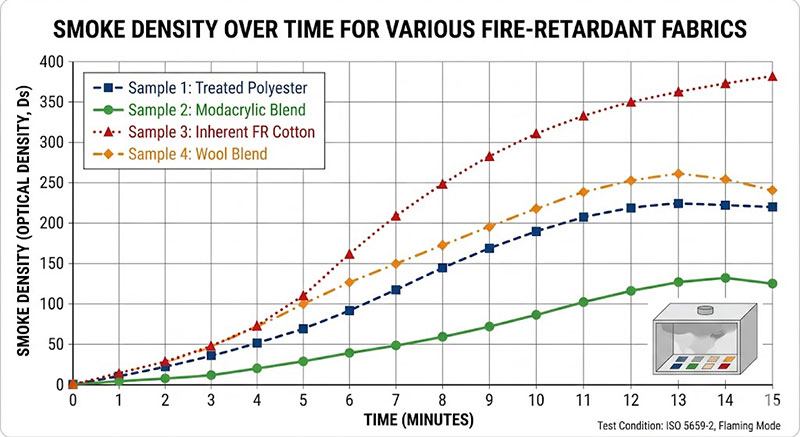
When reviewing rail transit material reports, ASTM E162 and ASTM E662 are often seen together. ASTM E162 focuses on surface flame spread, while ASTM E662 evaluates smoke density.
Many fabric suppliers working on rail projects for the first time focus heavily on flame retardancy. However, in practice, smoke density is often the harder requirement to meet.
| Review Focus | Common Test | What Buyers Should Pay Attention To |
|---|---|---|
| Flame spread | ASTM E162 | Whether flame easily spreads across the material surface |
| Smoke density | ASTM E662 | A common challenge for many textiles, especially under heat exposure |
| Heat release | ASTM E1354 | May be used for fire modeling and system-level engineering evaluation |
| Curtain-type burning behavior | NFPA 701 or ASTM E162 | Depends on the specific requirement from the transit authority |
Some decorative flame-retardant fabrics can pass curtain burning tests, but when used in rail transit projects, their smoke density or heat release data may not be sufficient.
This is one of the key differences between rail interior textiles and ordinary public building textiles.
For hotel curtains, theater drapes, or office decorative fabrics, the focus is usually vertical flame resistance, flame spread, and local fire code requirements. Materials used inside rail cars must also face a more enclosed, crowded, and difficult-to-evacuate environment.
That is why the logic used for ordinary flame-retardant fabrics cannot be directly copied into subway or rail projects.
In rail transit applications, fabric rarely works alone.
A fabric may perform well when tested by itself. But once it is combined with foam, adhesive, coating, or backing materials, the test result may change.
This happens quite often in real projects.
At the early sourcing stage, a buyer may only ask for a fabric test report. Later, the train manufacturer or project owner may require testing based on the final end-use structure. Only then does the supplier realize that the required test may involve fabric + foam + adhesive, or curtain fabric with coating, rather than a single layer of fabric alone.
This directly affects the project timeline.
Rail transit sampling cycles are usually long. Testing costs are high. There are also many parties involved. If the color, texture, and hand feel are already approved, but the final structure test direction turns out to be wrong, the cost of rework can be significant.
For this type of project, it is better to clarify these questions from the beginning:
This step may seem detailed, but it can prevent many problems later.
Customers involved in global rail transit supply often encounter both NFPA 130 and EN 45545-2.
These two standards have similar goals: both aim to reduce fire risk in rail systems. However, they belong to different regulatory systems and cannot simply replace each other.
| Standard | Common Region | Key Point in Project Communication |
|---|---|---|
| NFPA 130 | North American subway, light rail, airport people mover projects | Often used together with ASTM E162, ASTM E662, ASTM E1354, and other test data |
| EN 45545-2 | European railway projects | Evaluates materials based on application and hazard level, with more detailed smoke and toxicity requirements |
| BS 6853 | Older UK projects or legacy requirements | An older system with strict smoke and toxicity requirements; many new projects now move toward EN 45545-2 |
For suppliers, the safest approach is to first confirm the project region and the requirements of the transit authority.
For North American projects, prepare materials according to the NFPA 130 system. For European projects, follow the material classification, hazard level, and test combinations under EN 45545-2.
Standards should not be mixed based on assumption.
Subway and light rail interiors are not temporary event products. They are used for many years and must withstand cleaning, abrasion, sunlight, temperature changes, humidity, and routine maintenance.
If flame retardancy mainly depends on a finishing treatment or surface coating, buyers need to pay close attention to washing durability, abrasion resistance, odor, and long-term stability.
The advantage of inherently flame-retardant fibers is that the flame-retardant performance comes from the fiber itself, rather than relying heavily on a surface coating.
However, this does not mean that every inherently flame-retardant fabric automatically meets NFPA 130 requirements. The final result still depends on the material structure, weight, finishing process, smoke density, heat release, and third-party test results.
The earlier and more precisely a rail transit project is discussed, the smoother the later stages usually become.
If a customer only says, “We need railway fabric,” the supplier cannot make an accurate recommendation right away. The fabric may be used for seat upholstery, curtains, partitions, soft wall panels, wall coverings, sunshade materials, or even as part of a composite interior structure.
Different locations have different testing requirements.
A more effective conversation is to make the project details clear:
These questions may seem numerous, but they are all designed to avoid rework later.
In rail transit projects, the biggest risk is not that the fabric is slightly more expensive. The real problem is confirming samples first, then discovering that the test report does not match the project approval direction.
For rail transit fabric projects, we do not start by simply asking, “Do you need flame-retardant fabric?”
That question is too broad.
We first check which standard system the project follows.
For North American subway, light rail, or airport people mover projects, the focus is usually on NFPA 130-related requirements, together with ASTM test methods such as ASTM E162, ASTM E662, and ASTM E1354.
For European railway projects, the discussion usually moves to EN 45545-2, including the material category and hazard level required by the project.
After that, the next question is where the fabric will be used.
Seat fabric is not judged by fabric alone. Foam, adhesive, backing material, and the final seat structure can all affect the result.
Curtains and sunshade fabrics have another set of concerns. The hanging method, flame spread, smoke density, dimensional stability, and color durability all need to be checked.
For wall coverings or soft panels, the base material, lamination method, and installation structure are just as important as the fabric surface.
This is why rail projects cannot be handled by recommending one general “flame-retardant fabric.”
A better way is to select the material according to its exact position in the rail car, the required test methods, expected service life, and cleaning or maintenance conditions.
In these projects, we usually pay close attention to several points: inherently flame-retardant fibers, low-smoke performance, abrasion resistance, antistatic needs, color stability, and environmental documents.
These details may look small at the sample stage, but they can affect testing, bulk production, long-term use, and maintenance later.
NFPA 130 is mainly about giving passengers more time to escape during a rail transit fire.
For fabrics, the issue is not just whether the material is flame-retardant. Flame spread, smoke density, heat release, assembly structure, and long-term stability all matter.
Seat fabric, curtains, wall coverings, foam, adhesives, and laminated layers can all change the final test result.
So before sourcing fabric for a rail project, buyers should first confirm four things:
This is much more reliable than simply asking:
“Do you have NFPA 130?”
NFPA 130 is a system-level fire safety standard. It is not a single fabric test report. For materials, buyers should check the specific ASTM or NFPA test reports referenced by the project specification, such as ASTM E162, ASTM E662, or ASTM E1354.
Usually not by itself. NFPA 701 may be relevant for hanging textiles, but NFPA 130 rail projects often require additional data such as flame spread, smoke density, and sometimes heat release. The final answer depends on the transit authority and project specification.
Start with the project specification. In many cases, buyers will need ASTM E162 for flame spread and ASTM E662 for smoke density. For more detailed engineering evaluation, ASTM E1354 heat release data may also be requested.
For early material screening, fabric-only reports are useful. For final approval, many projects care more about the end-use configuration, including fabric, foam, adhesive, backing, and substrate. This should be confirmed before bulk orders.
No. NFPA 130 and EN 45545-2 use different test logic and classification systems. EN 45545-2 also places strong emphasis on smoke and toxic gas requirements. A report for one system should not be treated as automatic approval for the other.