Get in touch
Thank you for reaching out! Please tell us more about your needs — our expert team will get back to you within 24 hours.
Get in touch
Thank you for reaching out! Please tell us more about your needs — our expert team will get back to you within 24 hours.




One of the most common problems in curtain projects appears very late in the process: the test report does not match the final product.
At the beginning, many buyers only confirm one thing: “Is the fabric flame-retardant?”
But later, during project approval, the fire consultant may start asking more specific questions:
If bulk production has already started at that point, the cost can be painful.
So when buying flame-retardant curtain fabric, it is not enough to ask, “Is it FR?” Buyers need to confirm a few key points early:
Once these points are clear, fabric selection becomes much safer.

Flame-retardant curtain standards do not prove that a curtain will “never burn.”
They check how the curtain fabric behaves under controlled flame conditions. For example:
A supplier might say that a fabric is flame-retardant. If the supplier does not have the test report that the project requires the fabric may still not be approved for use in hotels, hospitals, theaters, schools, offices, exhibition halls or other public buildings.
The flame-retardant fabric specification should start with the standard that the flame-retardant fabric must meet then it should describe the flame-retardant fabric.
For example we need to know:
This is much more useful than simply writing “FR curtain fabric.”
Curtain standards are easy to mix up because different markets use different systems.
Here is a simple reference table for common sourcing situations:
| Standard | Common Region / Application | What Buyers Should Check |
|---|---|---|
| NFPA 701 | United States; hotels, schools, offices, events, theaters, and other hanging textiles | Make sure the report matches the final curtain fabric, not just a similar material |
| BS 5867-2 | UK curtain and drapery projects | Type B and Type C should not be confused; Type C usually pays more attention to durability and cleaning |
| EN 13773 | European curtain and drapery classification | Class 1 is often seen as a higher level, but the final requirement still depends on the project country |
| DIN 4102-B1 | German commercial interiors and decorative textiles | German projects may require B1 specifically; do not assume another European report can replace it |
| NF P92-503 M1 | French curtains, decorative fabrics, and contract interiors | M1 is common in French projects and should be confirmed early |
| CAN/ULC-S109 | Flame-retardant fabrics used in Canadian building interiors | Do not assume NFPA 701 will always be accepted in Canada |
| IMO FTP Code Part 7 | Marine interiors, cruise ships, ferries, and ship cabins | Marine projects often care more about documentation, type approval, and long-term compliance |
This table shows one important thing: there is no single global standard for flame-retardant curtains.
A hotel curtain project in the United States may need NFPA 701.
A UK project may need BS 5867-2.
A French project may ask for M1.
A German project may ask for B1.
If the curtain is used in a cruise ship cabin, a normal hotel curtain report may not be enough. IMO FTP Code Part 7 may be required.
In the United States, commercial curtain projects often mention NFPA 701.
In Canada, the local standard CAN/ULC-S109 may be required.
A common problem is that the fabric structure changes after testing.
Some reports say NFPA 701, but the tested sample was only a base fabric. If the final order uses blackout coating, backing, lamination, or another finishing process, the burning behavior may change completely.
In that case, the old report may not represent the final curtain fabric.
For buyers, there are two things to check:
First, do not assume a US report will automatically be accepted in Canada.
Second, check whether the fabric in the report really matches the bulk order — weight, color, coating, backing, and finishing included.
When it comes to UK curtain projects BS 5867-2 is something that people look at.
You have Type B and Type C curtains. These are both used a lot but UK curtain projects that use Type B and Type C curtains are not the same.
One thing that people who buy curtains often get wrong is that they do not think about how the flame retardant works after the curtains have been cleaned.
Some curtain fabrics will pass the test but after you wash them in water or take them to a commercial dry cleaner the flame retardant on the fabric may not work as well and the curtains will not perform as well as they did before.
If the place where the curtains will be used needs them to be cleaned a lot, like hospitals or schools or other places with contract interiors, UK curtain projects that use Type C curtains are often the choice.
In Europe, EN 13773 is commonly used for curtain and drapery fire classification. Class 1 is often treated as a higher level.
But in real projects, it is risky to say only “European standard.”
Different European countries may have their own project habits and local requirements.
German projects may specifically ask for DIN 4102-B1.
French projects may specifically ask for NF P92-503 M1.
If you develop samples based only on a general European standard, confirm the color and hand feel, and then discover later that the local project only accepts M1 or B1, the whole material selection may need to be redone.
Before developing samples, confirm the exact country of the project.
If it is Germany or France, put B1 or M1 clearly into the technical requirement or contract. It is also worth checking whether the project has any requirements for the testing laboratory.
Curtains used on ships, cruise liners, ferries, or offshore accommodation may look similar to hotel curtains, but the testing logic is not the same.
Marine interiors often refer to IMO FTP Code Part 7. This part applies to vertically supported textiles and films, including curtains, draperies, and similar hanging materials.
The biggest difference between marine projects and ordinary hotel projects is the environment.
When sourcing marine curtain fabric, buyers should check more than flame retardancy:
We have seen customers prepare documents based on hotel curtain standards at first, only to find out later that the project needed IMO documents.
Once a marine project reaches the later approval stage, fixing missing documents can become very stressful.
So if the project is for a cruise ship, ferry, marine cabin, or offshore accommodation, it is better not to treat it like an ordinary hotel curtain project.
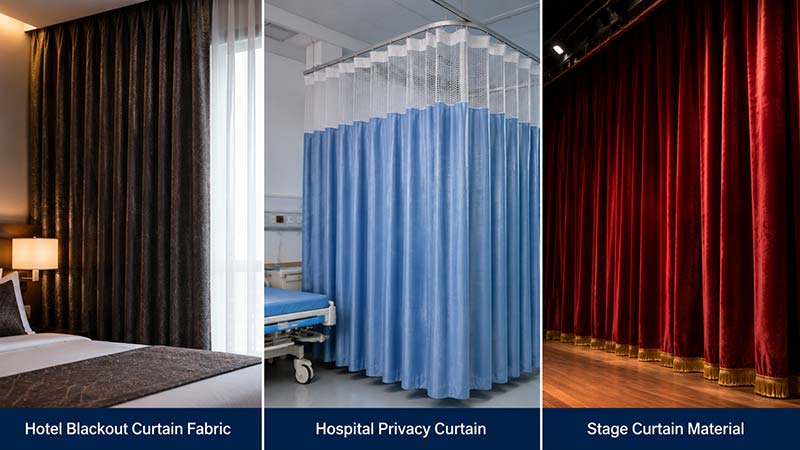
A flame-retardant curtain for a hotel is not the same as one for a hospital, school, theater, office, or ship.
Here is a simple way to understand the difference:
| Application | Common Standard Direction | What Buyers Should Focus On |
|---|---|---|
| Hotel curtains | NFPA 701, BS 5867-2, EN 13773, M1, B1 | Blackout effect, drape, color batch consistency, wash durability |
| Hospital cubicle curtains | NFPA 701, BS 5867-2, EN 13773, B1 | Antibacterial function, removability, washing cycle, report matching |
| School curtains | NFPA 701, BS 5867-2, EN 13773 | Safety, durability, budget, maintenance method |
| Theater / stage drapes | NFPA 701, BS 5867-2 Type C, DIN 4102-B1 | Large-area hanging, heavy fabric, dark colors, acoustic feel |
| Office / meeting room curtains | NFPA 701, EN 13773, BS 5867-2 | Light control, clean appearance, stable supply |
| Marine curtains | IMO FTP Code Part 7 | IMO documents, batch traceability, marine project approval |
This table is not meant to replace the project specification. It only helps buyers start the conversation in the right direction.
Before placing an order, always follow the project documents, local regulations, and the fire consultant’s requirements.
There are two common routes for flame-retardant curtain fabrics.
Inherently flame-retardant fabric gets its flame-retardant performance from the fiber itself. It is usually more stable after repeated cleaning and long-term use. This is often a better fit for hotels, hospitals, schools, and public building projects that require long service life.
Post-treated flame-retardant fabric gets its flame-retardant performance through finishing after the fabric is made. It can be useful for decorative projects, budget-sensitive orders, or applications with low cleaning frequency.
For contract projects, the initial price should not be the only concern.
If the buyer only looks at the first test result and ignores later cleaning or added finishing, the fabric may create problems later. Replacing the fabric at that stage can cost much more than choosing correctly at the beginning.
For long-term commercial projects, maintenance cost and test stability should be part of the total budget.
Blackout curtains are one of the easiest products to misunderstand when reviewing reports.
The reason is simple: many blackout fabrics are not single-layer fabrics.
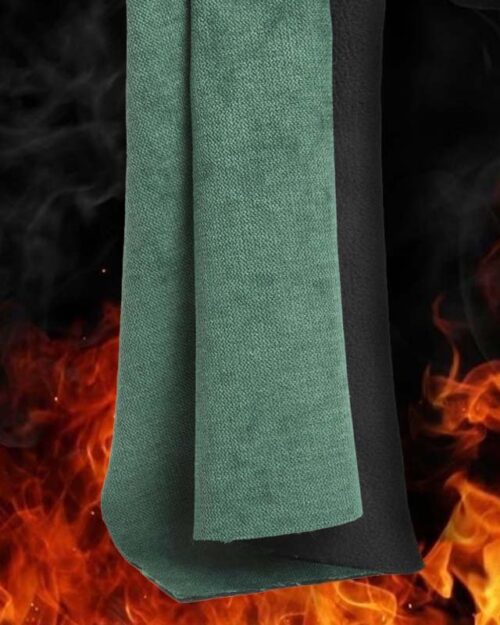
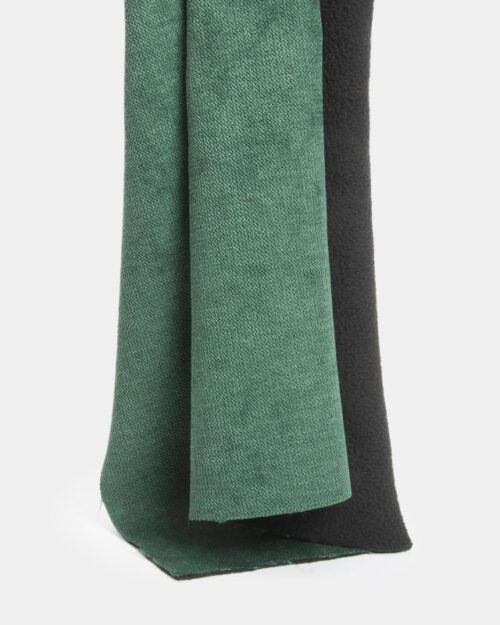
They may include black yarn, white backing, foam coating, or laminated layers.
A flame-retardant base fabric does not automatically mean the final blackout fabric can pass the same test.
If the project reviewer finds that the report does not cover the final coating or laminated structure, the report may be rejected and retesting may be required.
When you are buying blackout curtains you should check a things:
You should not just ask if the fabric blocks out light or if it is flame retardant when you are looking at blackout curtains.
The final fabric structure is really what matters when it comes to whether the test report’s valid or not.
Blackout curtain fabric needs to meet standards for being flame retardant but it also needs to work well as a curtain.
Some fabrics pass the test but do not hang well.
Some fabrics have beautiful color but weak blackout performance.
Some fabrics are cheap but have strong batch color difference, which becomes very obvious after installation.
Before ordering, buyers should at least confirm:
These details may look small, but they matter in real projects.
Curtains are installed over large areas. Any color difference, shrinkage, or poor drape will be easy to see.
In project purchasing, the most common curtain problem is not “no report.”
It is that the report does not match the order.
A new version replacing an old one, a light color changing to a dark color, a base fabric being coated for blackout, or the addition of digital printing or special finishing can all affect whether the old flame-retardant report is still valid.
Before placing an order, do not only ask, “Do you have a certificate?”
Confirm these four points:
Only when the report scope fully covers the final bulk fabric is project approval safer.
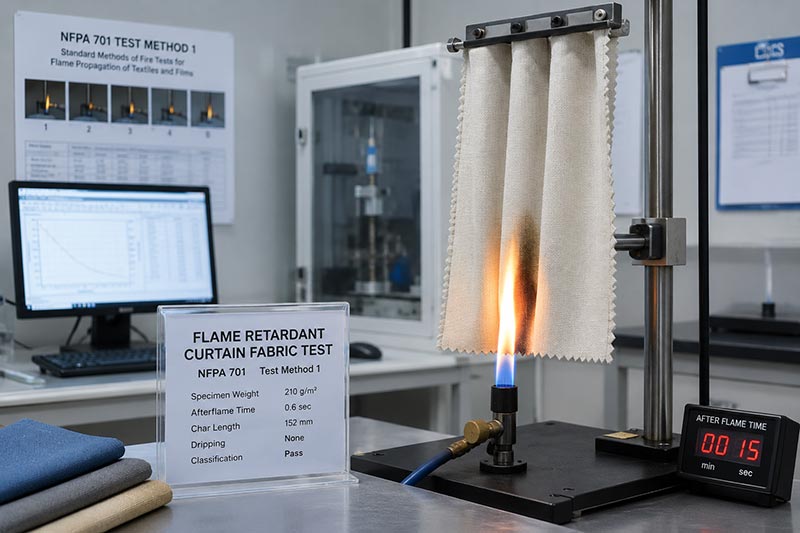
A reliable supplier should not only say, “Yes, we have a certificate.”
They should help buyers judge which standard, fabric structure, and report scope the project actually needs.
An experienced supplier will usually ask for these details before quoting:
These questions are not meant to slow down the quotation.
They help avoid the wrong recommendation.
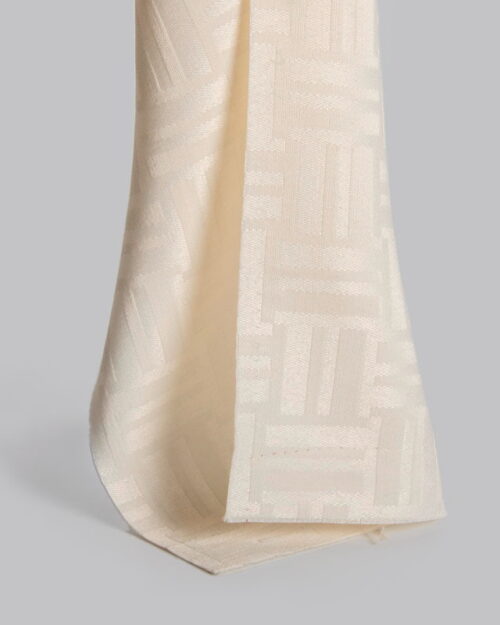
Begoodtex can provide different flame-retardant curtain fabric directions, including inherently FR polyester curtain fabrics, FR blackout fabrics, FR sheers, FR velvet stage drapes, jacquard fabrics for hospital cubicle curtains, and coated FR roller blind fabrics.
For special projects, we can also develop fabrics around weight, width, color, blackout rate, antibacterial finishing, antistatic performance, water repellency, and third-party testing.
The best way to start is not simply:
“I need flame-retardant curtain fabric.”
A better request would be:
“I need curtain fabric for this application, installed in this country, with this required standard. It may need blackout or washing, and the final report should cover this fabric structure.”
The clearer this sentence is, the more accurate the fabric recommendation will be.
The correct flame-retardant curtain standard is not decided casually by the supplier.
It depends on the project country, building type, installation environment, and final application.
But the standard name is only the first step.
The real question is whether the test report matches the final fabric.
A flame-retardant curtain is not ready just because it has an “FR” label.
The standard, fabric, structure, application, and documents all need to match.
When these points are confirmed early, approval, production, installation, and delivery become much smoother.
NFPA 701 is the most common standard for curtains, draperies, event backdrops, and hanging decorative textiles in the United States. Buyers should confirm that the report matches the actual ordered fabric and final curtain structure.
No. NFPA 701 is mainly used for US projects. UK, European, German, French, Canadian, and marine projects may require BS 5867-2, EN 13773, DIN 4102-B1, NF P92-503 M1, CAN/ULC-S109, or IMO FTP Code Part 7.
Type B is common in contract curtain applications. Type C is usually used for projects with higher cleaning durability or long-term use requirements. The final choice should follow the consultant, local regulation, or project specification.
Class 1 is usually seen as a higher classification, but not every project requires Class 1. The right choice depends on the building type, project country, and specification.
In many cases, yes. Blackout coating, foam layers, backing, lamination, or printing can change burning behavior. Buyers should confirm whether the final blackout fabric or final curtain structure has been tested, not just the base fabric.
For long-term commercial projects, inherently flame-retardant curtains are often a better choice because the flame-retardant performance comes from the fiber or polymer itself. This usually helps with repeated cleaning and long-term use. Post-treated FR curtains can still work for some decorative or low-cleaning projects, but the report and maintenance conditions must be checked.
Buyers usually need the flame-retardant test report, technical data sheet, fabric composition, weight, width, color information, care instructions, and any certificates required by the project. For bulk orders, it is also wise to keep approved samples and production batch records.