Enter your details and we will send the requested document to your inbox.





In the UK contract textiles market, BS 5867-2 Type C is the reference point that decides whether a curtain fabric is safe enough for the most demanding spaces. Published by the British Standards Institution (BSI), it is the highest flame retardant classification available for curtains and drapes, and it is the mandatory “gold standard” for NHS hospitals, care homes, and other high-risk commercial environments. This guide walks through what Type C actually requires, how it differs from Type B, why the 50-wash test matters, and what buyers should check before specifying fabric.
Featured snippet: BS 5867-2 Type C is the highest flame retardant rating for curtains and drapes in the UK. A Type C fabric must keep its self-extinguishing properties after 50 industrial wash cycles, with a mean afterflame time of 2.5 seconds or less. It is required for NHS hospitals, care homes, prisons, and similar high-risk settings.
BS 5867-2 Type C is the top flame retardant rating for curtains and drapes in Britain. Its core definition is simple but strict: a fabric that still self-extinguishes rapidly after 50 industrial wash cycles. Lower ratings only ask for a basic ignition test on a fresh sample; BS 5867-2 Type C proves the fabric keeps its fire safety through its whole service life, no matter how often it is laundered at high intensity.
The BS 5867-2 Type C pass criteria are unforgiving. After flame exposure, the mean afterflame time must be under 2.5 seconds, and the burn damage must not reach the edges of the specimen. That is what makes BS 5867-2 Type C the only sensible choice where any fire risk is unacceptable — a hospital ward, a mental health unit, or an offshore platform cannot gamble on a curtain that loses its protection after a few washes. For buyers working through UK flame retardant curtain standards, Type C is the line that separates “good enough” from “compliant under inspection.”
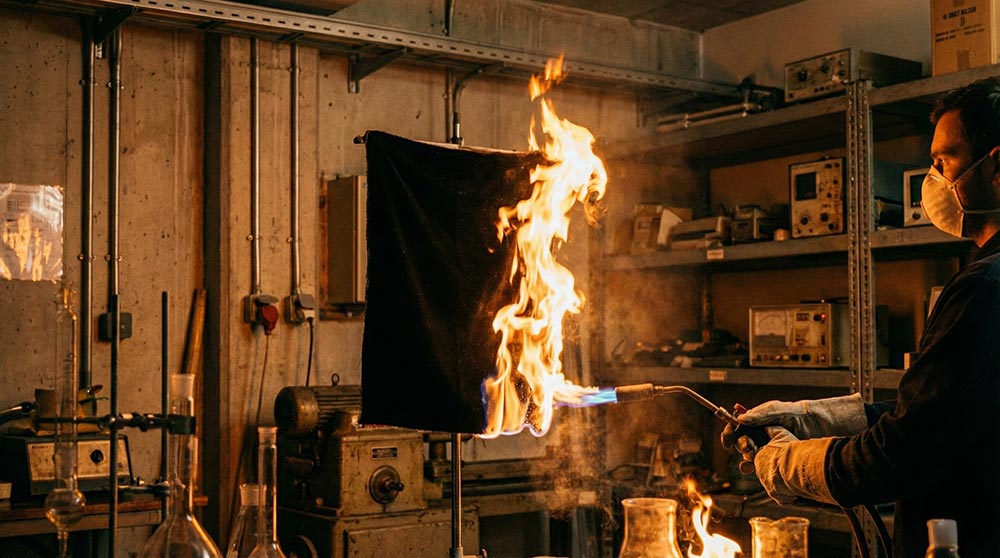
The most common point of confusion in procurement is mixing up Type B and Type C. The difference is not “is it flame retardant” — both are. The split is in the durability of the retardancy and the speed of self-extinguishing.
| Dimension | Type B (Standard Durability) | Type C (High-Risk / Maximum Safety) |
| Applicable scenarios | Hotels, offices, schools, general public buildings | NHS hospitals, care homes, prisons, mental health units, offshore facilities |
| Pre-treatment (laundering) | Usually tested after 12 standard wash cycles (BS EN ISO 10528) | Must be tested after 50 industrial wash cycles (BS EN ISO 10528) |
| Ignition times tested | 15 seconds only | 5s, 15s, 20s, and 30s (multi-point) |
| Afterflame limit | No specific limit, provided flame does not reach edges | Rapid self-extinguishing: mean afterflame ≤ 2.5 seconds |
| Fabric recommendation | FR treated (chemical finish) may degrade over time | Typically IFR (inherently flame retardant), e.g. Trevira CS or modacrylic |
Because BS 5867-2 Type C demands durability, it almost always points to inherently flame retardant (IFR) fibres rather than a surface chemical treatment. An IFR polyester keeps its protection in the fibre itself, so 50 washes cannot wash it out. A treated fabric relying on a topically applied finish is far more likely to fail at the laundering stage.
The strict BS 5867-2 Type C requirement from the NHS and care-sector buyers is driven by two pressures that do not exist in a typical office: infection control and slow evacuation.
Hospital cubicle curtains sit at the centre of infection control and are washed constantly, often with thermal disinfection at 71°C or higher. Only a flame retardant medical cubicle curtain verified through the 50-wash test can promise zero loss of fire performance under that cleaning rhythm. A cheaper treated curtain may pass on day one and quietly lose its rating by month six.
Evacuation is the second factor. In care homes and wards, patients often have limited mobility, so leaving the building takes far longer. The “self-extinguish within 2.5 seconds” rule cuts the ignition source the moment it appears — a dropped lighter, a spark from equipment — and buys the precious “golden time” staff need to move people out. The Department of Health’s technical memorandum HTM 05-03 explicitly advises that healthcare textiles meet BS 5867-2 Type C to satisfy the highest fire codes, and many hospital divider curtain specifications now name Type C by default.
Type C testing follows BS EN ISO 15025 (limited flame spread) and is only valid after the fabric has been through its pre-treatment. There are three stages a buyer should understand.
1. The 50-wash pre-treatment. This is the gate that separates genuine BS 5867-2 Type C from marketing claims. Every fabric claiming Type C must first survive 50 full wash-and-dry cycles per BS EN ISO 10528. If it is not washable, it must take equivalent dry-cleaning cycles. Cheap FR fabrics built on surface coatings usually wash out and fail here.
2. Multi-point ignition testing. Using the face ignition method with the fabric hung vertically, a propane burner is applied directly to the surface. Type B tests only at 15 seconds; BS 5867-2 Type C must pass at four separate ignition times — 5, 15, 20, and 30 seconds — which simulates real-world exposure far more realistically.
3. Pass/fail criteria. After the ignition source is removed at any of those times, the fabric must meet all of the following: no flame reaches the top or side edges; the mean afterflame or afterglow time does not exceed 2.5 seconds; and no flaming debris or molten droplets separate from the sample.
Buyers who want to see the evidence should review the supplier’s certification and test reports, and for context on how this UK method sits beside other regions, the textile fire safety standards comparison is a useful reference.
Compliance under BS 5867-2:2008 is not just a PDF test report. Every BS 5867-2 Type C curtain installed on site must carry a permanent label stating:
A practical warning: if a fire officer inspecting the building finds curtains without that permanent label, you can still be served a rectification notice even when you hold a valid paper test report. The label is what proves compliance in the room, not the file.
 Blue Double-Layer Polyester Blackout Door Curtain with Flame Retardant Protection for Made-to-Order Supply | 82 × 55 in | BS 5867 Type C
 Flame Retardant Blackout Double-Layer Polyester Curtains in Blue for Bulk Orders and Contract Projects | 60 × 70 in | BS 5867 Type C
 Dark Blue Coated Polyester Blackout Curtains with Flame Retardant Protection from a China Textile Mill | 92 × 68 in | BS 5867 Type C
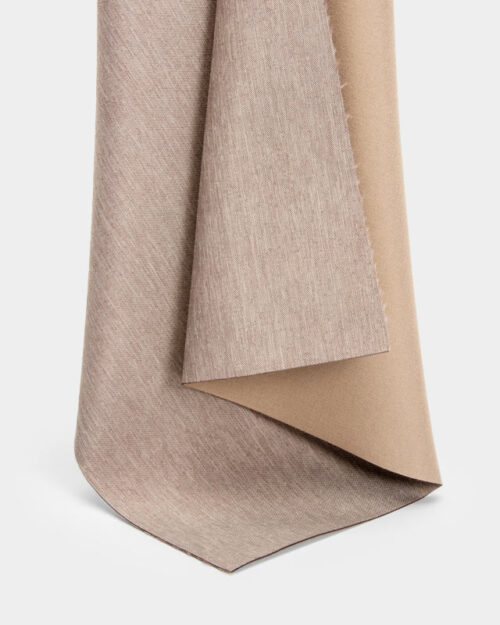 Flame Retardant Cationic Polyester Composite Blackout Curtain Fabric for OEM Production | 420 g/m² | 280 cm | BS 5867 Type C
 Inherent Flame Retardant Anti-Light Blackout Polyester Composite Fabric in Gray for Bulk Orders | 425 g/m² | 300 cm | EN 13773 Class 1
For the UK healthcare and contract market, Begoodtex supplies a full range of BS 5867-2 Type C compliant fabrics, all tested by UKAS-accredited laboratories and guaranteed to hold FR performance after 50 washes:
If you need specific specs or samples for a UK project, the flame retardant fabric range covers the full Type C line.
No, they are not equivalent and cannot be used interchangeably. NFPA 701 is a US flame retardancy standard, but its test method — especially around wash cycles — is different from BS 5867. Type C requires performance to survive 50 wash cycles, which is far more demanding on durability than standard NFPA 701 Method 1. For UK projects, fire officers normally accept only BS 5867 certificates.
BS 5867-2 Type C is primarily designed for water washing. The standard exists to support the high-frequency water washing and disinfection that healthcare environments require. Genuine Type C fabrics, usually IFR polyester, tolerate standard 40°C–75°C industrial washes. That is a major cost advantage for budget-sensitive care homes, since water washing is much cheaper than dry cleaning.
Check two fields. First, wash cycles: a Type C report must state “tested after 50 wash cycles.” If it shows only 12 cycles or “cleaned as per instructions,” it is likely Type B. Second, the afterflame conclusion: a BS 5867-2 Type C report records the afterflame time explicitly and concludes Pass at ≤ 2.5 seconds.
Yes. Type C is the highest level of the standard. If a fabric survives the stricter testing after 50 washes, it naturally meets the easier Type B requirements (12 washes). Specifying BS 5867-2 Type C therefore covers both and avoids needing two separate fabrics on one project.
BS 5867-2 Type C is the UK’s most rigorous curtain fire-safety rating, and for good reason: it is the only classification that proves flame retardancy survives the reality of healthcare laundering. For specifiers, the takeaways are straightforward:
Choosing a flame retardant fabric partner that can show UKAS-accredited Type C evidence turns a compliance headache into a checked box.


