Get in touch
Thank you for reaching out! Please tell us more about your needs — our expert team will get back to you within 24 hours.
Get in touch
Thank you for reaching out! Please tell us more about your needs — our expert team will get back to you within 24 hours.




Flame retardant curtains should meet the fire standard required by the project country, building type, and end-use environment. For most commercial projects, buyers commonly check NFPA 701 in the United States, BS 5867-2 in the United Kingdom, EN 13773 in Europe, DIN 4102-B1 in Germany, NF P92-503 M1 in France, CAN/ULC-S109 in Canada, and IMO FTP Code Part 7 for marine interiors.
The right standard depends on where the curtains will be installed and how they will be used. Hotel curtains, hospital privacy curtains, school curtains, theater drapes, office blackout curtains, and ship cabin curtains may need different test reports. As a professional flame retardant fabric manufacturer and solution supplier, Begoodtex provides flame retardant curtain fabrics with options for custom weight, width, color, blackout performance, antibacterial finish, and third-party testing support.

Flame retardant curtain standards define how a curtain fabric behaves when exposed to a controlled flame. They do not mean the curtain is completely fireproof. They measure whether the fabric resists ignition, slows flame spread, reduces afterflame, limits char length, and avoids dangerous flaming droplets.
This distinction matters for procurement. A curtain may be described as flame retardant, fire retardant, fire resistant, or IFR, but buyers should always ask which test standard it meets. A general FR claim is not enough for hotels, hospitals, schools, theaters, offices, exhibition halls, or public venues.
A good flame retardant curtain specification should name the required standard first, then define the fabric type, color, weight, width, finish, washing method, and test report requirements.
For a broader explanation of industry abbreviations such as FR, IFR, DFR, PFR, and CFR, buyers can also review the Begoodtex guide to flame retardant abbreviations.
The main flame retardant curtain standards are NFPA 701, BS 5867-2, EN 13773, DIN 4102-B1, NF P92-503 M1, CAN/ULC-S109, and IMO FTP Code Part 7. These standards are commonly used for curtains, draperies, stage curtains, decorative hanging fabrics, and other interior textile applications.
| Standard | Region | Common use | Buyer note |
|---|---|---|---|
| NFPA 701 | United States | Curtains, draperies, event fabrics, window treatments, hanging textiles | Common requirement for commercial and public interiors |
| BS 5867-2 Type B or Type C | United Kingdom | Curtains, drapes, decorative fabrics | Type C is often selected for higher durability and contract use |
| EN 13773 Class 1 or Class 2 | Europe | Curtains and drapes in public and commercial interiors | Class 1 is generally the highest curtain classification |
| DIN 4102-B1 | Germany | Interior textiles and building-related decorative materials | Often requested for German commercial projects |
| NF P92-503 M1 | France | Decorative fabrics, curtains, interior textiles | Common French fire classification for contract interiors |
| CAN/ULC-S109 | Canada | Flame-resistant fabrics used in buildings | Do not assume NFPA 701 automatically replaces Canadian requirements |
| IMO FTP Code Part 7 | Marine | Ship curtains, cruise interiors, vertically supported textiles | Needed for marine and vessel interior projects |
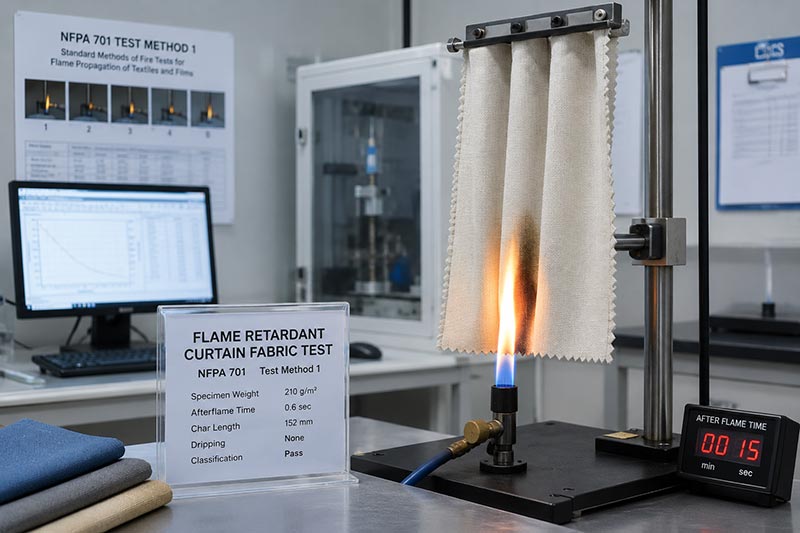
NFPA 701 is the key U.S. flame propagation test for curtains, draperies, window treatments, and many decorative hanging textiles. It is one of the most common standards requested for hotel curtains, office curtains, school curtains, event backdrops, and theater drapes in the United States.
Buyers should pay attention to the test method used, because fabric weight, construction, coating, backing, and installation style can affect the result. Lightweight sheer fabrics, heavy blackout fabrics, coated roller blind fabrics, and velvet stage curtains may not behave the same way under flame exposure.
For U.S. projects, a useful starting point is Begoodtex content on NFPA 701 fire testing. For product selection, buyers can also consider IFR polyester curtain fabric compliant with NFPA 701 or inherent flame retardant backdrop fabric for event and public venue applications.
BS 5867-2 is the main UK standard for flame retardant curtain and drape fabrics. Type B and Type C are commonly discussed in contract curtain projects, with Type C usually selected when higher durability or more demanding cleaning performance is required.
This standard is especially relevant for hotels, schools, care homes, theaters, offices, and public buildings in the UK. The buyer should confirm whether the final curtain will be washed, dry cleaned, or used as a fixed decorative installation. Cleaning durability can be just as important as the first flame test result.
For UK-focused projects, Begoodtex offers product options such as inherent flame retardant sheer fabric with BS 5867 support and BS 5867 Type C chenille curtain fabric.
EN 13773 classifies the burning behavior of curtains and drapes in Europe. Class 1 is generally treated as the highest performance level, while Class 2 is also commonly used in many commercial curtain projects depending on local requirements.
European buyers should not assume that one certificate automatically covers every country. A project in Germany may still request DIN 4102-B1, while a project in France may ask for M1 classification. EN 13773 is important, but national fire authority requirements can still control the final specification.
Begoodtex has a detailed guide to EN 13773 Class 1 curtain standards, which can help buyers understand how this classification fits into wider European procurement.
For German projects, buyers often need DIN 4102-B1. For French projects, buyers often need NF P92-503 M1 or related French fire classification documents. These national standards are common for curtains, decorative fabrics, and contract interior textiles.
The safest procurement method is to confirm the exact national standard before sampling or bulk production. A fabric that meets one international curtain test may still need separate testing for a German venue, French hotel, or public building project.
Begoodtex provides references on DIN 4102-B1 fire retardant standards and NF P92-503 M1 fire standards. Product options include M1 certified FR blackout faux linen fabric and DIN 4102-B1 certified antibacterial medical cubicle fabric.
CAN/ULC-S109 is commonly used in Canada to evaluate flame-resistant fabrics used in buildings, including curtain and decorative textile applications. Buyers supplying Canadian hotels, institutions, public venues, or commercial buildings should confirm whether this standard is required.
Some buyers assume that NFPA 701 is enough for Canada, but this is not always safe. Local codes, project consultants, and fire authorities may request Canada-specific documentation. For roller blinds and window treatment projects, Begoodtex offers options such as inherent flame retardant roller blinds fabric with CAN/ULC-S109 support.
For more background, buyers can review the Begoodtex guide to CAN/ULC-S109 flame-resistant fabric standards.
Marine curtains should meet IMO FTP Code Part 7 when used in ships, cruise vessels, ferries, and other regulated marine interiors. This part applies to vertically supported textiles and films, including curtains, draperies, and similar hanging materials.
Marine curtain procurement is different from ordinary hotel or office curtain procurement. Buyers may need to consider flame spread, smoke, toxicity, cleaning durability, salt-air exposure, and long-term compliance documentation. For cruise cabins, ship public areas, and ferry interiors, test reports should be confirmed before fabric selection.
Begoodtex provides additional guidance on IMO 2010 FTP Code for marine textiles and IMO MSC 307 fire safety testing.
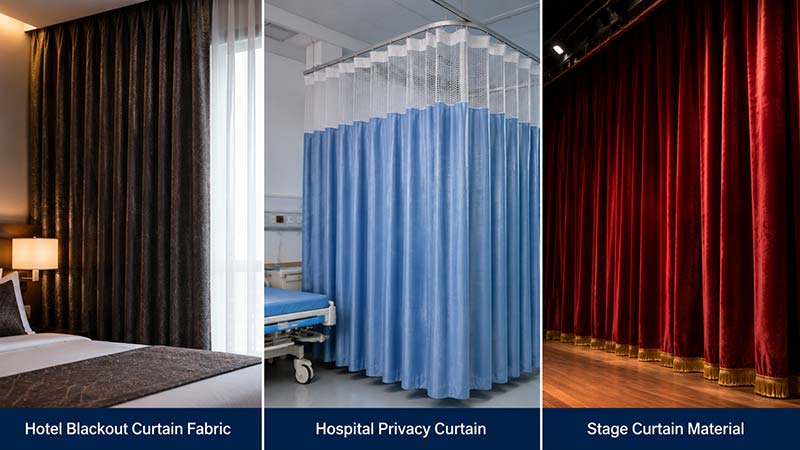
Buyers should choose the curtain standard based on the installation location, building type, and end-use risk. A hotel blackout curtain, a hospital cubicle curtain, a school hall curtain, a theater stage drape, and a ship cabin curtain may all require different test documents.
| Application | Common standard to check | Recommended fabric direction | Key buyer concern |
|---|---|---|---|
| Hotel curtains | NFPA 701, BS 5867-2, EN 13773, M1, B1 | IFR polyester, FR blackout, FR dimout, decorative jacquard | Appearance, drape, color consistency, wash durability |
| Hospital privacy curtains | NFPA 701, BS 5867-2, EN 13773, DIN 4102-B1 | FR fabric with antibacterial or washable finish | Hygiene, replacement cycle, test report, easy maintenance |
| School curtains | NFPA 701, BS 5867-2, EN 13773 | Durable IFR polyester or FR treated curtain fabric | Safety, durability, budget, cleaning method |
| Theater and stage curtains | NFPA 701, BS 5867-2 Type C, DIN 4102-B1 | Heavy FR velvet, IFR stage drape fabric, FR backdrop fabric | Flame spread, heavy weight, acoustic feel, deep color |
| Office curtains | NFPA 701, EN 13773, BS 5867-2 | FR dimout, FR blackout, FR roller blind fabric | Light control, clean appearance, stable supply |
| Marine curtains | IMO FTP Code Part 7 | IMO-tested IFR curtain fabric | Marine approval, durability, project documentation |
For application-specific guidance, buyers may also compare Begoodtex solutions for hotel fire-retardant curtains, hospital flame-retardant curtain solutions, school curtain projects, and theater and stage curtains.
Inherent flame retardant curtains are usually better for long-term commercial use and repeated cleaning, while treated flame retardant curtains can be suitable for decorative projects with lower cleaning frequency. The main difference is where the flame retardant performance comes from.
Inherent FR performance is built into the fiber or polymer, so it is more stable for long-term use. Treated FR performance depends on a chemical finish applied to the fabric, so washing, coating, printing, and finishing changes may affect performance.
For a more detailed comparison, buyers can read Begoodtex analysis on inherent vs treated FR fabrics.
A flame retardant curtain should be evaluated by both fire test compliance and practical curtain performance. Passing the required flame test is essential, but buyers also need to check whether the fabric works for the design, installation, maintenance, and budget.
| Buyer checkpoint | Why it matters | Typical requirement |
|---|---|---|
| Material composition | Affects flame behavior, drape, hand feel, cost, and durability | IFR polyester, FR polyester, FR velvet, FR jacquard, FR sheer |
| Fabric weight | Controls opacity, drape, acoustic feel, and test method selection | 100 g/m2 to 500 g/m2 depending on curtain type |
| Width | Impacts sewing efficiency and fabric waste | 150 cm, 280 cm, 300 cm, or custom width |
| Blackout or dimout performance | Important for hotels, schools, theaters, and conference rooms | Dimout, 95 percent blackout, or 100 percent blackout |
| Cleaning durability | Important for long-term compliance and maintenance cost | Dry cleaning, washing, or project-specific care method |
| Color fastness | Protects appearance in hospitality and public interiors | Project color standard and bulk color consistency |
| Special finish | Adds value for healthcare, office, and hospitality use | Antibacterial, anti-static, water-repellent, acoustic, or blackout finish |
| Documents | Supports inspection, approval, and handover | Test report, technical data sheet, care instruction, bulk order record |
For blackout curtain projects, Begoodtex offers AntiLightFR flame retardant blackout fabric and product options such as NFPA 701 certified blackout curtain fabric. For healthcare projects, buyers can consider FRAntiBact flame retardant antibacterial fabric and detachable antimicrobial flame retardant medical privacy curtains.
The most common mistake is buying fabric described as flame retardant without checking whether the test report matches the required standard, fabric construction, color, finish, and end-use. A valid curtain project needs more than a product label.
Buyer tip: always ask whether the report applies to the exact fabric you will order, not just a similar material from the same supplier.
A reliable supplier should help buyers match the correct curtain standard, provide tested fabric options, support third-party reports, and customize fabric parameters for the project. The supplier should understand both flame retardant compliance and real curtain manufacturing needs.
For buyers who need certified flame retardant curtain fabric for commercial projects, Begoodtex provides IFR polyester curtain fabric, flame retardant blackout fabric, flame retardant sheer fabric, FR velvet stage curtain fabric, FR jacquard hospital curtain fabric, and coated FR roller blind fabric. These fabrics can be developed around target standards, visual design, width, weight, color, blackout rate, antibacterial performance, and bulk order needs.
Suitable project directions include hotels, hospitals, schools, offices, theaters, event venues, public buildings, and selected marine interiors. Third-party test reports can be provided based on project requirements.
Flame retardant curtains should meet the standard required by the project country, building type, and application. NFPA 701 is widely used in the United States, BS 5867-2 is important in the United Kingdom, EN 13773 is common in Europe, DIN 4102-B1 is often requested in Germany, NF P92-503 M1 is common in France, CAN/ULC-S109 is used in Canada, and IMO FTP Code Part 7 applies to marine curtain projects.
The safest procurement approach is to confirm the required standard before selecting fabric. Then check material composition, weight, width, color, blackout performance, cleaning durability, special finishes, and test report availability. Inherent flame retardant curtain fabrics are often the stronger choice for hotels, hospitals, schools, offices, theaters, and other commercial interiors where long-term performance matters.
Begoodtex supports buyers with flame retardant curtain fabrics and customized textile solutions for different applications, including blackout curtains, sheer curtains, hospital privacy curtains, stage curtains, roller blinds, and decorative contract fabrics.
NFPA 701 is the most common U.S. standard for flame propagation testing of curtains, draperies, window treatments, and many hanging decorative fabrics. Buyers should request a test report that matches the actual fabric and final curtain construction.
No. NFPA 701 is important for U.S. projects, but UK, EU, German, French, Canadian, and marine projects may require different standards such as BS 5867-2, EN 13773, DIN 4102-B1, NF P92-503 M1, CAN/ULC-S109, or IMO FTP Code Part 7.
Type B is commonly used for contract curtain applications, while Type C is usually selected for more demanding applications where cleaning durability is important. Buyers should confirm the required type with the project consultant or local authority.
EN 13773 Class 1 is generally the highest curtain flame retardant classification, while Class 2 may still be acceptable for some projects. The correct choice depends on the building type, location, and project specification.
Often yes. Blackout coatings, foam layers, backing fabrics, and laminated structures can change flame behavior. Buyers should request testing for the final blackout curtain fabric or final curtain assembly, not only the base fabric.
Inherent flame retardant curtains are usually better for long-term commercial use and repeated cleaning because the FR performance is built into the fiber or polymer. Treated FR curtains can work for decorative or lower-wash projects if the test report and care conditions are clear.
Buyers should request the flame retardant test report, technical data sheet, fabric composition, weight, width, color information, care instruction, and any project-specific certificates. For bulk orders, sample approval and production consistency records are also important.