Enter your details and we will send the requested document to your inbox.





When sourcing flame-retardant fabrics, many buyers feel confused the first time they see a technical specification sheet.
FR, IFR, DFR, PFR, CFR — they all seem related to flame retardancy, but in real projects, these abbreviations can mean very different things.
Some fabrics achieve flame-retardant performance from the fiber itself.
Some are treated chemically after weaving.
Some may pass the initial test, but their performance may weaken after several washes.
This article is not intended to turn these abbreviations into a simple glossary. A more practical way is to look at them from a buyer’s point of view: when you see these terms, what should you ask next?

FR stands for Flame Retardant.
It is the most common term used for flame-retardant fabrics. You may see “FR” in product names for curtains, stage drapes, medical cubicle curtains, bedding, upholstery, workwear, transport interiors, and many other textile products.
But FR is only a broad description. It tells you that the fabric has some level of flame-retardant performance, but it does not explain where that performance comes from.
This is why the term FR can easily mislead buyers.
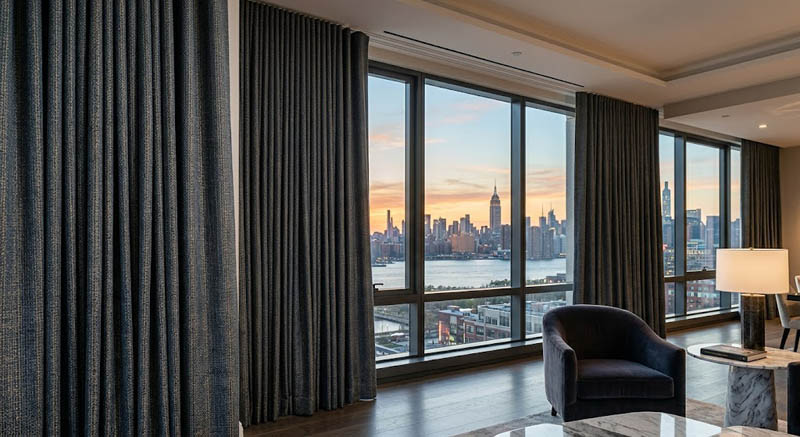
For example, in a hotel curtain project, the product name may say “FR curtain fabric.” At first glance, it looks suitable. But the project owner may require NFPA 701, BS 5867, or EN 13773 test reports. If the supplier cannot provide the correct report, or if the report does not match the actual fabric being ordered, the FR label has limited practical value.
When you see “FR,” it is better to ask a few more questions:
These questions can quickly help you judge whether “FR” means a project-ready solution or just a general product description.
IFR stands for Inherent Flame Retardant.
In this type of fabric, flame-retardant performance comes from the fiber or polymer system. Taking polyester as an example, the flame-retardant component can be introduced into the polymer structure during fiber production. The fiber is then spun, woven, dyed, and finished.
This makes the flame-retardant performance more stable. Ordinary washing and surface abrasion are less likely to remove it.
IFR fabrics are commonly used in long-term commercial projects, especially for:
hotel curtains, hospital cubicle curtains, school curtains, office and public building decorative fabrics, transport interiors, theater textiles, and public space textiles.
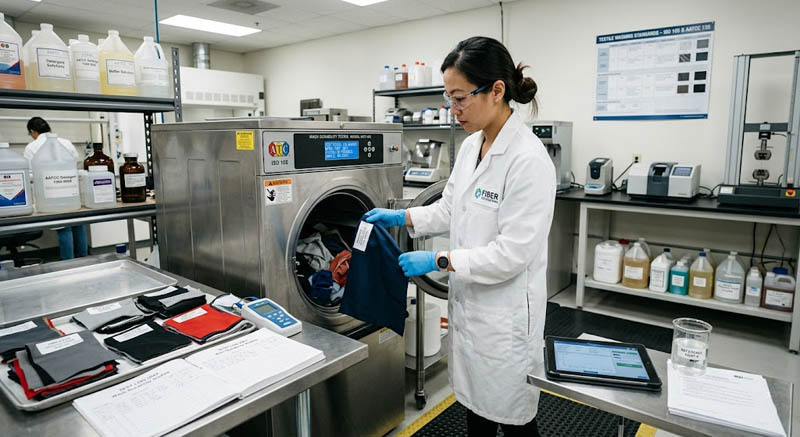
These projects usually require more than passing the first test. The fabric must hang for a long time, be opened and closed repeatedly, withstand rubbing and cleaning, and still maintain color, drape, and surface appearance.
In some hotel and healthcare projects we have worked with, customers focused mainly on price at the beginning. Later, they realized that stability after washing was more important. Curtains and cubicle curtains are not disposable products. They are used for a long time. If flame retardancy depends mainly on surface treatment, washing and maintenance must be handled much more carefully.
The advantages of IFR are mainly reflected in several areas:
Of course, IFR usually costs more and requires more specialized production technology. Short-term events, temporary displays, or low-frequency decorative projects may not always need IFR. The longer the project life, the higher the cleaning frequency, and the stricter the approval process, the more valuable IFR becomes.
DFR stands for Durable Flame Retardant.
The key word here is “durable.” It means the fabric can still maintain flame-retardant performance after a certain number of washes.
DFR and IFR are often discussed together, but they do not focus on exactly the same thing. IFR describes where the flame-retardant performance comes from. DFR focuses on whether the flame-retant performance can survive use and washing.
Some DFR fabrics are inherently flame-retardant.
Some DFR fabrics rely on highly washable finishing.
Some use crosslinking, resin, or special finishing processes to bond flame-retardant components more firmly to the fiber.
So when buyers see DFR, the most important thing is not the abbreviation itself, but the after-wash test data.
For example:
We have seen projects where ordinary FR fabrics could pass the initial test during sampling. Later, the project owner asked for after-wash test reports, but the supplier could not provide the required documents. As a result, the fabric had to be retested or even replaced.
DFR is suitable for projects that require frequent cleaning and maintenance, such as hotels, hospitals, schools, dormitories, and public building interiors.
When sourcing DFR fabrics, the washing times and washing conditions should be clearly written. Simply saying “DFR” is still not enough.
PFR usually stands for Permanent Flame Retardant.
This term sounds attractive in marketing materials because the word “permanent” feels very clear and reassuring. But in procurement, it should be understood carefully. Sometimes PFR is a technical description. Sometimes it is closer to a sales term.
Some suppliers use PFR to describe IFR fabrics.
Some suppliers also call highly durable post-treated fabrics PFR if they can still pass testing after repeated washing.
These two production routes are not the same.
So when you see PFR, treat it as a starting point, then check the technical documents.
It is useful to confirm:
For example, if a curtain fabric claims to be PFR, buyers can request reports for NFPA 701, BS 5867, EN 13773, or other project-specific standards. If the project requires wash durability, after-wash test results should also be reviewed.
It is easy to write “Permanent” on a datasheet. What makes a project owner accept the fabric is still the report, sample description, washing conditions, and actual application scope.
CFR usually stands for Chemical Flame Retardant.
This type of fabric is generally woven, dyed, or finished first, and then treated with flame-retardant chemicals through padding, coating, or other chemical finishing methods.
Common methods include:
CFR has clear advantages. It is often lower in cost, faster to produce, and can be applied to a wide range of base fabrics. Short-term exhibitions, temporary events, one-time decorations, and low-washing-frequency applications often consider this type of solution.
But there are also details that need to be confirmed in advance.
Ordinary chemical flame-retardant finishing may weaken as the number of washes increases.
Coatings may affect hand feel, breathability, and drape.
Some chemical systems may involve halogens, heavy metals, PFAS, or other substances of concern.
For projects in hotels, hospitals, schools, green buildings, or export markets, this information can directly affect approval.
CFR does not mean low-end, and it does not mean unsuitable. The key is the project condition.
For short-term, low-frequency, budget-sensitive projects, a suitable CFR solution can work well. For long-term commercial use, frequent washing, skin contact, or strict environmental review, buyers need to evaluate it more carefully.
| Abbreviation | Common Meaning | What Buyers Should Focus On |
|---|---|---|
| FR | General flame-retardant term | Standard, report, flame-retardant method |
| IFR | Inherent Flame Retardant | Fiber system, wash durability, long-term stability |
| DFR | Durable Flame Retardant | Washing times, after-wash test, maintenance method |
| PFR | Permanent Flame Retardant | Technical basis, test proof, whether it is only a marketing term |
| CFR | Chemical Flame Retardant | Wash durability, hand feel changes, environmental and chemical safety |
This table can be used for initial judgment. But real procurement still needs to return to the project requirements: where the fabric will be used, whether it will be washed, how long it will be used, which report is required, and whether there are environmental restrictions.
The requirements for a temporary event and a long-term commercial project are very different.
For a three-day exhibition backdrop, the main concerns may be cost, delivery time, and passing the initial fire inspection.
For a five-star hotel curtain project, the focus shifts to color stability, drape, washing maintenance, long-term compliance, and batch consistency.
Hospital cubicle curtains may also involve cleaning, antibacterial performance, replacement cycles, and hygiene management.
Schools and public buildings usually care more about safety, durability, and maintenance cost.
Transport interiors may further require attention to smoke, toxicity, abrasion resistance, and complete documentation.
So the same abbreviation may have different value in different applications.
In the past, many projects only checked flame-retardant test results.
Now, more buyers also pay attention to chemical safety.
This is especially common in export projects, green buildings, schools, healthcare facilities, hotels, and public spaces. Customers may request documents such as:
This has a stronger impact on CFR fabrics. After the fabric passes the flame-retardant test, buyers still need to confirm whether the chemical system meets customer and market requirements.
In some projects, the approval logic has already moved from “Can it be flame-retardant?” to “Can it be used safely, sustainably, and reliably over the long term?”
This is also why inherently flame-retardant systems, halogen-free flame retardancy, PFAS-free solutions, dope-dyed flame-retardant fibers, and sustainable flame-retardant textiles are receiving more attention.
If the project involves skin contact, children’s spaces, hospitals, schools, or green buildings, environmental documents should be confirmed before sampling. Waiting until bulk production is finished before collecting these documents can create much higher risk.
Test reports are very important for flame-retardant fabrics, but many problems are hidden in the details.
Some reports show “Pass” on the cover, so they look fine at first. But when you read further, the sample description may only say “FR polyester fabric,” without fabric weight, color, weave structure, finishing method, or washing conditions.
This may be enough for general communication, but it can easily trigger questions during formal project approval.
Buyers should pay attention to:
For example, if a fabric is described as DFR but the report only shows initial testing with no after-wash result, then the word “durable” lacks evidence.
If a fabric is described as PFR but there is no clear technical route or washing verification, further confirmation is needed.
For bulk projects, it is also recommended to keep approved samples and batch records. If the project owner checks later, these records can help prove that the order fabric is consistent with the tested sample.
If a flame-retardant fabric supplier only says “Yes, it is FR,” the information is still very limited.
A more effective way is to explain the project conditions clearly:
This information directly affects whether the supplier should recommend IFR, DFR, CFR, or another solution.
When Begoodtex works on flame-retardant fabric projects, we usually start with the final application.
For curtains used in hotels, hospitals, schools, offices, and public spaces, we pay more attention to long-term flame-retardant stability, drape, color consistency, and wash durability.
For short-term exhibitions and decorative projects, post-treatment solutions can be evaluated based on budget, delivery time, and local requirements.
For green buildings, export projects, medical applications, and school projects, the environmental system and chemical safety documents should be confirmed early.
A good fabric recommendation usually comes from clear project conditions.
If the request is only “FR fabric,” the recommendation can be too broad. Once the application, standard, washing requirements, and environmental requirements are clear, the solution becomes much more accurate.
FR, IFR, DFR, PFR, and CFR are all related to flame retardancy, but each abbreviation has a different focus.
FR is the broadest general term.
IFR focuses on flame retardancy built into the fiber itself.
DFR focuses on durability after washing.
PFR sounds like permanent flame retardancy, but it still needs technical proof.
CFR represents a chemical flame-retardant route, with advantages in cost and flexibility, while wash durability and environmental safety must be reviewed.
In procurement, abbreviations are only the starting point. The more valuable information is found in test reports, washing data, chemical systems, fabric structure, and real project applications.
Short-term events may focus more on cost and delivery.
Long-term commercial projects need to consider wash durability, appearance, maintenance, and compliance together.
Export, healthcare, school, and green building projects should also confirm PFAS-free, halogen-free, or other environmental requirements in advance.
When you see a flame-retardant fabric, ask more specific questions:
Once these questions are clear, testing, approval, production, and delivery will all be much more stable.
FR is a general term for flame retardancy. IFR means inherent flame retardancy, which usually indicates that the flame-retardant performance comes from the fiber or polymer system. IFR fabrics are usually more stable and more suitable for long-term projects that require wash durability.
No. DFR focuses on durable flame-retardant performance. It may come from inherently flame-retardant fibers, or from highly washable post-treatment finishing. Buyers should check the after-wash test report.
PFR is often used to mean permanent flame retardancy, but sometimes it has a marketing meaning. Buyers should check the technical documents, washing test data, and third-party reports.
CFR fabrics are suitable for short-term decoration, temporary events, low-washing-frequency applications, or budget-sensitive projects. For long-term commercial use, frequent washing, or projects with strict environmental review, CFR needs to be evaluated more carefully.
Check the after-wash test report. Focus on the number of washes, washing method, whether the fabric still passes the target standard after washing, and whether the tested sample matches the current order fabric.
It depends on the market and project requirements. Export projects, healthcare facilities, schools, green buildings, and public spaces are paying more attention to PFAS-free, halogen-free, REACH, OEKO-TEX, and other chemical compliance documents. It is better to confirm these before sampling.
Buyers should confirm the flame-retardant method, testing standard, wash durability, environmental system, fabric structure, report scope, and final application. Looking only at abbreviations such as FR, IFR, or PFR is not enough.


